





























Brent “BJ” Larson wore a body camera during visits with his children to document his conduct. Some of the most revealing material in The Nightmare Upstairs: What Happened to Ty and Bryn? comes from that recording: his son explaining why he fears him and challenging the purpose of their continued contact. Directors Henry Roosevelt and Caitlin Keating use Ty’s voice over nighttime neighborhood images at the opening, then give the exchange its uncomfortable setting. The father controls the recording equipment. His son supplies an account that the equipment cannot make reassuring.
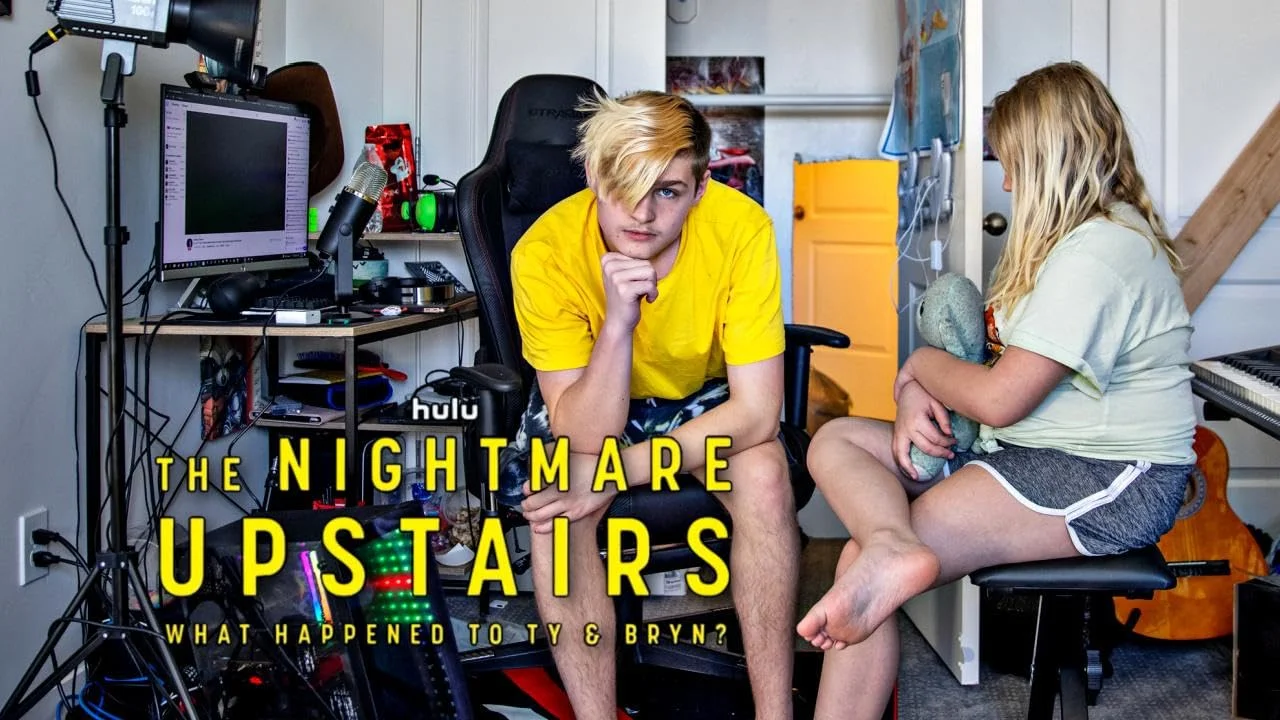
Ty later takes charge of a different camera. Facing court-ordered reunification arrangements with BJ, he and his sister, Brynlee “Bryn” Larson, barricade themselves upstairs in their mother’s Utah home for 54 days. Both siblings accuse BJ of sexual abuse; he denies their allegations.
Their TikTok livestream brings thousands of people into a dispute previously conducted through family proceedings, therapy, and contested allegations. Ty says both the barricade and the broadcasts were his ideas. The series preserves that authorship, allowing him to explain a strategy through which the siblings sought outside attention when refusing contact had failed to resolve their situation.
The relationship between these recordings gives this two-part Hulu documentary its strongest reason to exist. BJ’s footage records the children’s resistance during visitation; Ty’s broadcasts seek witnesses to their refusal. Television then collects both, giving encounters an audience well beyond their original viewers.
That access carries real explanatory value. Footage of the visits, including those ordered after the barricade, makes the children’s distress difficult to reduce to a procedural disagreement. It cannot independently establish what happened during the alleged abuse. It does show what continued contact asks the siblings to endure.
The documentary’s interview structure is less assured about distinguishing the kinds of knowledge it assembles. The children and their mother, Jessica Zahrt, describe their experiences, while BJ’s mother, Jolleen Larson, defends her son and attributes the estrangement to Jessica and therapeutic influence.
Jolleen acknowledges his alcohol problems and employment instability, and explains that she and her husband paid his legal expenses. Her participation helps establish the family loyalties surrounding the dispute. Her certainty about his innocence, however, cannot answer allegations concerning encounters she did not witness. The series gives substantial space to that certainty without consistently clarifying its evidentiary limits.
Interviewing Jolleen is a defensible editorial decision. Her contribution reveals how the father’s account is maintained within his family, and excluding her would remove part of the machinery sustaining the conflict. The difficulty lies in how readily personal conviction can acquire authority through the familiar documentary interview.
The series also acknowledges child-protection workers’ assessments that the siblings’ allegations were credible. Those findings, the children’s testimony, BJ’s denials, and the absence of criminal prosecution require careful differentiation. Arranging them as competing positions leaves viewers with interpretive work that the production should help them perform.
Detective Aymee Race and social worker Michelle Jones appear under restrictions that prevent discussion of case specifics. Their presence suggests access to the professional decisions shaping the family’s life, yet the interviews cannot fully deliver that explanation.
The production has secured the relevant job titles; the limits on their testimony leave important questions beyond the interview chair. Respecting those restrictions is appropriate. Their effect on the documentary still matters. Investigative reporter Hannah Dreyfus provides reporting context, but the gap between hearing an institution represented and understanding its actions remains conspicuous.
Across approximately 83 minutes, the first episode establishes the parents’ relationship, the allegations, and the custody conflict; the second concentrates on the barricade and its aftermath. This is a manageable structure for a painful, complicated account.
The series avoids a sprawling episode count and gives the recorded encounters room to register. Occasional repetition is costly within such a short running time. Returning to the family’s competing accounts offers diminishing value when the intervention that prompted the barricade still needs a fuller explanation. The chronology becomes clearer than the process through which reunification was presented as an answer.
Parental alienation and reunification treatment are central to that process. Jones is identified with recommending reunification, and the prospect of attending a program gives the siblings’ resistance its immediate stakes. Yet the documentary’s treatment of the proposed intervention is too thin to match the attention given to the standoff.
What would participation require? How was that recommendation reached? What would happen when the children continued to refuse? These are practical questions about the event being documented. Without sufficient examination of them, the barricade risks becoming the extraordinary spectacle through which viewers remember a less clearly explained institutional decision.
The livestream also creates responsibilities that cannot be resolved by celebrating its reach. Ty’s strategic use of TikTok deserves recognition, while Bryn’s participation should not automatically be assigned the same degree of control. Jessica’s acknowledgment of criticism over merchandise sales and her online conduct complicates the family’s relationship with its audience.
The series is right to include that complication. Her commercial decisions do not settle the children’s allegations, and public support does not establish their truth. Each issue needs its own scrutiny. A documentary can preserve a child’s agency while examining the exposure attached to exercising it.
BJ’s prepared video message at the end makes the production’s priorities especially visible. Having declined a new interview, he receives an opportunity to address his children directly, without the exchange that an interview might have produced. Including his position is reasonable; placing that appeal last gives the fractured family relationship the closing emphasis.
After footage of resisted visits and weeks spent broadcasting from upstairs, the series returns to the language of parental connection. The proposed remedy of reunification receives less sustained scrutiny than the father’s wish to be reunited, leaving the intervention’s practical demands insufficiently examined as his appeal plays.
The Nightmare Upstairs: What Happened to Ty and Bryn? premiered on Hulu and Disney+ on May 19, 2026, where it is available to stream. Produced by ABC News Studios, Wise Fool, and Herzog & Co., the true-crime docuseries explores the harrowing story of two Utah siblings who barricaded themselves in their bedroom for 54 days and livestreamed their protest on TikTok to avoid a court-ordered reunification program with their father.
Where to Watch The Nightmare Upstairs: What Happened to Ty and Bryn? Online

Full Credits
Title: The Nightmare Upstairs: What Happened to Ty and Bryn?
Distributor: Hulu, Disney+, ABC News Studios
Release date: May 19, 2026
Rating: TV-MA
Running time: 1 hour 23 minutes (2 episodes, 43–44 minutes per episode)
Director: Caitlin Keating, Henry Roosevelt
Writers: Caitlin Keating, Henry Roosevelt
Producers and Executive Producers: Katie Doering, Mark Herzog, Claire Weinraub, David Sloan, Henry Roosevelt, Caitlin Keating, Rylan Soref
Cast: Ty Larson, Brynlee Larson, Jessica Larson, Brent Larson, Aaron Larson, Jolleen Larson
Director of Photography (Cinematographer): Henry Roosevelt
The Review
The Nightmare Upstairs What Happened to Ty and Bryn
The visitation footage and the siblings’ livestreams give this documentary a powerful account of children seeking an audience beyond family court. Its recognition of Ty’s agency matters. Yet the production handles competing testimony unevenly and explains the proposed reunification intervention too lightly. The recorded encounters make the siblings’ distress visible; the institutional decisions behind those encounters receive less effective scrutiny.
PROS
- Revealing visitation footage.
- Recognizes Ty’s strategic use of livestreaming.
- Manageable two-episode scope.
CONS
- Uneven distinction between conviction and evidence.
- Insufficient examination of reunification treatment.
- Repeated accounts consume limited runtime.







