




























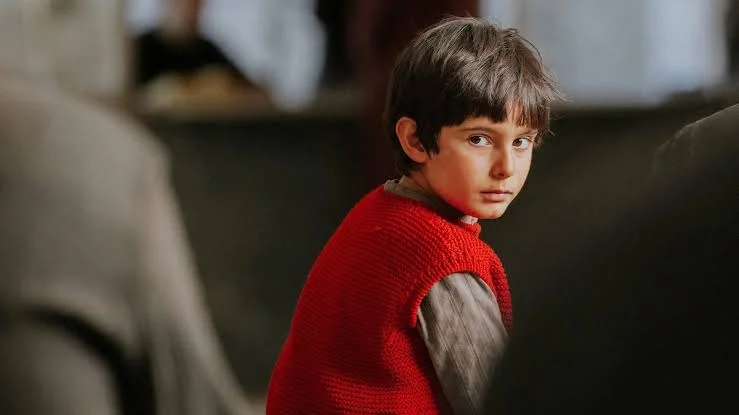

Spanish gives the displaced people of Novilla a shared language, but it cannot tell them where they belong. Simón and six-year-old David arrive without reliable memories of their previous lives, able to speak to each other yet unable to recover the relationships that might explain their attachment.
Simón takes responsibility for a boy who is not his son. In adapting J. M. Coetzee’s Jesus trilogy for Aquí, Portuguese director Tiago Guedes places that improvised bond in a Spanish-speaking society without a securely identifiable country or historical period. The language supplies familiarity without the reassurance of a recognizable home.
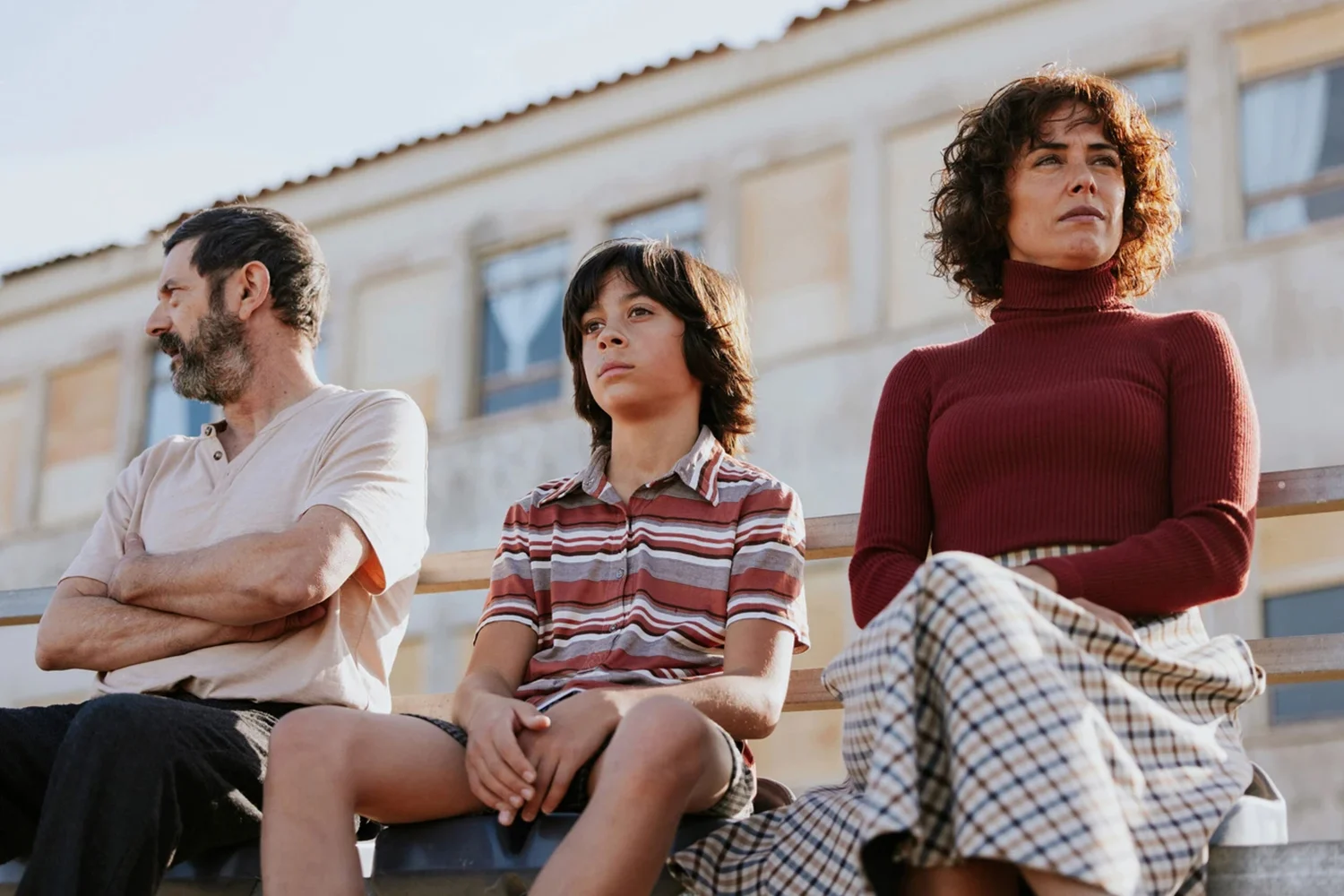
Daniela Cajías’s photography extends this separation between recognition and belonging. Warm sunlight makes Novilla look approachable, while sterile surroundings and wide compositions leave its inhabitants looking small. The contradiction matters to the adaptation: these people have entered a world they can physically occupy before they can understand their place within it.
Guedes resists turning Coetzee’s imagined society into a readily decoded national setting. That freedom allows the family’s predicament to travel, though the film sometimes leaves Novilla so indistinct that its resistance to difference becomes easier to grasp than its ordinary social life.
Simón’s response is to establish relationships through conviction. He believes he can recognize David’s mother and chooses Inés, played by Patricia López Arnaiz, without evidence that could substantiate the claim. Her initial resistance puts an awkward pressure on his generosity.
A man willing to assume responsibility for an unrelated child also assumes the right to tell another adult who she is. Guedes and co-screenwriter Luís Araújo give this arrangement emotional possibilities without providing the biological certainty that would make it comfortable. Inés’s eventual acceptance creates a family through care, while leaving Simón’s original claim unproved.
The absence of a conventional romance between the guardians gives their household an unusual character. Their connection develops around David’s needs, disagreements, and questions rather than a couple’s progress toward intimacy. Manolo Solo makes Simón’s patience persuasive in the repeated conversations with the boy, particularly as explanations cease to reassure him.
Care becomes a practice of continuing to answer after the answer has already failed. Álex Peláez gives David enough stubbornness to make that practice exhausting. When the child asks if he is a ghost, the question carries both spiritual unease and the difficulty of reassuring someone who will not accept the available account of himself.
David’s exceptional status invites religious interpretation, especially beneath the literary trilogy’s title. Yet treating him as a set of theological correspondences would flatten the difficult child Peláez plays. His curiosity can trouble adult assumptions and wear down the people protecting him within the same exchange.
Later, Hugo Encuentra’s appearance as an older David tests the family’s achievement across time. Sustained affection has given him guardians, but it has not supplied the origins he wants. His growing independence exposes a limitation in Simón’s idea of belonging: the home an adult constructs may never answer the questions a child brings to it.
The dance academy offers a different response to this problem of communication. Numerical ideas become movement, and David’s aptitude allows him to participate in something that does not depend on recovering his history. Sofia Dias and Vítor Roriz’s choreography gives the adaptation a way to make thought visible without requiring another explanatory conversation.
Numbers can be spoken and disputed; dancing them creates rhythm, coordination, and a body occupying space. Movement does not become an automatically transparent language, but it changes what David can express and what Simón can receive.
This shift is especially effective during the tribute to Ana Magdalena, when David dances the number seven on a red-lit stage and Simón cries. The father’s response gives the performance a human measure without solving its numerical or spiritual meaning. For once, his relationship with David can proceed through attention rather than explanation.
The relative scarcity of music elsewhere, much of it situated within the film’s world, gives the academy’s voices and instruments unusual force. Dimitri’s monologue afterward returns speech to the occasion. Daniel Elías’s combination of approachability and intimidation keeps the academy from becoming an uncomplicated refuge, even where it permits David a freedom unavailable in his conversations at home.
Across roughly three hours and twenty minutes, the film allows these relationships to accumulate irritations and accommodations. That duration helps distinguish accepting a parental role from continuing to perform it. Its narrative breadth is less successful at giving the surrounding society comparable substance. Sergi López’s ill-tempered dockworker enters and recedes, leaving the social world he might help establish only partly developed.
The problem is the disparity between the sustained attention given to guardianship and the provisional treatment of people outside it. Compressing three novels into one feature can still produce a film that feels prolonged within individual relationships and abrupt between them. Missing explanations and missing connections create different kinds of uncertainty.
David’s encounters with death give the uncertainty firmer emotional consequences. The horse’s death, the dog killing the lamb, and Ana Magdalena’s death challenge any account of the world that parental reassurance can sustain. These losses need no fixed religious interpretation to expose the gap between protection and knowledge.
Simón can remain present for David without possessing an answer adequate to what has happened. Here, the film’s refusal to explain becomes productive because a concrete experience gives the unanswered question weight. Death interrupts the child’s life; it does not arrive merely as another subject for philosophical conversation.
Near the end, Simón’s thought of writing about David brings the adaptation’s own difficulty into the family. To tell someone’s story is to select a shape for a life that may resist it. David asks him to promise not to understand him, a demand that unsettles the authority Simón has exercised since choosing Inés as his mother. The boy still addresses the man who has cared for him, but asks that care to make room for something it cannot explain.
Aquí (released internationally as Here) premiered in 2026, stemming from an international co-production partnership. Directed by Tiago Guedes and adapted from J. M. Coetzee’s Jesús trilogy, the Spanish-language dystopian drama follows a child refugee who forms a profound bond with a local man as they navigate a bleak, austere future society.
Full Credits
Title: Aquí
Distributor: Leopardo Filmes, Alfama Films
Release date: 2026
Running time: 1 hour 45 minutes (105 minutes)
Director: Tiago Guedes
Writers: Tiago Guedes, Luís Araújo
Producers and Executive Producers: Paulo Branco
Cast: Álex Peláez, Manolo Solo, Patricia López Arnaiz, Beatriz Batarda, Ivo Canelas, Teresa Madruga
Director of Photography (Cinematographer): João Ribeiro
Editors: Roberto Perpignani
Composer: Not publicly specified
The Review
Aquí
Aquí carries Coetzee’s displaced world into Spanish-language cinema with its questions of belonging intact. Its strongest passages let care, framing, and dance express what explanation cannot settle. Solo’s patient guardianship gives the abstraction emotional substance, while the academy turns numerical thought into physical experience. Novilla remains thinly inhabited, and abrupt narrative connections strain the film’s expansive duration, but David’s resistance to being understood gives its parental drama a difficult, persuasive intimacy.
PROS
- Solo’s patient, emotionally credible guardianship.
- Dance gives philosophical ideas cinematic expression.
- Warm photography complicates the characters’ estrangement.
- Family bonds retain affection and troubling uncertainty.
CONS
- Novilla’s social world remains underdeveloped.
- Abrupt narrative connections interrupt the sustained immersion.







