























Few Soulslikes ask you to admire the grass before preparing to die. Lunarium does. Team Lunarium places its collapsing world beneath soft watercolour skies, fills its ruins with piano melodies, then hands Ave a sword and expects exact parries against enemies capable of cutting her down in seconds.
Ave is a knight in training travelling with Lune, a primordial Starfarer who attacks from range and assists with environmental puzzles. Their goal is to stop the Nihilus, a blight consuming the land and its history. The premise follows familiar action RPG ground, yet the presentation separates it from the grey castles and rotting swamps that still dominate the Soulslike family tree. Its abandoned forts, tranquil forests, cosmic chambers, and sunken fishing village carry the story through place before the dialogue has a chance to explain anything.
The Bench Between Battles
The main menu offers the clearest statement of what Team Lunarium wants this world to feel like. Ave sits on a bench in a grassy field while a quiet piano track plays. Selecting continue removes the text, moves the camera toward her, and resumes control at the last bench visited without a visible loading break. It is a modest transition, yet it connects the interface to the fiction with rare confidence.
Benches serve the function of Dark Souls bonfires, restoring Ave’s resources and creating checkpoints across each region. Their purpose is mechanical, but the game gives them emotional weight through music and framing. A new bench often arrives after a difficult stretch, and sitting there for another minute feels natural because the soundtrack treats rest as part of exploration rather than dead time between fights.
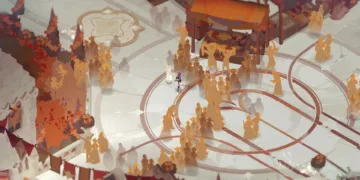
The isometric camera invites comparison with Hades, especially when Ave reaches a new area and the composition briefly opens to reveal the route ahead. Hades uses those reveals to announce another chamber in an underworld built for repetition. Lunarium uses them to mark pieces of a world being lost. Hand-drawn backgrounds hold rich colour without becoming visually noisy, while Ave and Lune’s animations remain readable against detailed scenery.
The soundtrack performs similar work. Exploration themes flow into sharper battle arrangements without snapping the atmosphere in half. The world still sounds wounded during combat. Even the more energetic tracks retain the same melodic identity heard at the benches, linking danger and rest as parts of the same place.
Stitches That Change the Fight
Ave’s basic toolkit follows recognisable Soulslike rules. Light sword attacks build quick combinations, charged strikes trade speed for force, and dodges or parries create the safest openings. She can summon a large magical blade for a heavier slash and repel certain projectiles toward their source. Lune hovers nearby, firing light arrows and using resonant skills that weaken enemies or strengthen Ave.

The relationship between them works because Lune never feels like a detached ability icon. Her ranged pressure creates room for Ave to close distance, while resonant attacks can interrupt a sequence or set up a stronger response. Combat gains a two-character rhythm without asking the player to control two full move sets.
The Cloak and Embroidery system gives that rhythm room to change. Each Cloak carries a passive benefit and a set number of Embroidery slots. One setup increases damage each time Ave lands another hit without taking damage, turning clean parries and disciplined spacing into an escalating reward. Another raises maximum health according to the number of attached Embroideries, supporting players who prefer to survive mistakes rather than avoid every one.
Individual Embroideries can restore health after a resonant skill or increase damage following a perfect parry. These effects shape decisions during battle instead of raising numbers that disappear into a menu. Switching Cloaks can move Ave from an aggressive momentum build to a slower defensive one, and the difference is clear within the next encounter.
The skill tree is less restrictive. It can be completed during a normal playthrough, and resources become generous enough to upgrade much of Ave’s equipment at Lune’s shrine headquarters. Players familiar with RPG trees built around permanent exclusions may find this approach forgiving, but it suits a game whose strongest progression system already lives in interchangeable Cloaks.
Bosses provide the cleanest test of these systems. Their attacks must be learned, greedy combinations are punished, and successful parries create brief moments of control. Spawn points sit directly outside boss rooms, removing the long return trips associated with older Soulslikes. Team Lunarium borrows the genre’s demand for repetition and wisely discards its fondness for commuting.
When Precision Loses Its Rules
Regular encounters do not maintain the same balance. Once Ave’s block is understood, several enemy placements can be handled with little risk. Later arena gauntlets swing toward the opposite extreme, surrounding her with groups of knights whose damage and aggression produce sudden walls. One such encounter can consume hours in a game built to last roughly a working day.

Difficulty alone is not the issue. Hard combat needs reliable cause and effect. Lunarium sometimes makes identical sword combinations produce noticeably different damage, while enemy attacks can connect after Ave appears to have cleared their range. A failed parry is readable. A dodge that looks successful before damage appears is harder to learn from.
The absence of difficulty settings leaves no route around an overtuned encounter. An assist option reducing enemy damage or widening defensive timing would preserve the pattern-learning design while letting players continue Ave and Lune’s story. Here, a single gauntlet can halt every other system, including the exploration and progression that make the game worth pushing through.
Technical problems create a second break in trust. Placeholder text appears in dialogue, journal entries, and lore prompts. Some side quests provide unusable descriptions, then offer unclear or missing objective markers, forcing the player to search without enough information. Late scenes can assign dialogue to the wrong character, obscuring exchanges meant to develop Ave and Lune’s bond.
Patches have reportedly repaired portions of this text, yet scattered placeholders remain, and equipment menus still feel slow when upgrading several items. The unfinished language is especially damaging in a story concerned with memory and identity. Lunarium asks the player to recover a dying world’s history, then occasionally replaces that history with development text.
The Review
Lunarium
Lunarium gives the isometric Soulslike a striking new surface, then supports it with combat systems that reward genuine experimentation. Ave and Lune work together with satisfying rhythm, and the Cloak and Embroidery combinations can meaningfully reshape each encounter. Its watercolour environments and seamless bench transitions supply an identity few genre peers possess. Severe difficulty spikes, uncertain hit detection, placeholder dialogue, and unclear quest guidance reveal a game released before every piece was ready. The foundation deserves a future as polished as its scenery.
PROS
- Beautiful hand-drawn environments
- Flexible Cloak builds
- Strong Ave and Lune synergy
- Excellent soundtrack
- Convenient boss checkpoints
CONS
- Abrupt difficulty spikes
- Inconsistent combat feedback
- Placeholder story text
- Unclear quest markers
- Cumbersome upgrade menus