




























The most revealing line in Summer of ’94 is about avoiding disgrace. When the United States prepares to host the 1994 World Cup, the national team’s first ambition is painfully modest: do not embarrass the country before the world. That fear gives Dave LaMattina and Chad Walker’s documentary its real subject. This is less a record of a tournament than a study of how institutions manufacture belief before earning it.
The evidence for panic was strong. The United States had returned to the World Cup in 1990 after four decades away, lost every group match, and absorbed a 5-1 defeat against Czechoslovakia. There was no major domestic league, few players had meaningful European experience, and soccer remained both children’s recreation and foreign import.
Hosting the sport’s largest event under those conditions sounds visionary now. At the time, it looked faintly unhinged. America in 1994 wanted the prestige of global football without possessing its infrastructure. The solution was to build the team first and hope the culture arrived later.
Bora’s Laboratory
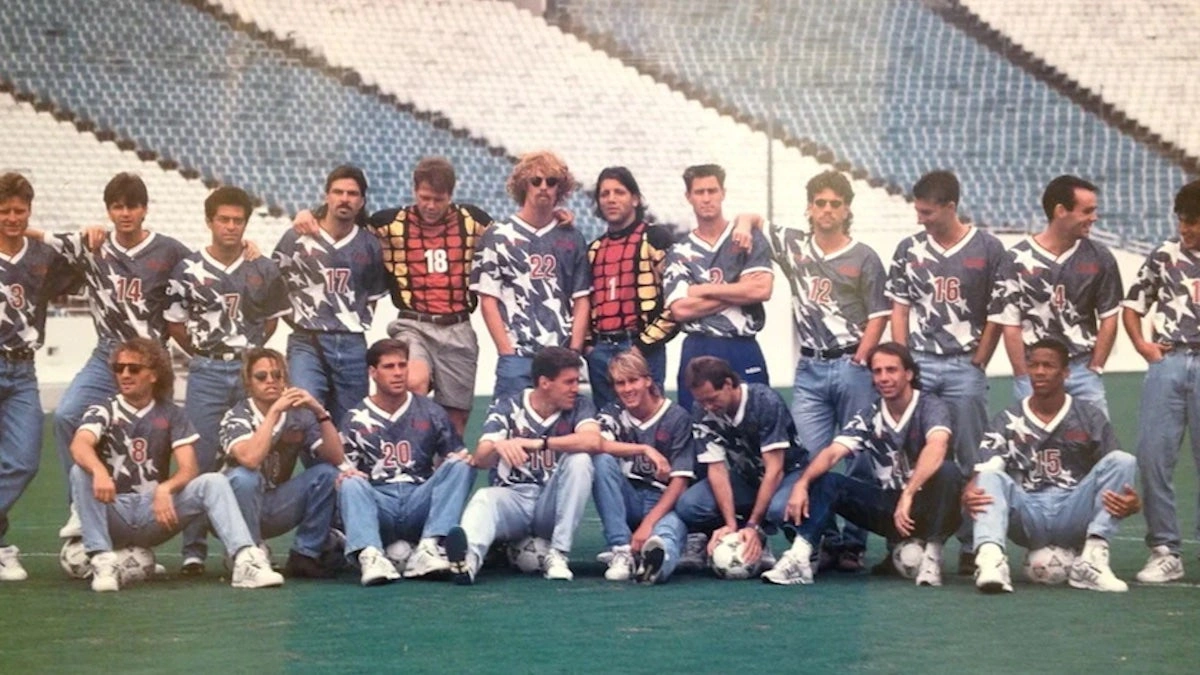
Coach Bora Milutinović responds to institutional anxiety by creating a human experiment in Mission Viejo. Roughly forty players live, eat, train, and wait to learn which twenty-two will survive the cut. The facility is unfinished, so Bora has them run. When the players expect tactics, he teaches them to tie their shoes. When language becomes a barrier, Marcelo Balboa translates Bora’s Spanish. Confusion becomes part of the method.
Call this disciplinary mysticism: an authority figure makes every instruction appear connected to a plan no one else can see. The film treats Bora as magician, chess player, and benevolent tormentor, and his analogies encourage the mythology. A coach must think several moves ahead. A soccer team needs a driver and a car. Yet the grainy camp footage gives his process a physical credibility the slogans lack. Players are exhausted, irritated, and slowly synchronized.
I resisted the documentary’s affection for Bora at first. His eccentricity can resemble coaching folklore polished by hindsight, especially when former players laugh about his English. Then the footage complicates that reaction. Endless drills, including hours of “one player, one ball,” strip the squad down to repetition and shared fatigue. He is not building confidence through speeches. He is making forty uncertain men inhabit the same clock.
The Men Inside the System
The camp works as an idea because the players refuse to become symbols. Alexi Lalas is introduced through his hair, his band, his taste for Slurpees, and his resistance to looking like anyone’s model professional. Bora orders a haircut. The gag is funny, yet it clarifies the coach’s instinct: individuality is tolerated only after it proves useful to the group.
Tony Meola carries the 1990 collapse behind his New Jersey swagger. His bravado reads differently once the film links it to the humiliation against Czechoslovakia. Eric Wynalda offers another defensive performance, abrasive, funny, and candid enough that his stress-induced hives threaten to become a larger dramatic event than the Colombia match. The documentary is fascinated by the bodily cost of anticipation, sometimes at the expense of the event itself.
Marcelo Balboa’s torn ACL supplies the cleanest individual arc. His rehabilitation is shown through punishing daily effort, and the possibility of losing his place gives each exercise a practical cruelty. Cobi Jones leaves school to train full-time. Paul Caligiuri watches Bora’s methods with the suspicion of a veteran asked to surrender familiar rules. Each man enters carrying a different idea of professionalism. Bora’s system forces those ideas into proximity.
The film insists that proximity became family. Here it creates the cohesion paradox: everyone describes togetherness from a room occupied alone. LaMattina and Walker interview the former teammates separately, so the audience hears about teasing, conflict, and loyalty without watching those rhythms reappear. A reunion scene could have tested the mythology. The film prefers testimony.
Archival Memory, Safe Form
The Hi8 tapes are the documentary’s finest discovery. Practices, locker rooms, unfinished buildings, casual jokes, and private frustration survive in a texture too rough to feel curated. The footage places viewers inside a period when the players did not know they were becoming historical figures. Once a story enters national memory, every setback looks like foreshadowing. These tapes still contain dead ends.
Billy McMillin’s editing keeps the long preparation legible, and period songs such as “Here Comes the Hotstepper” energize material that often consists of men remembering running. The approach is effective, if visually cautious. A brief Nintendo-style animation appears early, suggests a playful formal language, then vanishes. Talking heads, chronology, musical lift, injury, recovery, tournament payoff: the documentary uses the standard sports formation and rarely changes shape.
Spending most of the runtime before the World Cup is defensible. The camp is stranger than the matches, and the achievement was creating a team capable of entering the field without apology. Still, the final act compresses the tournament so tightly that Wynalda’s hives receive nearly the same dramatic weight as the victory over Colombia. History arrives, checks its watch, and moves along.
Then the stadium fills. The hesitant trainees from Mission Viejo step into a national spectacle, defeat Colombia, and reach the round of sixteen. America did not suddenly understand soccer in 1994. It learned how public belief can be staged, rehearsed, and, for one summer, made real.
Summer of ’94 premiered at the South by Southwest Film & TV Festival on March 14, 2026, and is available through festival circuits and documentary distribution channels. The sports documentary chronicles the United States men’s national soccer team’s journey through selection, training, and the 1994 FIFA World Cup.
Where to Watch Summer of ’94 (2026) Online


Full Credits
Title: Summer of ’94
Distributor: Imagine Documentaries
Release date: March 14, 2026
Running time: 99 minutes
Director: Dave LaMattina, Chad N. Walker
Producers and Executive Producers: Christopher Leggett, Rafael Marmor, Marc Gilbar, Dave LaMattina, Chad N. Walker
Cast: Alexi Lalas, John Harkes, Paul Caligiuri, Cobi Jones
Editors: Billy McMillin
Composer: Ryan “Bullet” Shields
The Review
Summer of ’94
Summer of ’94 turns an institutional panic into a warm account of collective invention. Bora Milutinović’s Mission Viejo camp becomes a laboratory where conditioning, confusion, and questionable haircut policies produce a credible national team. The archival tapes preserve that transformation with scruffy immediacy, while the separate interviews keep the players’ supposed family chemistry frustratingly abstract. Call it the cohesion paradox: everyone describes togetherness from a room occupied alone. The documentary follows a familiar formation, yet the people inside it remain funny, wounded, and easy to cheer for.
PROS
- Remarkable behind-the-scenes footage
- Bora’s eccentric coaching methods
- Strong individual player stories
- Effective historical context
CONS
- Conventional documentary structure
- Teammates interviewed separately
- Underdeveloped visual experiments
- World Cup matches feel compressed