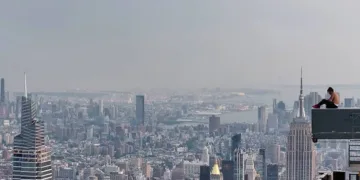


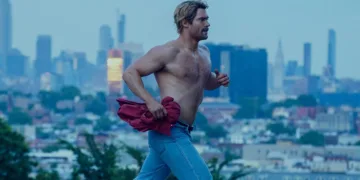











Police bodycams and a climber’s GoPro record the same Cincinnati pursuit from opposing moral systems. From Isaac Wright’s camera, the Great American Tower is a route, a canvas, and refuge above the city. From the officers’ cameras, every locked door and stairwell becomes evidence. Deon Taylor cuts between the two views with split screens and tightening crosscuts, turning a real chase into a sequence American crime cinema usually has to manufacture.
That collision defines Drift, Taylor’s 104-minute documentary about the army veteran and photographer known by his adopted name. Wright enters skyscrapers, stadiums, and bridges without permission, climbs without ropes, then photographs his Vans hanging over streets that resemble circuitry. The opening assurance that no footage was created by AI sounds playful, yet it protects the film’s main attraction.
Taylor treats the climbs with the propulsion of a heist film. Wright tests doors, studies routes, watches the weather, and carries camera equipment into spaces where one poor grip can end everything. Rain-darkened trousers, unsuitable shoes, and uncertainty about the route down puncture the polished mythology. The pictures look superhuman. The person making them keeps breathing hard.
Flight as an American Language
Unauthorized urban climbing belongs to a global visual culture shaped by rooftop videos, extreme sports, and social platforms that erase national borders. Wright’s story becomes specifically American once military service, race, policing, and entrepreneurship gather around the act. Childhood footage of him receiving a Superman figure leads to the adult Wright standing above city blocks. Taylor earns the obvious association by showing how badly Wright needs distance from the ground.
His history includes abuse, family deaths, PTSD, and an honorable discharge after a chronic condition affected his right leg. Photography gives him discipline after the army, while climbing becomes a private method of survival. He trains to simulate the camera gear he will carry. Each ascent joins preparation to an emotional impulse: pain remains below, and the lens waits above.
American culture has long made room for the outlaw who breaks a rule and later sells the story of breaking it. Social media turns trespass into audience growth. Arrests turn notoriety into artistic value. A newspaper profile changes public perception. NFT sales and gallery interest convert the outlaw image into capital. Other countries have their daredevils and forbidden rooftops, but Drift links risk to a national fantasy in which self-invention can absolve anything once the market approves.
Wright is thoughtful and relaxed before the camera, yet his serenity does not erase the danger below him. A fall could kill a pedestrian or leave strangers watching a death they never agreed to witness. Taylor barely presses this point. His camera favors the artist’s freedom over the public’s unwilling participation.
Cameras Against the State
The second half replaces exposed steel and rooftop edges with jail cells, attorneys, extradition threats, and charges spread across state lines. Still, the change reveals why the police footage matters. Wright and the authorities are producing rival identities for the same man.
Detective Jeff Ruberg represents the state’s version. The documentary describes efforts to emphasize Wright’s military training, familiarity with weapons, and interstate activity, while his recorded trespasses involve no violence and no weapon. An intimidating photograph is circulated to shape public opinion. In Arizona, officers stop traffic and approach him carrying rifles. Later, confinement leaves him alone for 23 hours each day, with one hour outside the cell.
The confrontations unfold around 2020 and 2021, when George Floyd’s murder had made every armed encounter between police and a Black man carry added weight. Wright is biracial and a veteran, two identities that American institutions praise in ceremony and treat with suspicion under pressure. His service is thanked until prosecutors can use it to describe him as unusually capable of violence.
Ruberg declined to participate, leaving the film with a structural weakness. Taylor grants Wright and his lawyers space to define motive, while the opposing side survives through archival footage and hostile description. The documentary simplifies the conflict into persecuted artist against obsessive officer. Wright’s actions remain illegal. The punishment described still appears grotesquely inflated.
The Outlaw Becomes the Product
Taylor’s crime-thriller background shows in his preference for pursuit and clearly assigned antagonism. Editors Martin Biehn and Kevin Hibbard organize GoPro images, drone shots, surveillance recordings, dashcams, and interviews with fluency. Their Cincinnati sequence carries the escalation of fiction: Wright climbs, police enter, the distance closes, and each camera supplies information the other cannot see. Later legal passages cannot recover that velocity because the film has already found its perfect form.
The biography is less complete. One brother, Micah, stands in for a larger family history, and attorney Laurence Haas represents an effort involving several lawyers. Those compressions keep the narrative legible but leave sections of Wright’s life outside the frame.
Repeated hints of a future biopic expose Taylor’s appetite for legend. Wright already has childhood pain, military discipline, outlaw fame, a determined lawyer, an adversarial detective, prison, public vindication, and images no stunt team could easily improve. Police surveillance tries to make him legible as a threat, while his own camera turns the same illegal act into art. Once buyers accept the second image, the first becomes part of the sales pitch.
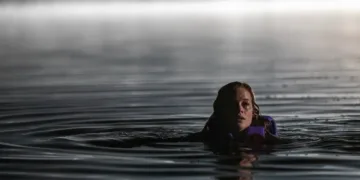
Drift was released on February 24, 2026, and is available for viewing on digital platforms such as Prime Video. The survival thriller follows a figure skating star who falls from a glacier during an Arctic promotional event and must fight to stay alive on a melting, drifting block of ice.
Full Credits
Title: Drift
Distributor: Capelight Pictures
Release date: February 24, 2026
Rating: 16+
Running time: 86 minutes
Director: Taavi Vartia
Writers: Taavi Vartia
Producers and Executive Producers: Lilette Botasi, Aleksi Puranen, Joonas Vartia
Cast: Thea Sofie Loch Næss, Nikos Koukas, Mimi Roivainen, Jasmin Simonen
Director of Photography (Cinematographer): Nikos Karanikolas
Editors: Nikos Karanikolas
The Review
Drift
Drift turns a global culture of rooftop trespass into a distinctly American fable about race, military service, punishment, and self-branding. Deon Taylor’s strongest passages fuse Wright’s GoPro images with police bodycams, making a Cincinnati pursuit feel like a collision between two rival versions of freedom. The legal chapters lose velocity, and the film’s loyalty to Wright leaves the danger faced by people below insufficiently tested. Still, Wright’s charisma and the astonishing climbing footage carry the film across its softer stretches.
PROS
- Vertiginous GoPro and drone footage
- Tense Cincinnati chase editing
- Wright’s candid screen presence
- Sharp race and military-service tensions
- Potent outlaw-artist mythology
CONS
- Legal passages slow the momentum
- Bystander risks receive little scrutiny
- Ruberg remains one-dimensional
- Family history feels compressed
- Sentiment sometimes weakens the analysis