



























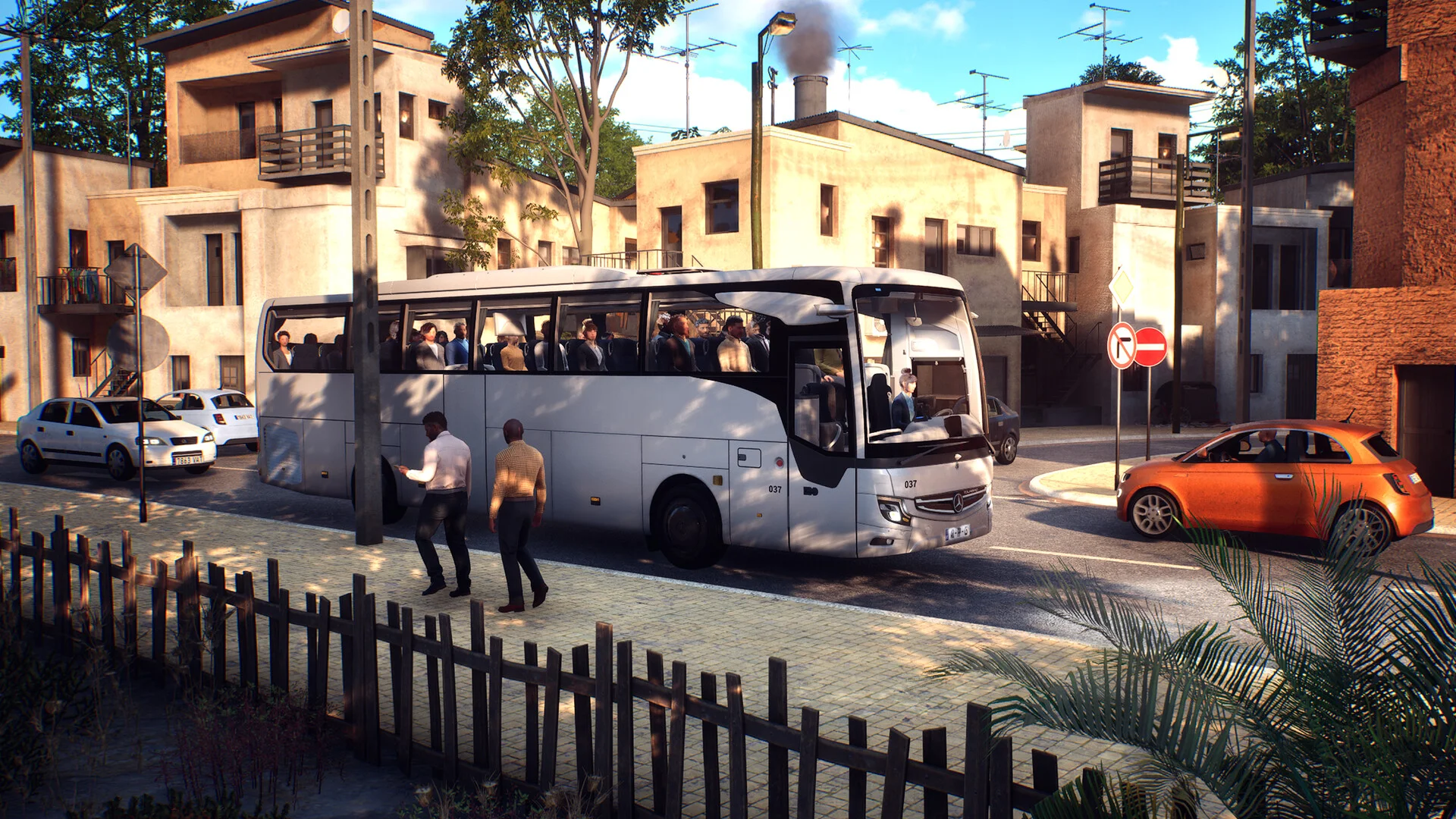

Bus Simulator 27 gives you control over doors, ramps, climate systems, tickets, indicators, routes, employees, company branding, and passenger behavior. The problem is that several of those systems cannot reliably agree on what the player actually did.
Simteract, previously responsible for Taxi Life and Train Life, takes over a series long associated with Stillalive Studios and expands its management ambitions considerably. You arrive in Felicia Bay, a fictional Mediterranean region inspired by Spain and Portugal, with the task of rebuilding its public transport network. From there, you buy buses, recruit drivers, create routes, assign vehicles, and occasionally leave the driver’s seat to walk around the city yourself.
There are 45 licensed buses from 13 manufacturers, including Mercedes, MAN, IVECO, and Ebusco, and each expects a degree of attention beyond steering and braking. Doors can be operated individually. Wheelchair ramps need deploying. The bus can kneel at stops. Tickets must be sold. Passengers complain about temperature. This is exactly the sort of procedural density the series should be chasing. It simply needs those procedures to work consistently.
Driving by Committee
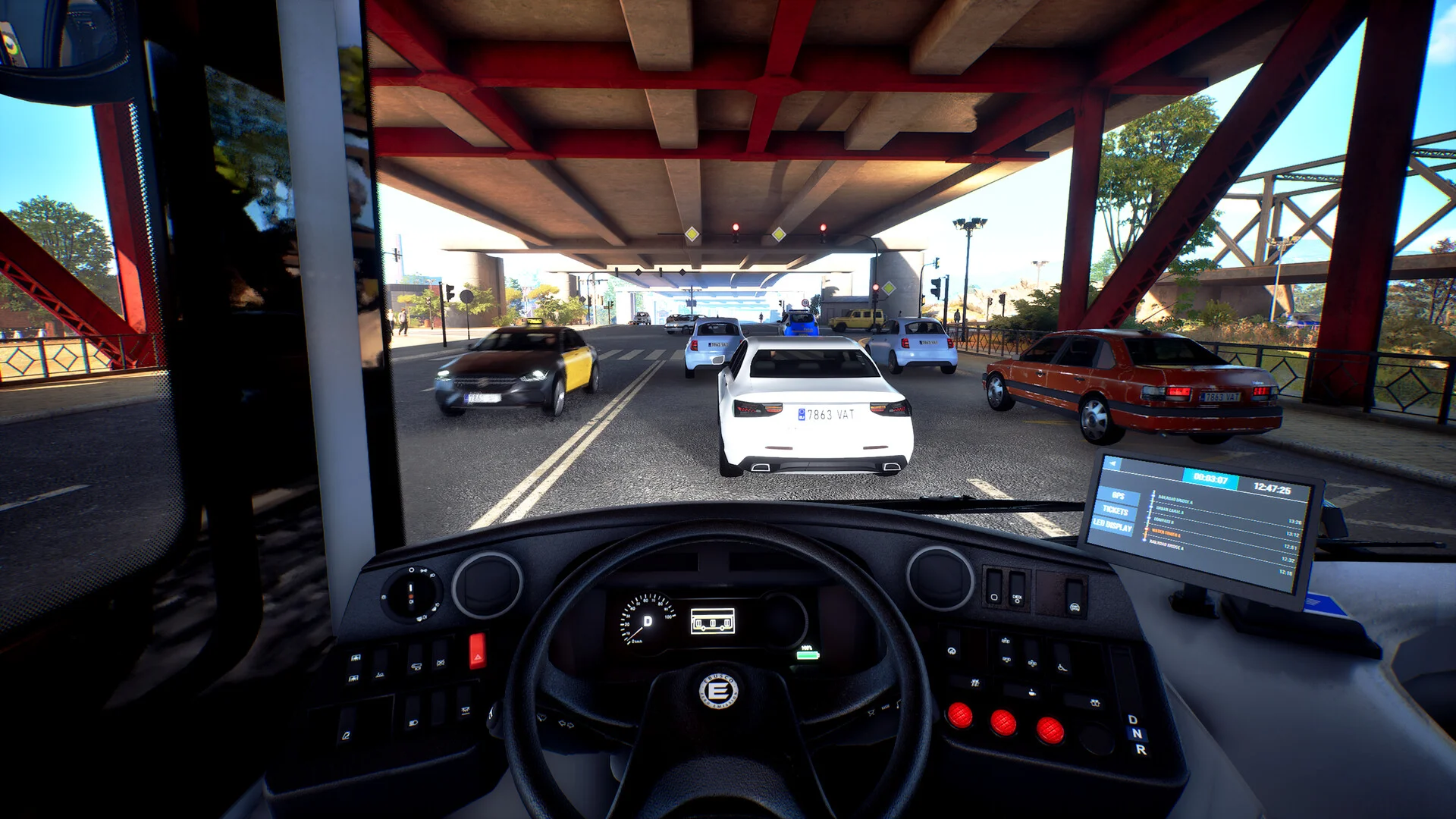
The act of operating a bus has plenty of texture. You can handle the ignition manually, work the doors yourself, activate lights, manage the ramp, and use a quick-access menu for functions that do not have dedicated shortcuts. Pulling into a stop, lowering the bus, opening the correct doors, and watching passengers board creates a satisfying little sequence when every part behaves.
The quick menu becomes awkward once the bus is moving. A passenger might complain that the cabin is too warm, leaving you scrolling through grouped functions while also trying to stay in lane. That friction feels less like simulation and closer to fighting an interface.
Bus Simulator 27 does give players considerable control over how much of this they want. Assists can automate vehicle functions, penalties can be softened, traffic pressure can be adjusted, and stricter players can leave the full rule set intact. This is one of its smartest systems because it changes the actual play loop rather than merely adjusting numbers behind the scenes. A relaxed player can focus on stops and routes. A simulation devotee can obsess over every signal and ramp deployment.
The handling itself is less convincing. Buses have the expected weight, yet they can vibrate or glide in ways that weaken the sensation of several tons of machinery connecting with the road. The simulation has detailed buttons surrounding a driving model that does not always deserve them.
Building the Network
The management layer fares better. Buying buses, creating lines, hiring drivers, and assigning staff are easy to understand, and automatic assignment keeps routine administration from swallowing the driving. Route creation is surprisingly painless, especially for a game happy to bury the player under mechanical controls elsewhere.
Staffing has less depth. Drivers carry attributes such as passenger skills and driving ability, but recruitment rarely develops into meaningful workforce strategy. Route planning suffers from a similar limitation. You can design lines across Mequina, Alcaztelar, and their surrounding districts, yet factors such as population density do not appear to reshape planning in substantial ways. You are building a transport company without having to think deeply about why people need transport.
The three main modes at least give these systems different purposes. Story mode teaches the mechanics through missions, though its dialogue quickly becomes disposable. Career mode strips away much of that framing and concentrates on company growth. Sandbox play gives you freer access to the buses and systems.
Four-player cooperative multiplayer may prove the strongest home for the management side. Splitting routes between friends and expanding the same company gives otherwise routine scheduling decisions a social consequence. Assigning a bus is much more interesting when another human is about to drive it.
The Rules Keep Changing
The largest problem is the game’s inability to judge its own systems consistently. Turn signals are the clearest example. The game can penalize you for failing to indicate while leaving a stop after you activated the indicator, partly because the signal may cancel during the turn before the system registers the action. Meanwhile, much rougher driving can escape punishment. A scoring system built around precision becomes difficult to respect once correct inputs can produce incorrect penalties.
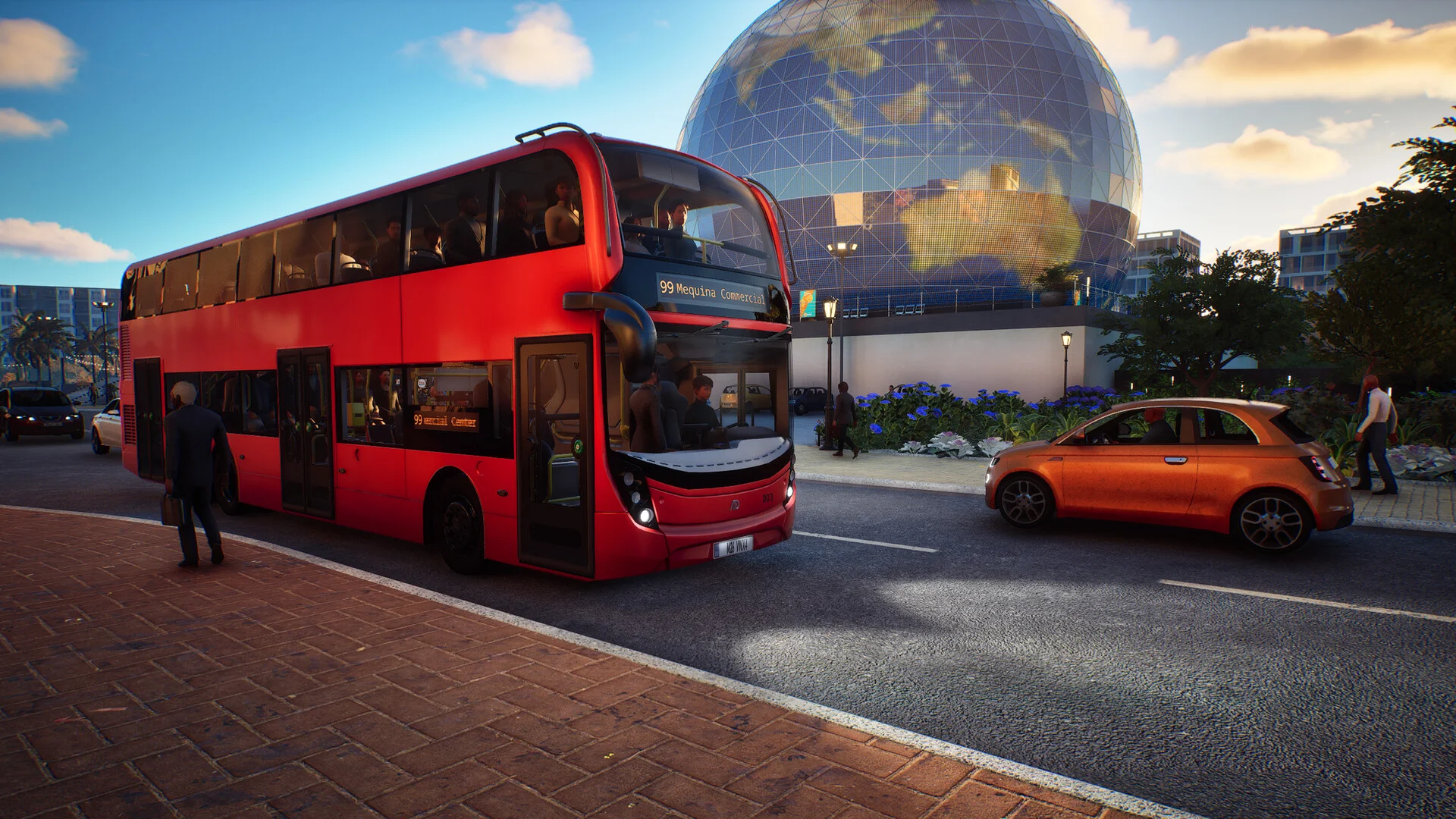
Traffic AI makes this worse. Cars stop unexpectedly, hesitate after lights change, lock intersections, or crowd the bus closely enough that routine turns become collision risks. If an AI-controlled vehicle creates the problem and you still lose points, the rating system stops measuring driving skill and starts measuring tolerance.
Passenger interactions follow the same pattern. Riders can fall asleep, play loud music, harass others, or complain about the temperature. The mirror is supposed to let you address some incidents from the seat, yet failures can force you to stand up, locate the offending passenger, and resolve the event manually.
Technical problems further destabilize the simulation. Passengers can clip through floors, remain seated after leaving the bus, and behave strangely around vehicles. PC players have reported crashes, autosave freezes, uneven performance, ghosting from upscaling, and interface resolution issues. Traffic itself can become stuck with no useful recovery behavior.
Bus Simulator 27 has enough interconnected machinery to support dozens of hours of route building and fleet management. Right now, too many of those systems produce consequences the player cannot predict, and simulation depends on predictability before complexity means anything.
The Review
Bus Simulator 27
Bus Simulator 27 builds a dense simulation around vehicle controls, route planning, staffing, and cooperative company management, and its adjustable assists give players useful control over how demanding that loop becomes. The trouble starts when the systems meant to judge the player stop behaving predictably. Incorrect indicator penalties, confused traffic AI, unreliable passenger interactions, and technical instability turn routine driving into troubleshooting. There is a strong management framework here, but the driving layer needs sharper feedback and far better consistency before the whole machine feels dependable.
PROS
- Flexible simulation settings
- Deep vehicle controls
- Straightforward route creation
- Extensive licensed bus selection
- Useful cooperative management
CONS
- Unreliable penalty system
- Frustrating traffic AI
- Shallow employee management
- Frequent technical issues
- Inconsistent driving feedback