




























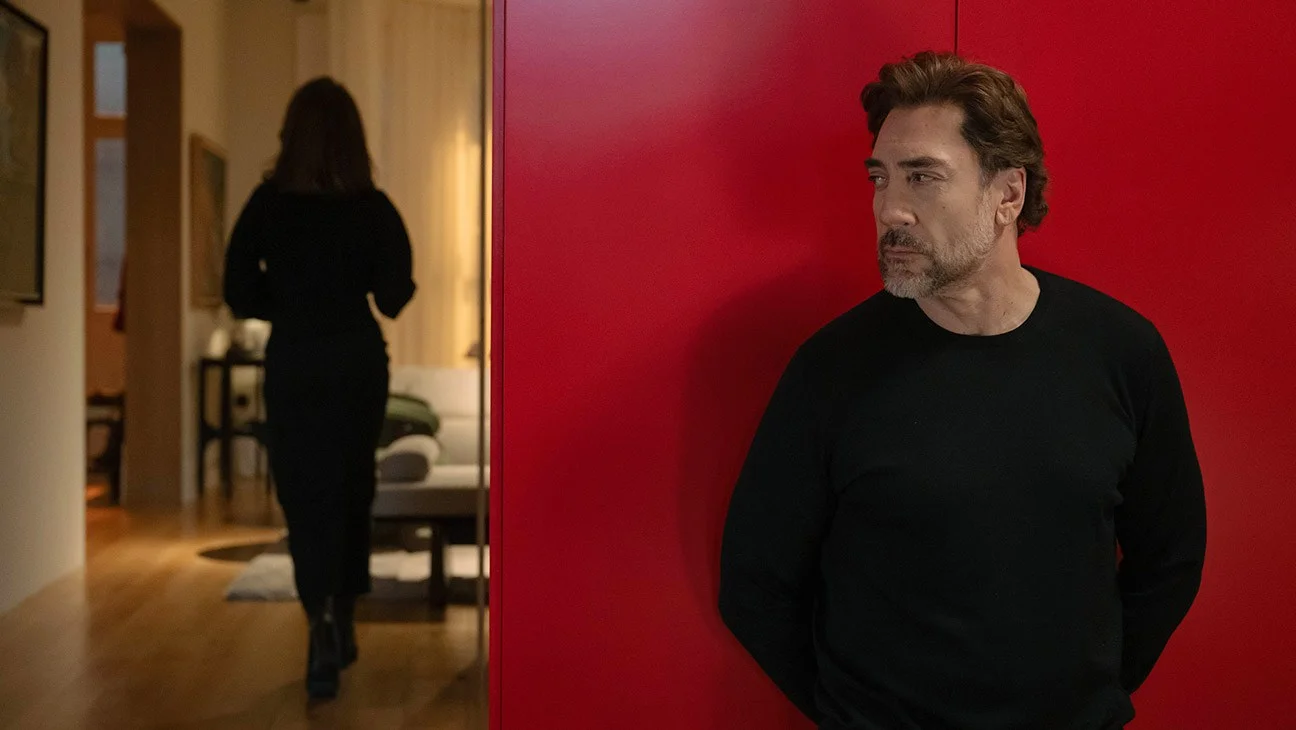

Florian Zeller has built a film in which everybody keeps confusing protection with control. Miguel, an award-winning Spanish architect living in London, receives an offer that should flatter every professional instinct he has: a tech billionaire wants him to design a vast survival bunker on a private Hawaiian island. Unlimited resources. Enormous fee. Thirty people underground for a year while civilization burns upstairs. His wife Sofia hears the proposal differently. What kind of future requires locking everyone else out?
That question gives Bunker its sharpest tension. Javier Bardem plays Miguel as a man who initially treats the project like an intellectual puzzle, while Penélope Cruz gives Sofia an immediate disgust that feels personal before we understand why. They have spent 17 years together, moved from Madrid to London, raised two daughters, and built the sort of life architectural magazines photograph from angles that conceal the emotional mess. Miguel’s career has flourished there. Sofia’s has stalled. Already, the bunker exists.
Glass Walls, Concrete Morality
Zeller literalizes nearly every idea he has, sometimes brilliantly, sometimes with the confidence of someone underlining his own sentences. Miguel and Sofia’s home is an immaculate construction of timber, concrete, glass, and hard geometric lines. It advertises openness while functioning like a sealed environment.
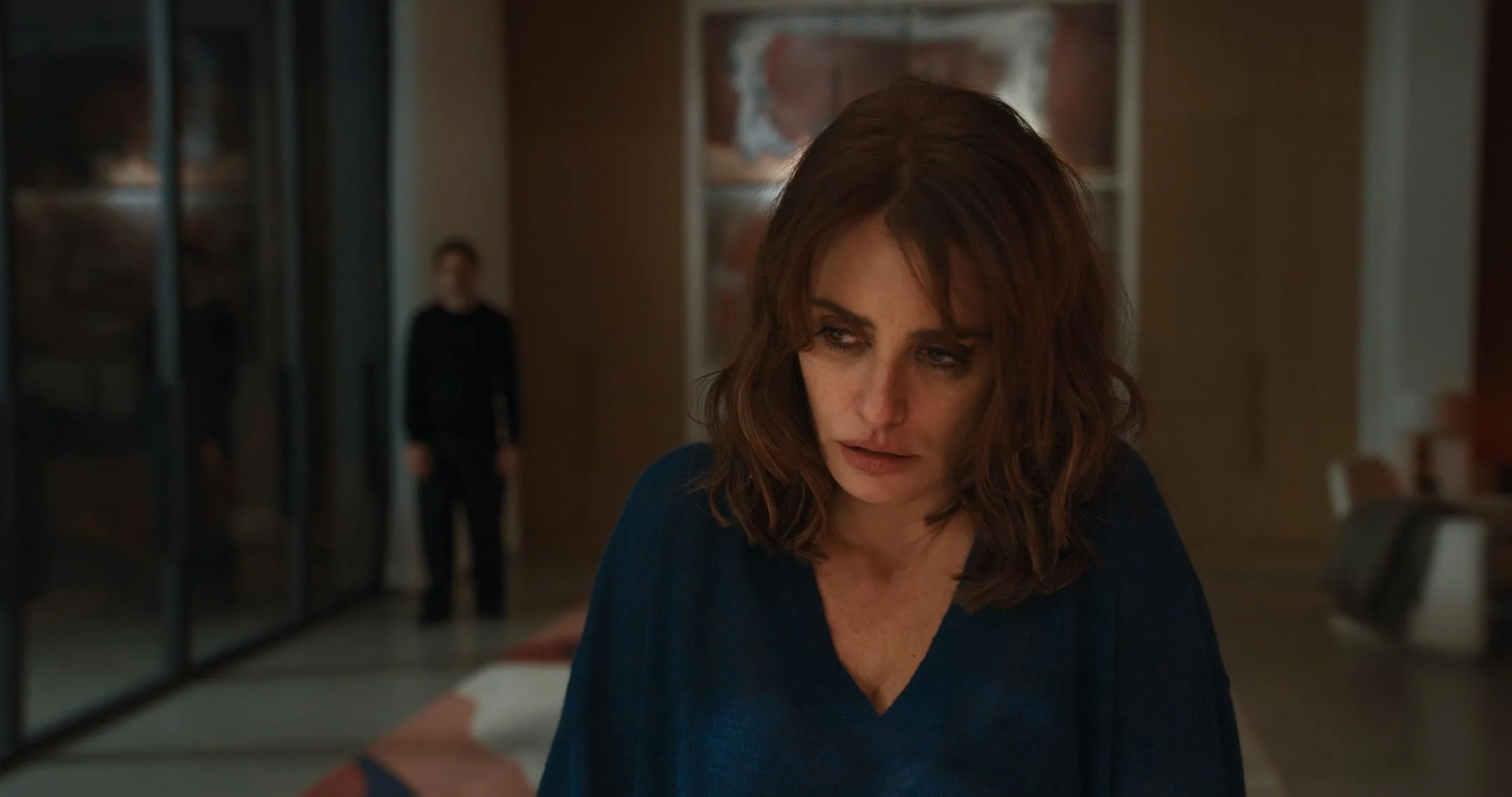
Cinematographer Ben Smithard initially places the couple comfortably inside shared compositions, then gradually pushes them toward opposite sides of the frame as their relationship deteriorates. The technique is simple. It works because the emotional movement is equally clear. Then a neighbour knocks a hole through the garden wall.
Toby, played by Stephen Graham, is converting a garage into living space and wants a window facing Miguel’s property. Miguel is legally right to object. Toby is also furious about wealthy newcomers reshaping a neighbourhood where longtime residents can no longer afford to live.
That complication briefly gives the film teeth. Property rights and class resentment occupy the same wall, and Zeller refuses to make Miguel wrong merely because he has money. Unfortunately, Toby gradually stops being a social counterargument and starts behaving like a thriller mechanism.
Miguel responds to the intrusion by buying an absurd security system complete with fog cannons. Bardem finds one of the film’s best comic registers here. Miguel is still trying to project authority while increasingly behaving like a man who expects civilization to breach the kitchen at any moment.
Paul Dano’s billionaire makes this paranoia grotesquely logical. During a remote conversation, he talks casually about survival systems, including technology that could preserve his command over the bunker during an internal revolt. The man fears collapse so deeply that he has already designed the hierarchy after it. Capitalism apparently survives the apocalypse.
Two People in the Same House
The film becomes far better whenever Zeller stops explaining society and lets Bardem and Cruz argue. Sofia’s frustration predates the bunker proposal. Moving to London strengthened Miguel’s career while narrowing hers. She works in publishing, tries to move into a senior fiction position, and runs into the quiet institutional ceiling of being foreign in a British company. A visiting novelist, James, becomes less a romantic temptation than a trigger. His writing and conversations force Sofia to examine the version of herself that disappeared somewhere inside the marriage.
Cruz makes this visible before the screenplay can articulate it. Her reaction to a painting of two sleeping lovers contains a softness missing from her conversations with Miguel. When she listens to James speak about dissatisfaction, the interest is emotional rather than obviously sexual. Sofia is hearing somebody describe a problem she cannot yet name. Miguel interprets the distance as infidelity because suspicion is easier than listening.
Their major confrontation is the film’s strongest scene. Questions about James slide into older injuries, abandoned ambitions, resentment, money, and the disturbing possibility that two people who still love each other may no longer recognize the values binding them together. Bardem shifts between accusation and wounded confusion, while Cruz can move from restraint to fury without making either state feel theatrical.
Their real-life marriage inevitably creates an extra charge, yet the performances work because of craft rather than biography. Small pauses, interrupted eye contact, and the rhythm of two people who know exactly where the other’s defenses are make the scene uncomfortable in the right way.
When the Metaphor Locks
The difficulty with Bunker is that its central idea becomes apparent long before the film stops explaining it. The billionaire has his underground refuge. Miguel turns his London home into a defensive system. Sofia retreats emotionally. Toby breaks through the wall. Wealth isolates. Fear fortifies. Marriage becomes another structure people assume will remain standing because it has stood for years.
Zeller keeps finding new ways to state the same equation. That insistence grows troublesome in the final act, when the neighbour conflict moves toward literal danger and the carefully accumulated anxiety becomes conventional suspense. The escalation asks for a degree of credibility the earlier drama never prepared. An off-screen medical explanation later clarifies part of what happened, which is rarely a promising sign for a climax.
Volker Bertelmann’s anxious strings and percussion keep tightening Miguel’s psychological enclosure, and Smithard’s camera increasingly turns the beautiful house into something claustrophobic. These craft choices often carry the themes cleanly enough on their own. Zeller seems reluctant to trust them.
The irony is almost architectural. Bunker spends two hours questioning the desire to control every possible threat, then constructs its symbolism with exactly that impulse. Every door locks. Every metaphor has planning permission. Every idea comes with reinforced concrete. Bardem and Cruz are the elements Zeller cannot fully contain, which is why their messiest scenes are his best.
Bunker had its world premiere at the 83rd Venice International Film Festival on September 8, 2026. The psychological thriller follows an architect who takes on a controversial commission to build a survival bunker for a tech billionaire, straining his seventeen-year marriage.
Where to Watch Bunker (2026) Online
Full Credits
Title: Bunker
Distributor: Wild Bunch, Tripictures
Release date: September 8, 2026 (Venice International Film Festival)
Running time: 1 hour 52 minutes
Director: Florian Zeller
Writers: Florian Zeller
Producers and Executive Producers: Fernando Bovaira, Simón de Santiago, Florian Zeller
Cast: Penélope Cruz, Javier Bardem, Stephen Graham, Paul Dano, Patrick Schwarzenegger, Mark Gatiss, Eileen Atkins
Director of Photography (Cinematographer): Ben Smithard
Editors: Yorgos Lamprinos
Composer: Nicholas Britell
The Review
Bunker
Bunker is strongest when its architecture does the arguing. The glass walls, invasive window, ridiculous fog cannons, and billionaire’s underground refuge turn security into a kind of moral illness. Zeller weakens that idea whenever the screenplay explains what the images have already made obvious, and the final act strains badly for shock. Javier Bardem and Penélope Cruz keep the marriage alive inside all that symbolism, especially during their brutal extended argument. The film builds an elegant house for its ideas, then labels every room.
PROS
- Bardem and Cruz’s volatile chemistry
- Expressive architectural symbolism
- Smithard’s increasingly divided framing
- Bertelmann’s anxious score
- Effective flashes of dark comedy
CONS
- Heavy-handed thematic dialogue
- Toby becomes a plot mechanism
- Sofia’s arc lacks development
- Implausible final-act escalation
- Symbolism repeatedly overexplained