

























Alistair Penfold explains that you have to spend money to make money. Hugh Shen points out that first you need the money you’re proposing to spend. Alistair adds another stage to the process; Hugh adds another prerequisite. By the time the exchange in Ground Up’s third episode has finished tying itself into knots, the two AFL officials have generated considerable verbal activity without getting any closer to financing anything. You can follow the argument, provided you abandon the hope that it leads somewhere.
Sam Pang, playing Hugh opposite Josh McConville’s Alistair, keeps this nonsense moving with an appealing conversational ease. His replies sound like practical corrections occurring to him as he speaks, which helps disguise how carefully Gary McCaffrie has constructed the loop. McConville supplies the boss’s confidence, an essential ingredient when the reasoning is this flimsy. Neither performer needs to announce the absurdity. The pleasure comes from hearing two men preserve the tone of a productive business discussion after its usefulness has expired.
That exchange suits the assignment Hugh has been given. Dispatched from Melbourne to establish Hobart’s Great Southern Football Club, he must assemble the public identity, commercial relationships and administrative infrastructure of a team. A controversial stadium is part of the deal. Hugh would also appreciate the job leading to the AFL chief executive’s chair, currently occupied by Alistair, who is understandably unenthusiastic about that possibility. McCaffrie and director Wayne Hope place Hugh inside a workplace where an instruction from above can become a dispute below before anyone has done anything with it. Even the proposed team song fails to get past his approval in the first scene.
Across the opening four episodes, this produces a comfortable rhythm of proposals, objections and attempted corrections. It also exposes the comedy’s ceiling. The money exchange keeps adding words after its central joke is clear, and the extra complication supplies momentum without much surprise. The distinction matters in a show descended from the administrative frustrations of The Games and Utopia: conversation can be the action, but its direction still needs to change. Here, the men’s growing fluency makes it increasingly easy to forget that neither has answered the question.
Emma Harvie’s Destiny Pitt creates a different kind of obstruction. Appointed to keep track of government spending, she attends to details Hugh would happily leave unattended. Their jobs give them immediate reasons to irritate each other, and the series gets useful mileage from the gap between his wish to keep the project moving and her responsibility to account for it. Harvie gives that scrutiny a clear purpose. Destiny has her own ambitions, too, which prevents the pairing from settling entirely into the familiar arrangement of an irresponsible man accompanied by his designated adult.
Their best illustration arrives over a bottle of non-alcoholic red wine. Hugh opens it at his desk first thing in the morning, prompting Destiny’s objection to apparent drinking at work. Once she learns there is no alcohol involved, she changes her complaint: it still looks terrible. Hugh then questions what time a person is permitted to start consuming a non-alcoholic drink. The scene has a proper comic turn because the new information changes the disagreement. Destiny cannot maintain her original objection, yet she has a perfectly serviceable replacement ready to go.
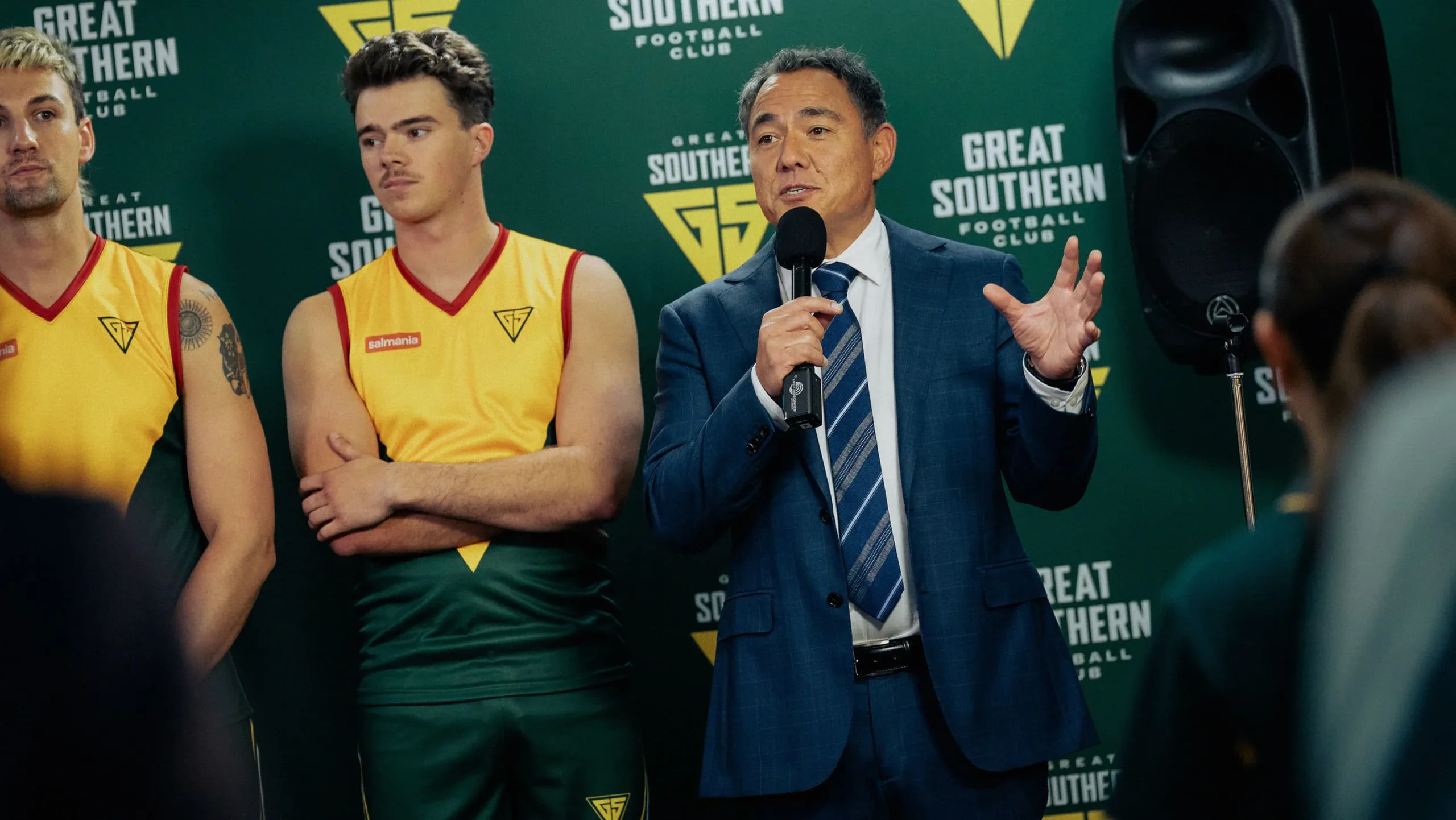
Pang’s dryness works especially well here. Hugh can sound reasonable while defending an activity whose principal workplace benefit appears to be alarming Destiny. His mildness also makes his ambition easy to underestimate. That is useful up to a point: a careerist need not snarl to make trouble. Yet Pang’s genial presence sometimes cushions behaviour that deserves a harder comic impact. His argumentative persistence is immediately legible; the consequences of giving this agreeable man authority can feel less substantial. With the wine, at least, Destiny ensures that clearing Hugh of misconduct does nothing to clear his morning schedule.
The club’s branding problems take this concern with appearances into public territory. A mascot must represent Tasmania without creating a fresh constituency of offended people; even “devil” carries troublesome religious associations. A team song needs to sound suitably local while satisfying the people authorising it. These are productive tasks for a workplace comedy because each apparent solution invites another condition. No football expertise is required to recognise the situation. Hugh’s office has to manufacture something people will feel belongs to them, through a process in which almost everyone gets a reason to object.
The limitation is how readily those objections settle into expected satirical territory. A sporting corporation treating community feeling as a communications problem is a credible target, but credibility alone cannot deliver the joke. The mascot anxiety has a specific cause and an awkward practical demand. By comparison, Hugh’s response to concern about the stadium, “We’ll build the stadium and shut them up,” gets its effect from bluntly stating the arrogance we already suspect. Pang makes the dismissal sound casually manageable. The writing exposes Hugh cleanly, then leaves relatively little for the scene to discover about him.
There is a nastier comedy available inside that response than the show’s pleasant office bustle always pursues. Hugh is supposed to establish a club that people will support, yet his proposed answer to their concerns excludes any need to hear them. The administrative task has swallowed its purpose. When Destiny objects to the wine, Hugh must at least continue the argument; when the public objects to the stadium, he imagines construction will end it. What happens when the people outside his office refuse to accept that the discussion is finished?
Ground Up premiered globally on Netflix on June 11, 2026. Created by Jeppe Gjervig Gram, the Danish financial thriller series follows an ambitious investigative journalist and a whistleblower who expose deep-seated corporate corruption within a major green-energy conglomerate.
Full Credits
Title: Ground Up
Distributor: Netflix
Release date: June 11, 2026
Rating: TV-MA
Running time: 45–55 minutes per episode
Director: Mikkel Serup
Writers: Jeppe Gjervig Gram
Producers and Executive Producers: Meta Louise Foldager Sørensen, Tomas Radoor
Cast: Dar Salim, Sonja Richter, Lars Ranthe, Danica Curcic, Esben Smed, Peter Andersson, Marijana Jankovic, Sofie Torp
Director of Photography (Cinematographer): Jesper Tøffner
Editors: Martin Schade
Composer: Jon Ekstrand
The Review
Ground Up
Ground Up makes football administration pleasantly watchable, helped by Sam Pang’s conversational timing and Emma Harvie’s purposeful resistance. Its best jokes find fresh complications inside ordinary workplace objections. Elsewhere, verbal loops outlast their payoff, and corporate arrogance arrives with its punchline already attached. Pang keeps Hugh likable, sometimes at the expense of making his authority sting. A capable office comedy that could afford to make its meetings less comfortable.
PROS
- Pang’s easy handling of intricate dialogue.
- Harvie’s sharp friction with Hugh.
- Specific, character-driven bureaucratic absurdities.
CONS
- Circular exchanges sometimes run too long.
- Familiar satirical targets limit surprise.
- Hugh’s geniality softens his misuse of authority.