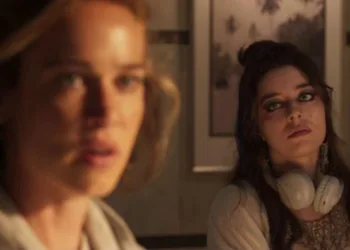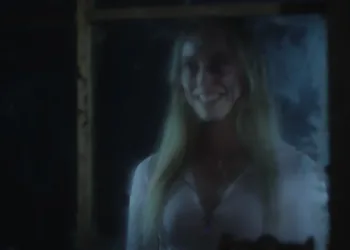


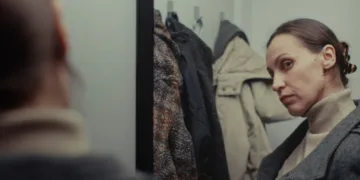
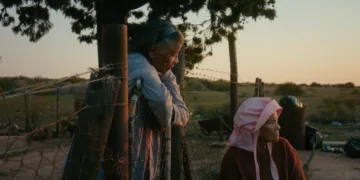
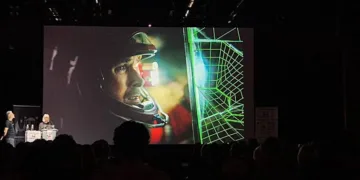


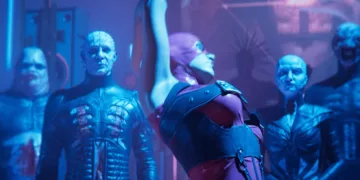





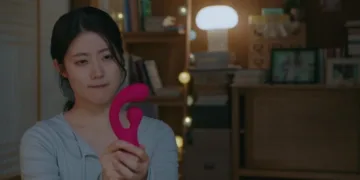















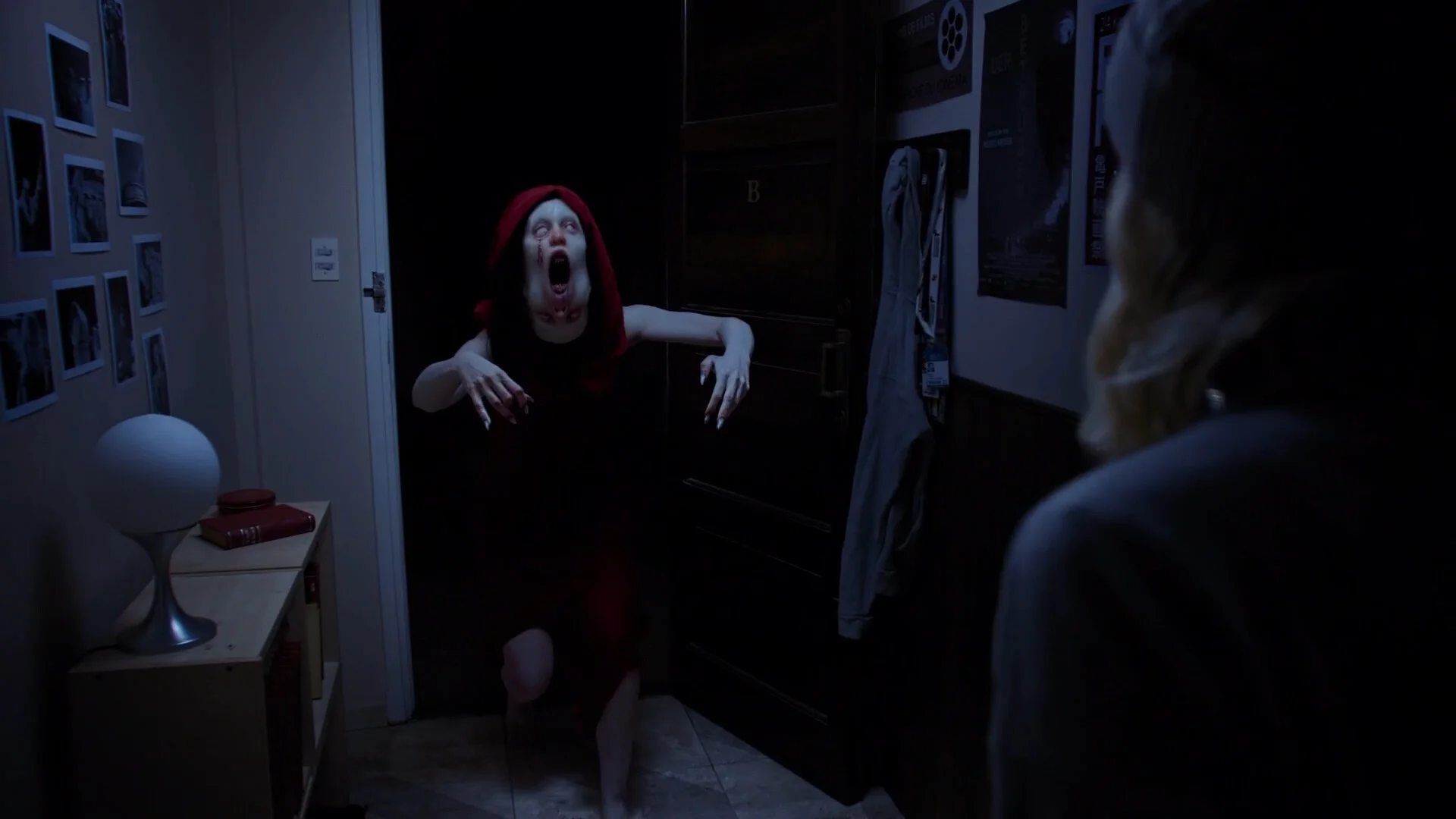
The creature approaching Julia gives her time to understand that she is in trouble. It looks at her, then charges. The live-action image gives way to pixel art, and suddenly getting her out of its path is your responsibility. Tenebris Somnia makes that handover wonderfully uncomfortable. You have already seen the thing moving toward a human body; the switch to a small sprite offers very little reassurance. Your hands have to catch up with a fear the footage has already planted.
Clara Kovacic’s performance helps that fear survive the transition. The filmed sequences have no spoken dialogue, leaving her visible distress to communicate what being trapped here is doing to Julia. Locations carry recognizable arrangements between their filmed and playable versions, so returning to the game preserves the sense of occupying the same threatened space. Practical creature effects supply a physical ugliness that the pixel art can leave partly to memory. Once you have seen what is coming for her, a handful of moving pixels can suggest plenty.
Julia has come to her former partner Iván’s apartment with belongings to return and nightmares about his safety troubling her. Inside, damaged possessions and a tape consigned to the oven suggest that something has gone badly wrong. Iván is a filmmaker, and the mystery surrounding his disappearance becomes tangled with his horror project, Devora. The initial search has an ordinary emotional difficulty beneath its supernatural escalation: Julia still cares about someone with whom she could no longer share a life. Finding him matters before the game has explained what happened.
That concern acquires substance through the places the search takes her. A bedroom, the studios where they worked on Devora, and a moonlit honeymoon spot bring different parts of their relationship into the present. Julia’s observations during exploration give these spaces personal associations.
You are looking for useful objects while she is encountering the remains of a shared history. The studio is especially effective because it puts their creative work beside their failed intimacy. As the search exposes Iván’s obsession with his film, concern for him has to accommodate an increasingly troubled understanding of the life they built.
Filmmaking reaches into the puzzles, too. Developing a photograph requires darkness; selecting a particular frame from a reel can produce something needed elsewhere. These tasks make images feel unstable and usable, capable of changing the space around Julia.
Collecting pieces of the monochrome Devora gives the player another reason to keep examining what Iván made. There is a satisfying connection between trying to understand his work and physically handling the materials of its production. For a game whose visual premise attracts immediate attention, Tenebris Somnia finds substantial reasons to keep film involved after the initial surprise.
The investigation does lose momentum when looking closely becomes looking everywhere again. Julia’s notebook records clues, and much of the item use follows approachable adventure-game logic. Some longer combinations are less intuitive, leaving progress dependent on finding the connection the game expects.
Across a roughly eight-hour adventure, repeated trips through long corridors can drain the urgency from the search. Returning to a bedroom with a changed understanding of its occupants gives repetition a purpose. Crossing the same passage while testing another object offers less to hold on to, especially after its immediate dangers have become familiar.
Movement can interrupt the connection with Julia much faster. She sometimes catches on environmental edges that look passable, with a winding red staircase providing a particularly irritating example. Shots can miss through inconsistent alignment, making a scarce bullet feel wasted for an uncertain reason.
These faults matter because the game has worked hard to make protecting her feel immediate. When escape fails against an apparently harmless edge, attention moves away from the threat and toward the obstruction. A creature is still coming, but now you are checking the wall.

The second boss compounds that irritation with a room that becomes progressively harder to move through. It leaves hazards across the floor that can force Julia to turn her weapon against herself. There is a nasty idea here, turning the means of self-defense into a danger.
The accumulating hazards and confined space, however, make small movements disproportionately punishing as the fight continues. Repetition starts to replace alarm with impatience. Julia’s predicament deserves an encounter in which the player can stay attentive to her danger without becoming preoccupied with the shrinking margin for movement.
Elsewhere, her limited means of defense create a much healthier reluctance to fight. The wrench is quick but demands proximity; the pipe gives reach and damage at the cost of a slower swing. Guns offer reassurance that limited ammunition steadily wears away.
Avoiding an ordinary enemy can preserve the bullets needed for a compulsory encounter later, making an uneventful escape feel like something worth protecting. There is enough time in a committed melee attack to regret choosing it. Julia’s vulnerability emerges from these small hesitations without requiring the player to feel helpless during every encounter.

The first boss makes uncertainty productive by requiring nearby candles to be extinguished before the creature can be seen and damaged. Darkness becomes a condition Julia has to create, despite everything the surrounding horror encourages her to fear about it.
Understanding the room gives the player a way to act. The relief comes from working out how to face the creature, with the danger still present while that knowledge is put to use. It is a stronger fit for the game’s emotional register than the later fight’s increasingly crowded floor.
Save points develop another, quieter relationship with the player. They initially allow repeated saving without a consumable cost, giving the building places where accumulated risk can be put down. A later objective requires destroying three of them.
By then, those locations have become part of how you judge a route: how far to push, how much damage is tolerable, how soon progress can be secured. Removing them changes the prospect of returning through rooms where enemies can reappear. You still know the way back. You have to travel farther before what Julia has survived is safely recorded.
The Review
Tenebris Somnia
Tenebris Somnia makes Julia’s survival feel personal. Its shifts from live action to playable danger carry fear across formats, while shared rooms and film puzzles give her broken relationship a tangible history. Awkward collision, occasional puzzle stalls, and a cramped second boss interrupt that attachment. Yet the game earns its unsettling moments, especially when familiar places of safety become things you must sacrifice to keep searching.
PROS
- Live-action transitions make danger feel immediate.
- Exploration gives Julia and Iván’s relationship emotional weight.
- Film puzzles connect creative obsession with player activity.
- Destroying save points turns familiarity into fresh anxiety.
CONS
- Collision and inconsistent shot alignment undermine control.
- Some puzzle combinations and corridor trips stall momentum.
- The cramped second boss becomes punishing and repetitive.