































The final decision is rarely the hard part of Donutal’s border control. The real tension comes beforehand, when two statements disagree, a supposedly harmless visitor turns out to possess a worrying biological trait, or an alien who technically cannot lie discovers that telling the truth and being useful are very different things.
Set in 2206, Donutal places you aboard the International Space Port, a converted orbital station handling extraterrestrial visitors to Earth. You wake from cold sleep without your memories, inherit the job of Chief Extraterrestrial Counselor, and discover that a large debt prevents you from simply returning to the planet below. Your responsibility is straightforward on paper: interview prospective visitors, decide who can enter Earth, reject those you distrust, and deal with particularly dangerous cases through considerably less diplomatic means.
The setup recalls Papers, Please, but Donutal replaces document inconsistencies with social and biological deduction. There are no complicated controls or sprawling environments to master. Each day brings a news report, a lineup of aliens requesting passage, and a limited amount of time in which to learn enough about them to make a decision. Its complexity comes from how those pieces of information interact.
The most important mechanic is the ability to interview two aliens simultaneously. Questioning a single visitor can reveal their background, species, diet, purpose for travelling, or knowledge of recent events. Bringing another alien into the room can change the conversation completely. Certain species dislike one another. Others possess abilities that make them useful during an interrogation. Martians, for example, are biologically incapable of lying, which sounds like a detective’s dream until you discover that honesty does not prevent someone from dodging a question.
That two-person structure gives Donutal much of its identity. Instead of treating every applicant as a self-contained puzzle, the game encourages you to compare them, provoke reactions, and discover information through relationships. Asking one visitor about another can reveal political tensions or social assumptions that neither character would volunteer alone. Locked dialogue options signal that something remains undiscovered, though the missing piece may come from another alien entirely.
The scanner expands that process beyond conversation. You can inspect belongings, equipment, and sometimes the visitor’s body itself. A strange biological characteristic might expose a hidden danger, while an apparently harmless species may possess enough energy to cause a catastrophic problem on Earth. These scans matter because Donutal keeps reminding you that appearance and intention are separate questions.
None of this happens freely. Questions consume time. Calling another interviewee forward consumes time. Scanning consumes time. There is also a condition meter for the protective glass separating you from the aliens, and a poor combination of personalities can turn an interview violent. Since several people may be waiting for judgment, investigating one case too thoroughly can leave you poorly prepared for another.
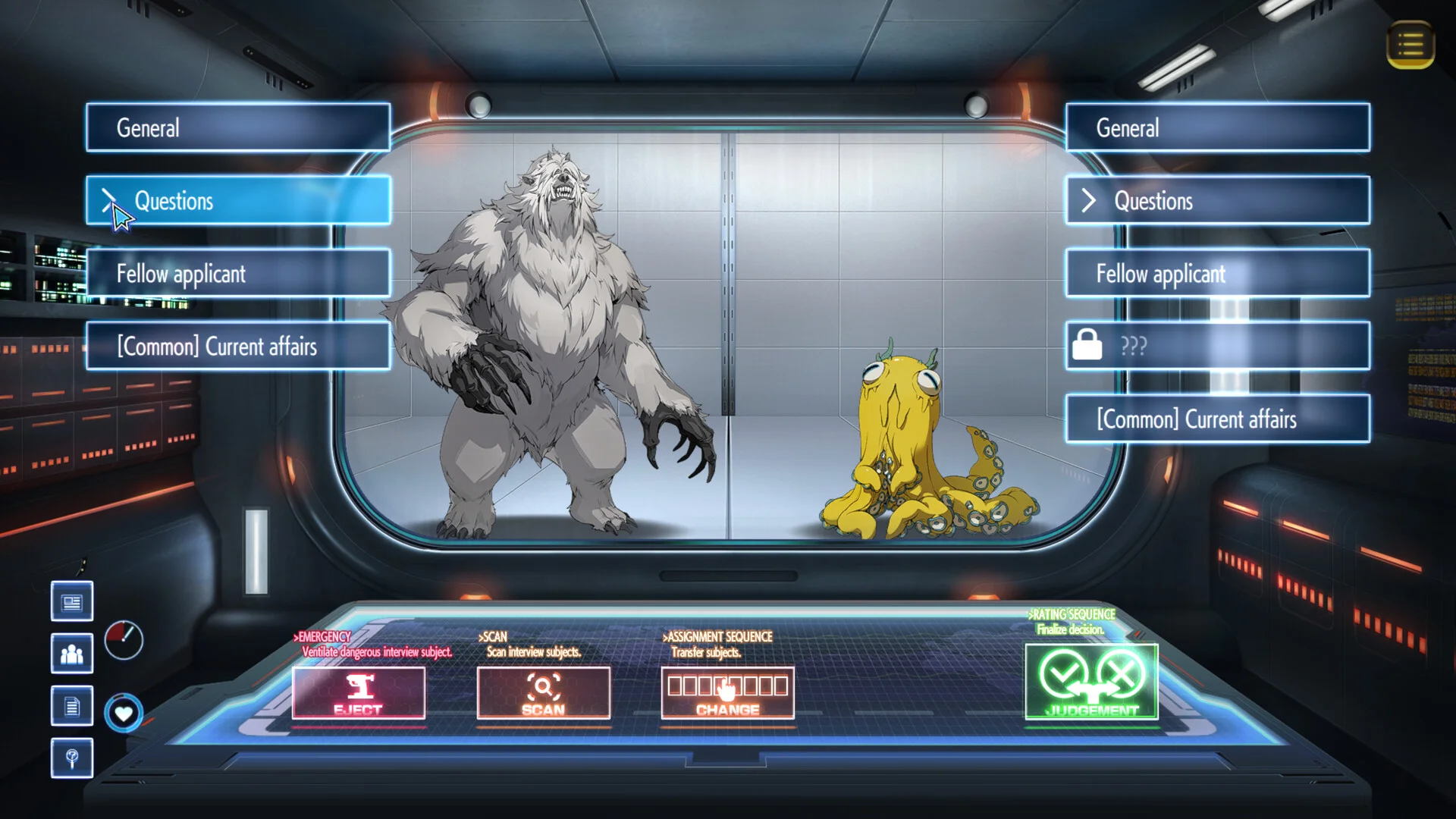
The individual actions remain simple, yet the pressure comes from deciding which ones deserve your remaining time. Compared with many deduction games that bury their mysteries beneath elaborate interfaces, Donutal makes uncertainty itself the resource you are managing.
Its branching structure pushes that idea further. Each day becomes a checkpoint in a flowchart, and returning to an earlier point creates another branch. Poor decisions can lead to early endings, while letting Earth’s Collapse Alarm fall too far can destroy a promising run. Those failures are rarely wasted. A disastrous branch may reveal information you can carry mentally into another attempt, turning failure into part of the investigative process.
This is where Donutal separates itself most clearly from a conventional visual novel. Replaying an earlier checkpoint is not simply a way to watch another ending. You may return because a later encounter taught you something about an alien you questioned hours earlier.
You might test a different pairing in the interrogation room, choose a reckless answer purely to see what happens, or follow a branch long enough to expose information that changes how you read your primary timeline. Knowledge becomes progression, giving repetition a clear purpose even when the process itself begins to show some wear.
Once you already know what a familiar visitor will say, asking the same early questions stops feeling investigative. Later runs can become exercises in skipping known dialogue, selecting the necessary options, and reaching the point where the branch changes. The same trial-and-error philosophy that makes failure interesting can gradually make solved portions of the game feel mechanical.
The finite number of save slots creates another inconvenience. Since each reload can produce another branch, older files may eventually need clearing once their purpose has been exhausted. The flowchart itself is a smart match for the design because it lets you see how different versions of events connect, though the interface can initially feel less intuitive than the underlying system deserves. In a game where organizing information is already part of the challenge, menus should help you think rather than become another puzzle.
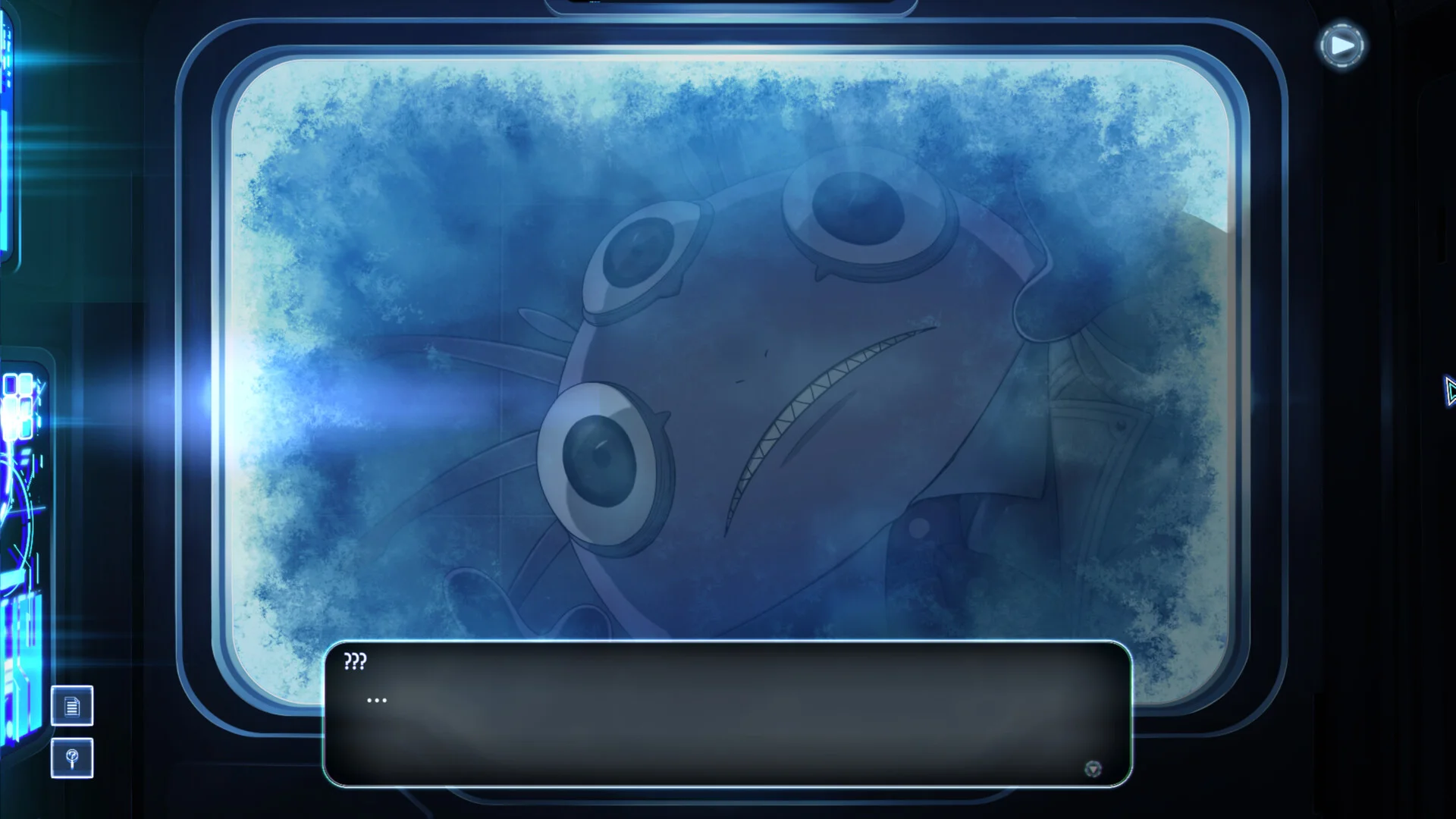
Fortunately, the worldbuilding gives players a reason to keep experimenting. Alien physiology regularly connects to culture, politics, and behavior, so meeting a new species carries mechanical significance alongside visual novelty. Some designs are busier than others, but the range of creatures makes each unfamiliar visitor worth examining. Daily news reports provide another connection between the interrogation room and Earth, showing how admission decisions alter conditions below.
The larger mysteries follow the same philosophy. Donutal gradually builds questions around the protagonist’s missing history, the relationships between alien civilizations, and the consequences of allowing particular visitors onto Earth. The details are best left untouched, but the important point is that these mysteries emerge through the systems the player already uses rather than sitting apart from them in long exposition sequences.
Players familiar with older science fiction may recognize certain ideas sooner than newcomers. Some developments draw on recognizable genre traditions, which can reduce the shock of particular revelations. Recognition does not necessarily undermine the story, though. Much of Donutal’s appeal comes from seeing how familiar science-fiction anxieties have been transformed into decisions you personally have to make.
That same structure will divide players sharply. Someone looking for action, direct progression, or constant mechanical novelty will find a lot of reading and repeated questioning here. A player who enjoys tracing information across multiple timelines will see those same qualities as the reason to keep returning.
The strongest moments arrive when a decision that seemed obvious during one timeline becomes indefensible after something discovered in another. You return to an earlier checkpoint carrying knowledge from a future that technically no longer exists, put the same alien back across the glass, and realize that the interview has changed before either of you has said a word.
The Review
Donutal
Donutal builds a surprisingly rich deduction game from simple tools: questions, alien pairings, scans, and the information carried between branching timelines. Its best idea is making failure useful, since a ruined path can teach you something that changes an earlier decision completely. Repetition eventually dulls solved encounters, and the save structure can create unnecessary friction, yet the central loop remains strong enough to keep curiosity alive across repeated runs.
PROS
- Excellent two-alien interrogation mechanic
- Branching timelines make failure productive
- Strong link between worldbuilding and deduction
- Consequences meaningfully reshape later decisions
CONS
- Repeated questioning can become mechanical
- Save-slot management adds friction
- Some revelations may feel familiar to seasoned sci-fi fans