



















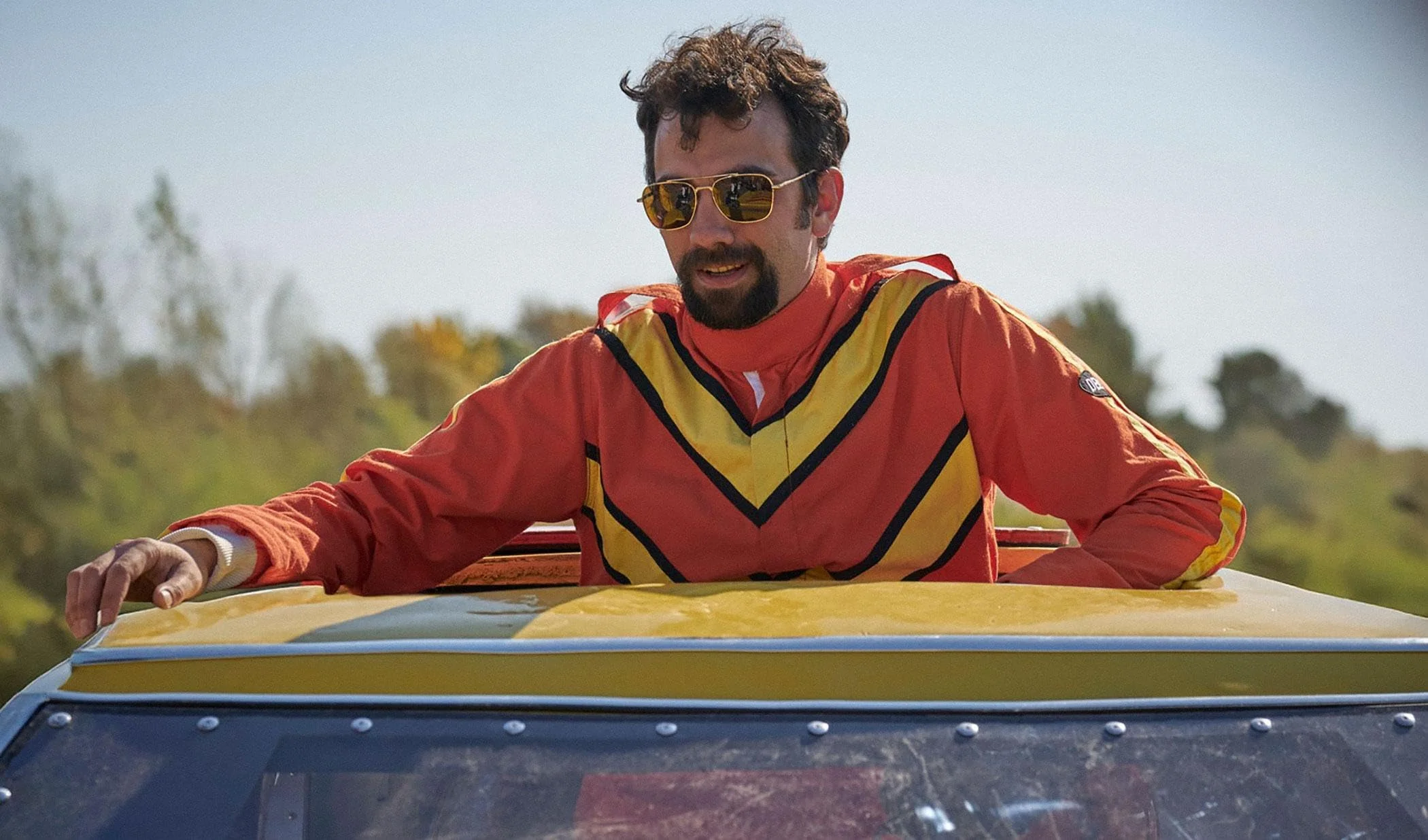

Canada has always had a complicated relationship with American spectacle. It consumes it, imitates it, mocks it, then quietly insists that its own version should count. Ken Carter fits perfectly inside that tension. He wants the scale of Evel Knievel, the crowds, the headlines, the immortality, yet he remains unmistakably rooted in a more provincial kind of showmanship. Michael Dowse understands that contradiction in The Stunt Driver, even if his film sometimes struggles to find a dramatic shape as eccentric as the man it portrays.
Carter’s proposed stunt is gloriously unreasonable. He plans to launch a rocket-powered Lincoln Continental roughly a mile across the St. Lawrence River, traveling from Canada toward the United States at around 280 miles per hour. It is the sort of plan that sounds like satire until the archival footage reminds you that people really built the ramp, tested the car, raised the money, argued about the weather, and spent years treating this as a legitimate engineering problem.
Dowse is adapting territory already occupied by Robert Fortier’s 1981 documentary The Devil at Your Heels, and that relationship matters. Carter was preserved on film while he was still constructing his own legend, which gives this dramatization an unusual problem. Jay Baruchel is not creating a personality from scattered historical fragments. He is standing beside footage of the real man and asking us to accept another version.
The formal solution is clever. Dowse moves between grainier, squarer images representing Fortier’s documentary footage and wider dramatic photography that claims access to the spaces outside the original camera’s reach. Cinematographer Sara Mishara makes the formats feel distinct without turning the shifts into a museum exhibit of old film stocks. The design has an argument behind it. Fortier’s camera records Carter performing Ken Carter.
Dowse’s wider frame tries to locate Kenneth Gordon Polsjek, the frightened man underneath the nickname. That is where Baruchel becomes indispensable. His Carter speaks with the confidence of someone constantly rehearsing his own biography. He boasts, competes, smokes, drinks, insults Knievel, and repeats his need to jump with the strange conviction of a man who has confused public attention with emotional survival.
Early footage of Carter injured after a stunt, still pleading with the crowd not to leave as he is carried away, makes the psychology brutally simple. People watching him is the point. Baruchel does not treat that need as a punchline. The performance is funny because Carter is funny, especially when his Canadian politeness collides with his enormous ego, but the humor keeps rubbing against fear. Dowse uses Carter’s real radio hypnosis session to push directly into that contradiction. The stuntman who markets courage is terrified of burning, drowning, failing, and perhaps worst of all, being dismissed as a coward.
The high-speed test with engineer Dick Keller gives that fear physical form. Keller, played with unusual restraint by Ed Helms, misleads Carter about how fast the rocket car will run. Carter emerges shaken after experiencing the speed he has spent years promising to exceed. Suddenly the distance between fantasy and physics becomes visible on Baruchel’s face.
Keller is also where The Stunt Driver finds its most convincing human relationship. He begins as the practical engineer staring at an absurd commission and slowly becomes someone invested in keeping Carter alive. His attempts to persuade Carter that survival would not amount to failure create an argument the stuntman cannot easily absorb. Carter has built an identity that depends on performing danger, so telling him he does not need to jump sounds almost like telling him he does not need to exist.
That masculine bond feels more fully developed than Carter’s marriage. Laurence Leboeuf brings warmth to Gloria, but the writing appears uncertain about what her position should be from scene to scene. At times she supports the dream. Elsewhere she becomes the necessary voice of anxiety. The shifts can feel dictated by dramatic function rather than by a clearly developed internal life. Carter is surrounded by people, yet the screenplay sometimes treats those people as instruments for measuring his confidence.
Joe Cobden’s Fortier works better because his role is tied directly to the film’s formal idea. Carter sees the documentary camera as another machine for producing fame. Fortier gradually sees the danger of recording a man whose self-image may be pushing him toward catastrophe. Their relationship gives Dowse something the historical footage cannot provide on its own: a dramatized argument about what it means to turn reckless behavior into an image for public consumption.
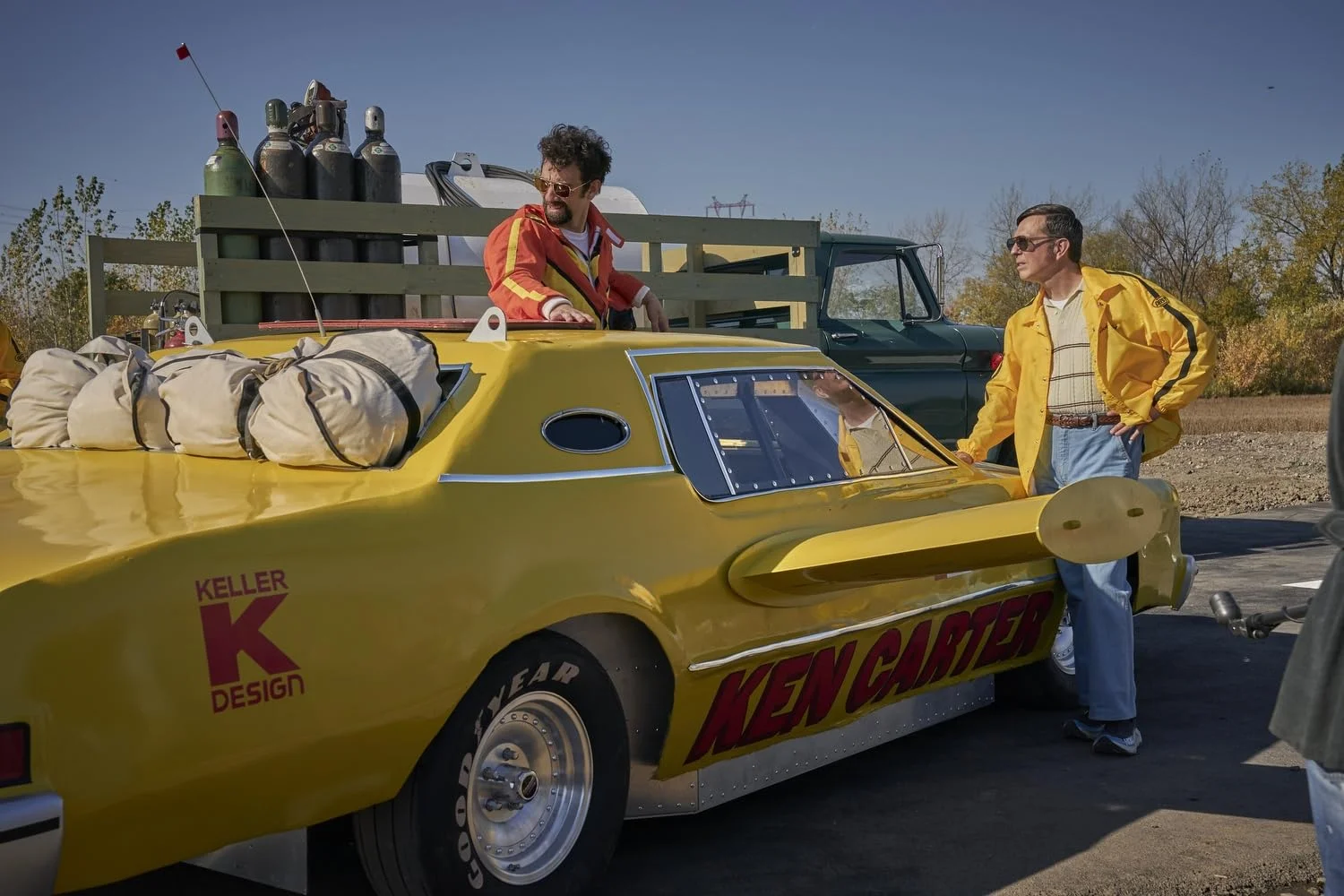
That question becomes especially sharp once Ben Foster enters as Evel Knievel. Foster’s appearances are brief, but they inject an energy the film sometimes lacks elsewhere. Knievel is the American spectacle Carter measures himself against, resents, and needs. Their rivalry carries a national charge that Dowse amplifies through Carter’s anti-American bluster, yet the contrast is more interesting when kept personal. For Carter, beating another stuntman carries a larger need: proof that a Canadian figure can command the same mythology. The irony is that The Stunt Driver itself feels less interested in myth than in delay.
The jump is postponed again and again through money problems, construction failures, weather, technical complications, and Carter’s faltering nerve. That repetition can slow the film, especially when interviews and arguments begin circling the same doubts. The original documentary apparently moved through this absurd logistical chaos with greater comic spring. Dowse wants the waiting to expose Carter psychologically, but stretches of the film seem caught between tragic character study and eccentric comedy.
The instability is frustrating because the production design is so sure of itself. The faded interiors, smoke-heavy rooms, jumpsuits, cars, ramps, and worn textures create a persuasive 1970s Canada that feels culturally specific rather than generically retro. The archival material strengthens that specificity. Cars fail. Fuel tanks explode. Machinery behaves badly. Human beings keep pretending they can negotiate with physics.
Then the project begins slipping away from Carter himself. His backers lose faith. Danny Lafortune is positioned as a possible replacement. The stunt that Carter designed as the final proof of his identity becomes something another man can perform.
That may be the film’s cruelest insight. Carter believes immortality lives at the end of the ramp, somewhere between Canada and America, waiting for him to cross into it. Dowse’s best scenes suggest the opposite. Carter becomes most legible during the years when nothing happens, when the ramp is unfinished, the money is disappearing, the engineer is worried, the documentary camera keeps rolling, and the man who built himself around one impossible act has to consider the possibility that he may never perform it.
The Stunt Driver premieres at the Toronto International Film Festival in September 2026 before expanding to theaters. The biographical comedy-drama chronicles the exploits of daredevil stuntman Ken Carter and his ambition to launch a rocket car across the St. Lawrence River.
Where to Watch The Stunt Driver (2026) Online
Full Credits
Title: The Stunt Driver
Distributor: Mongrel Media, Independent Film Company
Release date: September 2026 (Toronto International Film Festival) / September 25, 2026
Rating: Not Rated
Running time: 1 hour 39 minutes (99 minutes)
Director: Michael Dowse
Writers: Michael Dowse
Producers and Executive Producers: Not publicly specified
Cast: Jay Baruchel, Ed Helms, Ben Foster, Laurence Leboeuf, Dan Bakkedahl
The Review
The Stunt Driver
The Stunt Driver works best when it stops chasing the spectacle of Ken Carter’s impossible jump and studies the Canadian mythology surrounding the man who dreamed it up. Jay Baruchel gives Carter swagger, fear, and bruised vanity, while Michael Dowse’s shifting film formats intelligently question where documentary truth ends and self-invention begins. Uneven pacing, tonal hesitation, and thin supporting characterization keep the film from matching its formal ambition, but Carter remains fascinating enough to carry the ride.
PROS
- Jay Baruchel’s layered performance
- Strong documentary-fiction interplay
- Convincing 1970s Canadian atmosphere
- Effective Carter-Keller relationship
CONS
- Uneven comedy-drama balance
- Repetitive stretches around the delayed stunt
- Gloria is inconsistently written
- Supporting characters sometimes serve Carter’s arc too mechanically