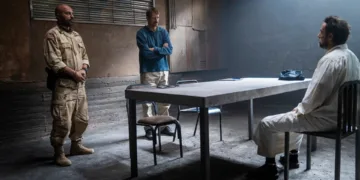




























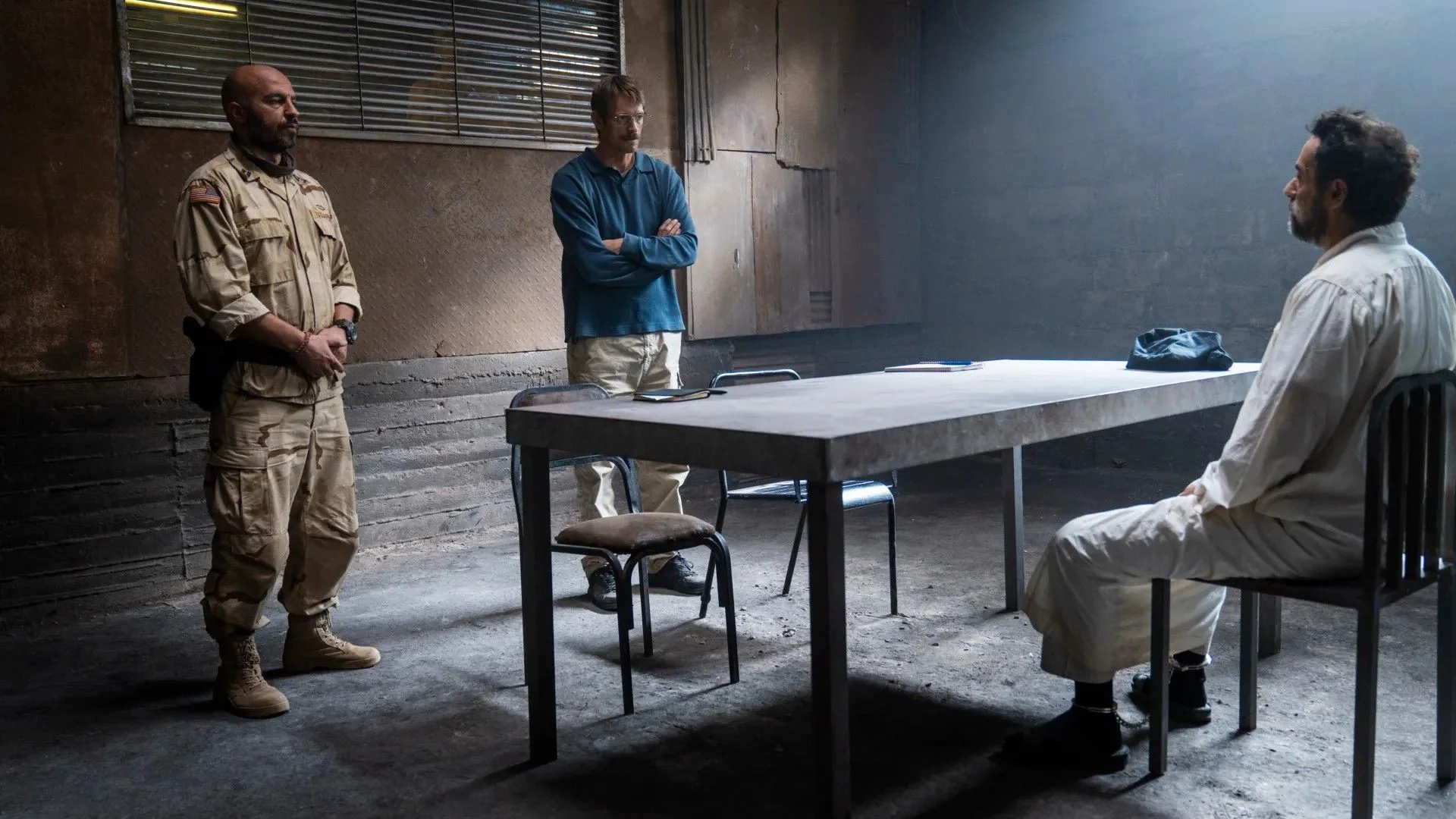

The first three episodes spend so much time trying to turn John Nixon into an action protagonist that the series nearly misses the drama sitting directly in front of it. Saddam Hussein is captured midway through Episode 3, and once Joel Kinnaman’s CIA analyst sits across from Waleed Zuaiter’s deposed dictator, High Value Target: The Hunt for Saddam suddenly discovers what kind of television it should have been making all along.
Before that point, the eight-part series has plenty to work with. Nixon is introduced as the CIA’s resident Saddam specialist, an analyst fascinated by Iraqi history while many of the people around him seem interested in shorter answers.
The United States invades Iraq in 2003, the hunt for Saddam accelerates, and Nixon leaves his desk for a war zone where his expertise acquires immediate practical value. These are enormous stakes, yet the early episodes struggle to convert them into sustained tension. Search operations happen. Gunfire happens. People rush through rooms looking terribly urgent. The drama itself remains oddly calm.
Part of the problem is that the series keeps trying to enlarge Nixon’s role. The historical Nixon was the first American to interrogate Saddam after his capture and helped establish his identity. Here, the story increasingly treats him as the decisive figure in locating Saddam, participating in the operation that finds him and receiving repeated recognition as the man responsible for the capture. It gives the miniseries a cleaner protagonist, but cleanliness is exactly what this material resists.
When the Interrogations Begin The structure improves immediately when Nixon and Saddam finally share a room. Their conversations contain the tension that the field sequences keep chasing because each man enters with a different understanding of what the war means.
Nixon arrives carrying assumptions about weapons of mass destruction and Saddam’s political intentions. Saddam, in Zuaiter’s hands, understands quickly that information is power and that his interrogator’s confidence can be attacked as efficiently as any military position. When Nixon presses him about Iraq’s supposed WMD stockpiles, Saddam tells him they exist in the American president’s mind. The line works because the series has spent hours establishing the certainty surrounding the invasion. Suddenly that certainty has someone sitting across the table questioning it.
Zuaiter gives these scenes their necessary weight. His Saddam can be arrogant, calculating and unexpectedly conversational, occasionally slipping into a version of himself that unsettles Nixon precisely because it does not fit the uncomplicated monster he expected to meet. Kinnaman responds well to that pressure. His performance makes Nixon’s changing perspective feel gradual even when the script occasionally jumps ahead and explains what he has learned.
The series is strongest when it allows that uncertainty to remain uncomfortable. It becomes shakier when complexity starts drifting toward softness. Saddam is shown gardening, discussing writing and presenting himself as a misunderstood statesman betrayed by a country he once considered friendly. Humanizing a historical figure is not the same thing as excusing him, and the series clearly understands that distinction. It simply does not always control how close the two ideas appear on screen.
Samir, Nixon’s translator, provides the necessary correction. After accusing Nixon of allowing Saddam to manipulate him, Samir takes him to a mass grave in South Baghdad and reveals that his father, uncle and two brothers lie among the dead. The scene succeeds partly because it does less than many of the series’ political speeches. There is no elaborate history lesson. A physical location and one man’s family history are sufficient.
That scene clarifies the political argument better than several later monologues. Nixon may be discovering the failures and assumptions behind the American invasion, but those discoveries cannot erase what Saddam’s government inflicted on Iraqis. The series can hold both ideas at once. Its problem is trusting itself to do so. Whenever High Value Target begins worrying that the viewer might miss its point, somebody tends to explain it.
Characters spell out parallels, narration directs interpretation, and one exchange draws a conspicuous connection between Saddam’s relationship with his father and George W. Bush’s own family history. By the finale, Nixon is placed opposite dramatized members of the Bush administration so the series can deliver its argument about the invasion almost directly to camera. The ideas are sharper than the storytelling used to express them. History Bent Around Nixon
This is where the adaptation’s largest structural problem becomes difficult to ignore. A series concerned with institutional failure keeps simplifying institutions until Nixon appears to be the one person who understood anything. That approach may create a recognizable television hero, but it weakens the argument surrounding him. If the failure of Iraq policy came from competing assumptions, bureaucracies, intelligence shortcomings and poor planning, then reducing the American side to Nixon and a collection of less perceptive colleagues shrinks the problem. The series is criticizing historical simplification while practicing a television-friendly version of it.
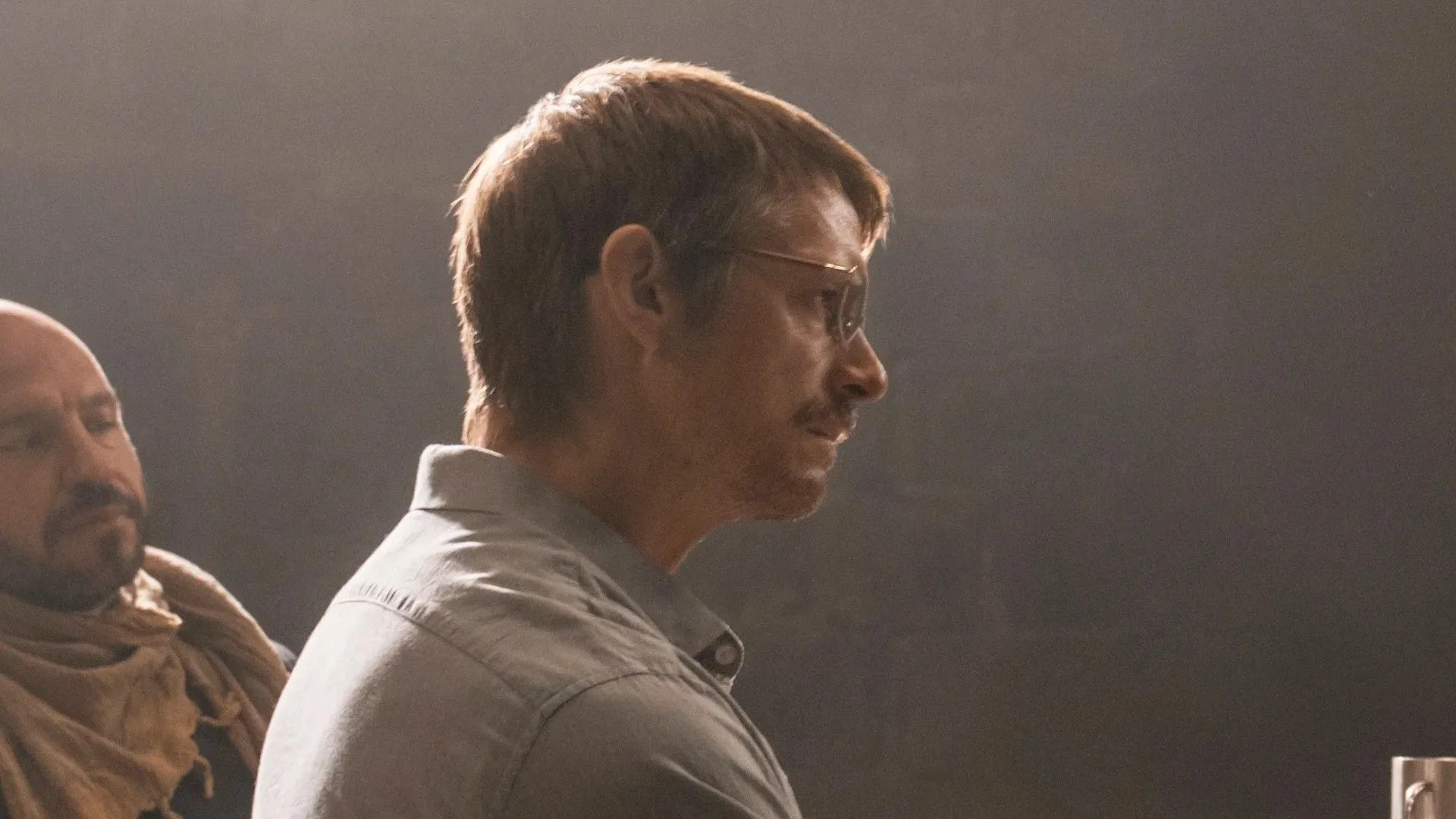
The supporting characters suffer first. Polly and Jerry circle Nixon without acquiring enough definition of their own. Samir becomes vivid when his family history confronts Nixon’s changing view of Saddam, yet much of his function still depends on moving Nixon toward the next stage of understanding.
Nixon’s father Charles, played by Tom Berenger, and his wife Rebecca are treated similarly: useful pressures on the protagonist rather than fully developed relationships. Berenger occasionally breaks through the limitation, especially when Charles discusses his own military experiences with Rebecca. It is a reminder that these characters did not require larger subplots. They required sharper ones.
The same principle applies to Leslie Greif’s direction. The interrogation sequences work because the conflict already exists between two faces and two versions of history. The action scenes have less personality. Their staging provides movement without much escalation, which makes a supposedly high-stakes manhunt feel routine in places where routine should be impossible.
Greif has a better idea with the extensive use of real news and documentary footage. George W. Bush appears through archival broadcasts, including rhetoric surrounding Iraq and weapons of mass destruction, placing the fictionalized story beside the public record that shaped it.
That makes the finale’s recreation of Bush particularly awkward. After repeatedly grounding the series with footage of the actual president, substituting an actor during a major dramatic scene breaks the visual contract the production has spent seven episodes establishing. The historical record has been sitting in the room the whole time. Suddenly television arrives wearing its suit.
A late scene captures the series’ contradiction cleanly. Charles watches Bush’s “Mission Accomplished” speech and treats the invasion as retaliation for the World Trade Center. Nixon corrects him. The moment is broad, but its purpose is precise: it exposes the simplified story linking Saddam Hussein to 9/11, even as High Value Target keeps discovering how difficult it is to resist simplification when history has to fit inside a television protagonist.
High Value Target: The Hunt for Saddam premieres on TNT on September 13, 2026. The political thriller limited series follows CIA analyst John Nixon as he conducts the first interrogation of Saddam Hussein following his capture in December 2003.
Full Credits
Title: High Value Target: The Hunt for Saddam
Distributor: TNT
Release date: September 13, 2026
Rating: TV-MA
Running time: 45–60 minutes per episode
Director: Leslie Greif, Krzysztof Skonieczny
Writers: Leslie Greif, Graham Sack, Daniel Stiepleman, Jonathan Wakeham
Producers and Executive Producers: Alexander Rodnyansky, Jason Sarlanis, Sam Linsky, Stuart Manashil, Michael Kupisk, Tamer Mortada, Joel Kinnaman, Leslie Greif, John Nixon
Cast: Joel Kinnaman, Waleed Zuaiter, Lena Góra, Rebecca Night, Tom Berenger, Christopher McDonald, Dar Salim, Paul Ryan
Director of Photography (Cinematographer): Xavier Dolléans
The Review
High Value Target: The Hunt for Saddam
High Value Target: The Hunt for Saddam is at its best when John Nixon and Saddam Hussein are left in a room to challenge each other’s understanding of history. Joel Kinnaman and Waleed Zuaiter give those exchanges tension the surrounding manhunt rarely matches. The series has sharp ideas about American intelligence failures, the Iraq invasion, and the danger of simplified historical narratives, but its own dramatization repeatedly bends complexity around Nixon and explains arguments that stronger scenes already made clear.
PROS
- Excellent Nixon-Saddam interrogation scenes
- Strong performances from Kinnaman and Zuaiter
- Thoughtful examination of the Iraq invasion
- Effective use of archival footage
CONS
- Early episodes lack sustained tension
- Nixon’s historical role feels heavily enlarged
- Secondary characters remain thin
- Political arguments are frequently overexplained