










A dead father can leave behind property, debts, photographs, a business. He can also leave three children with incompatible versions of the same childhood. That is the inheritance Joshua Giuliano gives the siblings in River, and for a while the film’s violence seems almost secondary to the argument already taking place on the boat.
I initially thought this was simply the familiar horror equation of grief plus isolation plus one very large man with poor social skills. The setup encourages that reading. Lucy, Carla, and Drew reunite after their father’s death and take his ashes onto the river he loved. Their boat fails near a derelict bridge. Phones and radio become useless. Someone enormous is watching from shore. We have all been here before, cinematically speaking, though preferably not in life. Then Carla starts talking about their father.
Jessica Rothe plays her as the sibling who escaped and has no interest in helping the dead man clean up his reputation. Lucy, played by Jane Levy, stayed behind, inherited responsibility for his business, and still carries enough affection to offer him something resembling a conventional farewell.
Drew, the younger brother played by Max Mattern, occupies the less stable ground between them. Their father once threw him into a lake as a swimming lesson and nearly drowned him, a story that converts what might have been an ordinary childhood anecdote into something much uglier. The film’s smartest early idea is that grief does not unite this family. It produces a dispute over memory.
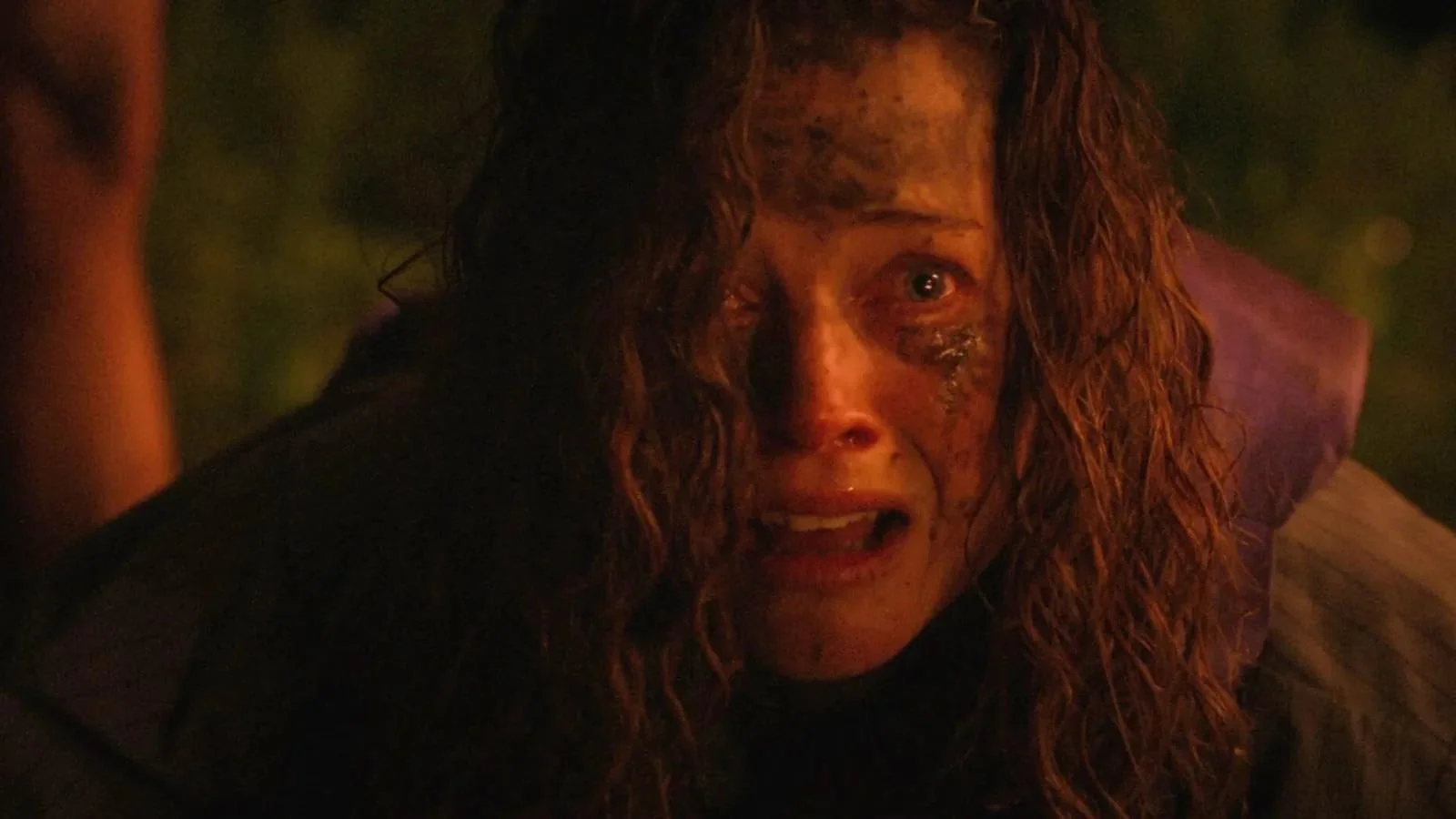
Call it memory custody. Carla remembers an abusive drunk who mistreated their mother. Lucy remembers someone whose failings apparently coexist with love. Drew remembers fear, affection, embarrassment, and his father’s enthusiasm for The Perfect Storm, which he recounts through the actors’ names rather than the characters.
None of these accounts cancels the others. The father becomes less a man than contested territory, which makes the later geography of the film feel strangely appropriate. First they are trapped inside different histories. Then they are trapped on the same patch of water.
Giuliano does not push this family conflict as far as he could. Carla’s anger has shape because the script gives it history. Lucy’s position is murkier. Her loyalty, resentment, duty, and grief are present, yet the film rarely forces them into the same conversation. Some dialogue is blunt enough to sound like structural labeling, especially the early use of “sis” and “bro.” A family this damaged should not need name tags.
The performances cover much of that thinness. Levy gives Lucy toughness without turning her into a genre machine built solely for survival. Rothe makes Carla’s bitterness feel earned rather than performative. Mattern has the harder tonal job, since Drew supplies awkward humor while remaining the sibling most visibly frightened by what is happening. His gentleness matters later because courage means something different when it comes from someone already scared.
Their bond also gives the slasher mechanics an unusual moral clarity. These people argue, resent, accuse, and remember badly, but none of them begins calculating which sibling would make the most useful sacrifice. Survival does not erase the family dispute. It exposes the part underneath it that argument has not destroyed. Giuliano is even stronger when he lets sound carry the horror.
The opening attack is constructed largely through absence. We hear a couple before we properly see what happens to them. The camera studies the car, beer, woods, and eventually the remains of violence while screams and impact occupy the space the image refuses to provide. The method returns later, and it works because River is perfectly willing to show brutality elsewhere. Decapitations, burns, severe wounds, bodies transformed into evidence: this is not a shy film. That makes the restraint matter.
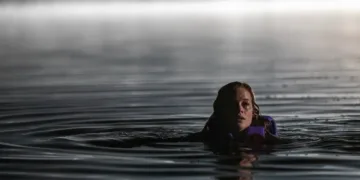
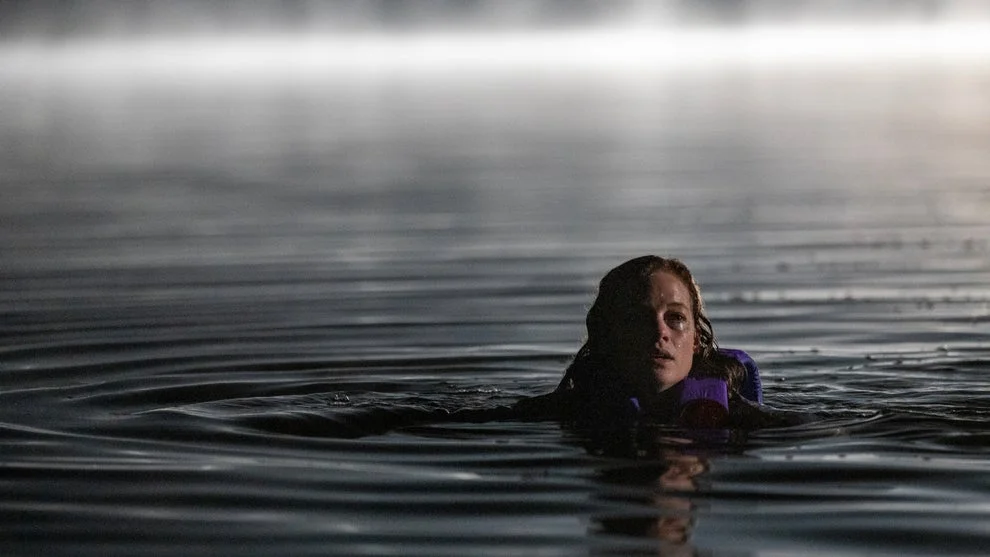
The unseen violence recruits imagination, but the stronger effect is spatial. Screams travel across rock, trees, and water without giving the characters, or us, a stable sense of where danger is located. The landscape stops behaving like scenery. It becomes an acoustic trap.
This is where River briefly finds its own identity inside familiar slasher grammar. Dane DiLiegro’s killer first appears on the shoreline as a huge, almost static figure. At 6-foot-8, he barely needs choreography. Standing there is sufficient. Once he begins moving through the water, though, the film discovers a much better problem than “how do we escape the killer?” The problem becomes “how do we escape someone who seems native to the exact environment trapping us?”
That distinction is small and extremely important. The boat cannot move. The siblings cannot call for help. The shore is unsafe. The river, which should represent movement, has become a containment system. Giuliano takes a familiar horror location and temporarily reverses its meaning.
A blood-covered woman stumbling into view pushes that idea into something uglier. She does not need a speech explaining the killers. Her body already describes the probable future. Then River retreats from its own best concept.
Once the story moves onto land, the environmental specificity weakens and the film resembles a far more conventional stalk-and-survive picture. The second masked killer expands the threat, the violence intensifies, and the action remains effective, but the earlier relationship between predator and terrain had suggested a stranger film. The river was becoming an idea. The woods are mostly a place to run.
I am tempted to call that a failure of nerve, though that would be unfair. Giuliano is plainly interested in classical slasher construction, and the second half delivers it with confidence. The issue is that his first half accidentally sets a higher standard for him.
Cinematographer Nick Matthews helps create that problem by making the location so persuasive. The wide framing allows greenery, water, shoreline, and bodies to occupy the same visual world, often with a disturbing calm. Blood does not transform the landscape into something gothic. It remains beautiful. That refusal matters. Evil has not entered this place and corrupted it. Evil was already standing there while the light looked lovely.
The sparse score leaves room for that unease, and the film understands the value of alternating quiet with explicit damage. A picture this violent could easily numb itself. Instead, Giuliano keeps changing the sensory register, withholding one attack, exposing another, letting silence prepare the next. The post-credits tease suggests somebody sees franchise potential here. Fine. Horror has built larger dynasties from thinner material.
What interests me is the contradiction Giuliano leaves behind. River is a traditional slasher made by a director whose most effective choices are the ones that momentarily escape tradition. The family remembers one dead man in incompatible ways. The film, curiously, has the same problem with itself: one version wants the comfort of familiar genre machinery, while another keeps staring across the water toward something much stranger.
River had its world premiere in the Midnight Madness section at the Toronto International Film Festival on September 10, 2026. The survival slasher film follows three estranged siblings who reunite to scatter their late father’s ashes on a remote river, only to find themselves stranded on a broken-down boat and hunted by a relentless killer.
Where to Watch River (2026) Online
Full Credits
Title: River
Distributor: Independent Film Company, Shudder
Release date: September 10, 2026 (Toronto International Film Festival)
Running time: 1 hour 32 minutes (92 minutes)
Director: Joshua Giuliano
Writers: Joshua Giuliano
Producers and Executive Producers: Steven Schneider, Nick Antosca, Alex Hedlund
Cast: Jane Levy, Jessica Rothe, Max Mattern, Dane DiLiegro
Director of Photography (Cinematographer): Nick Matthews
Editors: Thom Newell
Composer: Mondo Boys
The Review
River
River works best when Joshua Giuliano lets the river itself become hostile territory, using sound, distance, and the siblings’ fractured memories to give familiar slasher machinery unexpected tension. Jane Levy, Jessica Rothe, and Max Mattern make the family conflict worth caring about, while Dane DiLiegro supplies imposing physical menace. The film loses some of its identity once the chase reaches land, where invention gives way to convention. Still, this is a confident debut whose strongest ideas suggest Giuliano may be scarier when he ignores the genre rulebook.
PROS
- Excellent use of sound and off-screen violence
- Strong sibling chemistry and conflicting memories
- River setting becomes part of the threat
- Confident performances across the central cast
- Striking contrast between natural beauty and brutality
CONS
- Second half becomes considerably more conventional
- Lucy’s relationship with her father needs deeper development
- Some early dialogue is overly functional