



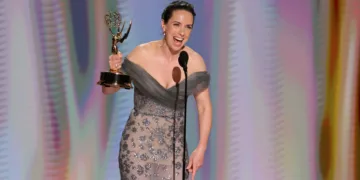



























The most unsettling idea in The Housewife is hidden inside a perfectly ordinary Queens kitchen. Hermine Ryan bakes oatmeal-raisin cookies, tends to a sick neighbor, serves dinner to her husband, and prepares carefully for American citizenship. Naomi Watts plays each ritual with such composure that domestic competence begins to look like camouflage. The horror does not arrive from some sudden transformation. It has already been sitting at the table.
Ben Shirinian’s film, set in 1964 and inspired by the story of Hermine Braunsteiner Ryan, initially understands the power of that contradiction. Austrian-born Hermine has fashioned herself into a model American homemaker, complete with pearls, spotless rooms, church functions, and an apparently unremarkable marriage to construction worker Russell Ryan (Luke Evans). Her belief that America allows people to become whoever they want acquires an ugly second meaning once New York Times reporter Joseph Lelyveld (Tye Sheridan) arrives at her door following a lead from Nazi hunter Simon Wiesenthal.
The film first encourages Joseph to suspect Russell. Evans is kept at a distance, often treated as an ominous presence inside the house, while Hermine welcomes the reporter with maternal attentiveness. She even insists on repairing a loose button on his jacket. Joseph begins worrying about what his investigation might do to this gracious woman if her husband proves to be the Nazi he has been sent to find. Then Russell speaks, and the assumption collapses. Hermine is the person Joseph should have been investigating, a former concentration-camp guard who has built a new identity in New York.
The revelation works because it corrupts nearly every domestic gesture that preceded it. The cookies, sewing, carefully arranged dinners, and neighborly kindness do not disappear once her past becomes known. They remain part of the same woman. That is the difficult idea the film briefly places before its audience: ordinary social behavior does not cancel atrocity, and familiarity can become an alarmingly effective shield against moral recognition.
Watts understands this better than the screenplay does. Her performance is constructed through control. Hermine smooths sheets, dusts surfaces, portions food, arranges herself, and keeps her environment ordered with the concentration of someone maintaining a border. Even costume becomes part of the defense.
Anette Cseri dresses her largely in restrained blues, grays, and blacks, then sends her out in a striking red dress after she becomes an American citizen. Reinvention becomes visible without requiring a speech. Later, the fluffy white hat and cardigan she wears in court echo an archival photograph of the real Braunsteiner shielding herself from cameras, allowing historical record and performance to occupy the same image.
Such moments are strongest because they trust objects and behavior. Shirinian repeatedly loses that trust. The film’s opening kettle practically announces that pressure will boil. Later, an ashen Austrian landscape hanging in the Ryan home carries its symbolism with little disguise. After Joseph publishes his exposé, sunlight catches him outside the newsroom in a heroic pose so emphatic that the image seems to congratulate him before the audience has finished processing what has happened. The visual insistence matches Alyssa Hill’s screenplay, which gradually begins explaining emotional and ethical stakes that were already clear.
That becomes especially damaging after Hermine’s identity is revealed. The first part of the film derives tension from Joseph misunderstanding the person in front of him. He feels protective toward Hermine before discovering what she has done, which should make the truth psychologically destabilizing. Instead, the story quickly converts that disturbance into publication, government resistance, immigration questions, and extradition hearings.
Joseph’s conflict is reinforced from several directions. He is Jewish, the son of a rabbi, professionally obligated to pursue the truth, personally drawn to Hermine, and increasingly aware that exposing her may hurt innocent people around her. Any one of those pressures could have been developed through behavior. Together, they often feel like instructions telling the audience why the investigation matters.
Sheridan sells Joseph’s uncertainty in the quieter encounters with Hermine, especially when his instinct to protect her interferes with his work, but the larger displays of moral anguish push him toward melodrama. The strange intimacy between Joseph and Hermine, sometimes maternal and briefly tinged with something harder to classify, never gains the psychological precision Watts gives Hermine’s private rituals.
The shift exposes how much stronger the film is inside the Ryan household than inside its later procedural machinery. The quiet dread of a journalist sitting across from a woman who has successfully rewritten herself gives way to arguments, hearings, crying, shouting, and institutional obstruction. A story about the difficulty of recognizing evil begins behaving as though evil must be continually pointed at.
Lena Olin’s brief appearance as survivor Rachel Berger restores some of the discipline the film has lost. Rachel does not need recreated camp imagery to make Hermine’s past present. Her testimony carries its own force. Shirinian’s decision to avoid flashbacks to Hermine’s crimes keeps the emphasis on the obscenity of the present: a woman accused of helping murder hundreds can live for years among church friends and neighbors, baking cookies and seeking citizenship while survivors of the same system inhabit the same postwar world.
That proximity is the film’s sharpest cultural observation. America appears here as both refuge and mechanism of reinvention, a nation selling the promise that identity can be remade while discovering the moral danger contained inside that promise. Hermine uses domestic respectability as social evidence. Her house, marriage, church life, clothing, and citizenship application tell everyone around her what kind of person she must be. The investigation reveals how easily respectability can be mistaken for innocence.
A small Nazi medal hidden among ordinary household possessions expresses that idea with greater clarity than most of the film’s speeches. Hermine has not escaped her past, and she has not discarded it. She has stored it inside the life that conceals her.
The Housewife keeps approaching a harsher, stranger film about that contradiction, then retreating into conventional historical drama. Watts never makes the same retreat. She lets menace seep through a button being sewn, a meal being served, a room being kept immaculate. The film keeps reaching for louder proof when its most disturbing evidence has been sitting quietly in the cupboard all along.
The Housewife had its world premiere at the Toronto International Film Festival on September 10, 2026. The historical drama follows a young journalist who tracks down a former Nazi officer living quietly in Queens, New York, but finds his investigation complicated after befriending the suspect’s charming wife.
Where to Watch The Housewife (2026) Online
Full Credits
Title: The Housewife
Distributor: Neon
Release date: September 10, 2026 (Toronto International Film Festival)
Running time: 1 hour 42 minutes (102 minutes)
Director: Ben Shirinian
Writers: Alyssa Hill
Producers and Executive Producers: Robbie Brenner, Lee Broda, Jason De Beer, Kevin McKeon, Jonathan E. Lim, Matt Paul
Cast: Naomi Watts, Tye Sheridan, Michael Imperioli, Luke Evans, Lena Olin, Debi Mazar, Hannah Marks
Director of Photography (Cinematographer): Michael Merriman
The Review
The Housewife
The Housewife finds its sharpest idea in Hermine Ryan’s spotless domestic life, where respectability becomes camouflage for atrocity. Naomi Watts gives that contradiction frightening precision, especially when ordinary gestures carry what the screenplay later insists on explaining aloud. Ben Shirinian’s film loses force once domestic unease gives way to familiar procedural drama, yet its strongest images retain their sting: America offers reinvention, and Hermine discovers how easily a convincing social identity can masquerade as innocence.
PROS
- Naomi Watts’ tightly controlled performance
- Domestic ritual used as moral camouflage
- Strong period costume work
- Lena Olin’s restrained testimony
- Effective avoidance of camp flashbacks
CONS
- Heavy-handed visual symbolism
- Joseph’s conflict is overexplained
- Tye Sheridan struggles with the larger dramatic beats
- Later procedural material feels conventional
- Melodrama weakens the film’s early unease