































Turning the hero into a bee still sounds like the kind of idea that could only have escaped from an early-’90s home computer game. That peculiarity remains one of Apidya’ Special’s greatest assets. Ikuro takes insect form after the Black Mage Hezaae poisons Yuri, then flies through meadows, waterways, sewers, and mechanical spaces in search of the means to save her. The anime-styled opening gives the rescue mission some shape, yet the plot quickly steps aside once the shooting begins.
Team Apidya has rebuilt Kaiko’s 1992 Amiga release with people connected to the original production and a longtime fan, and its approach resembles preservation through reconstruction. The widescreen presentation, redrawn pixel art, remixed audio, accessibility settings, and cooperative play belong to the remake. The enemy layouts, difficulty philosophy, strange biological imagery, and Gradius-inspired progression still feel rooted in the game that existed three decades ago. That continuity matters because Apidya was always stranger than its mechanics suggested.
Flowers, Firepower, and Pattern Memory
The basic rhythm will immediately make sense to anyone familiar with horizontal shooters from the period. Ikuro moves across scrolling stages, destroys incoming creatures, dodges scenery, and collects flowers that advance a power-up bar. The resemblance to Gradius is unmistakable, particularly in the decision to spend an upgrade immediately or keep collecting until a later option becomes available.
Those choices include Speed Up, Bomb, Spread, Laser, Pulsar, Drone, and Shield. SP Down can reduce movement speed when precision becomes preferable to raw mobility. Saving for stronger firepower is tempting, yet narrow passages or crowded enemy formations can make a shield or speed adjustment far more useful. The system is simple enough to understand during the first stage and demanding enough to punish careless selections later.
The original design philosophy survives too. Enemies often appear along predetermined routes, so reaction eventually becomes memorization. Ground-level creatures are especially troublesome because lining up a shot can place Ikuro dangerously close to scenery. Certain boss hitboxes demand similar familiarity, while puzzle-like hazards can kill a run almost immediately.
This could have turned Apidya’ Special into a museum piece intended primarily for players already comfortable with Amiga-era difficulty. Instead, the remake offers four difficulty settings, adjustable lives and continues, configurable extra-life frequency, checkpoint reloads, the ability to retain upgrades after death, and an option that prevents death from restarting the stage. Analog dead zones and D-pad sensitivity can also be tuned. None of these changes rewrites the underlying stages. They let players decide how much of 1992 they want to endure.
From Meadows to Rat Corpses
Its five worlds remain the clearest reason to choose Apidya over another traditional side-scrolling shooter. Meadow and Pond lean into the miniature scale of Ikuro’s transformation, filling the screen with vegetation, insects, water, and creatures that would barely register as threats in another game. Here they become an entire ecology of hazards.
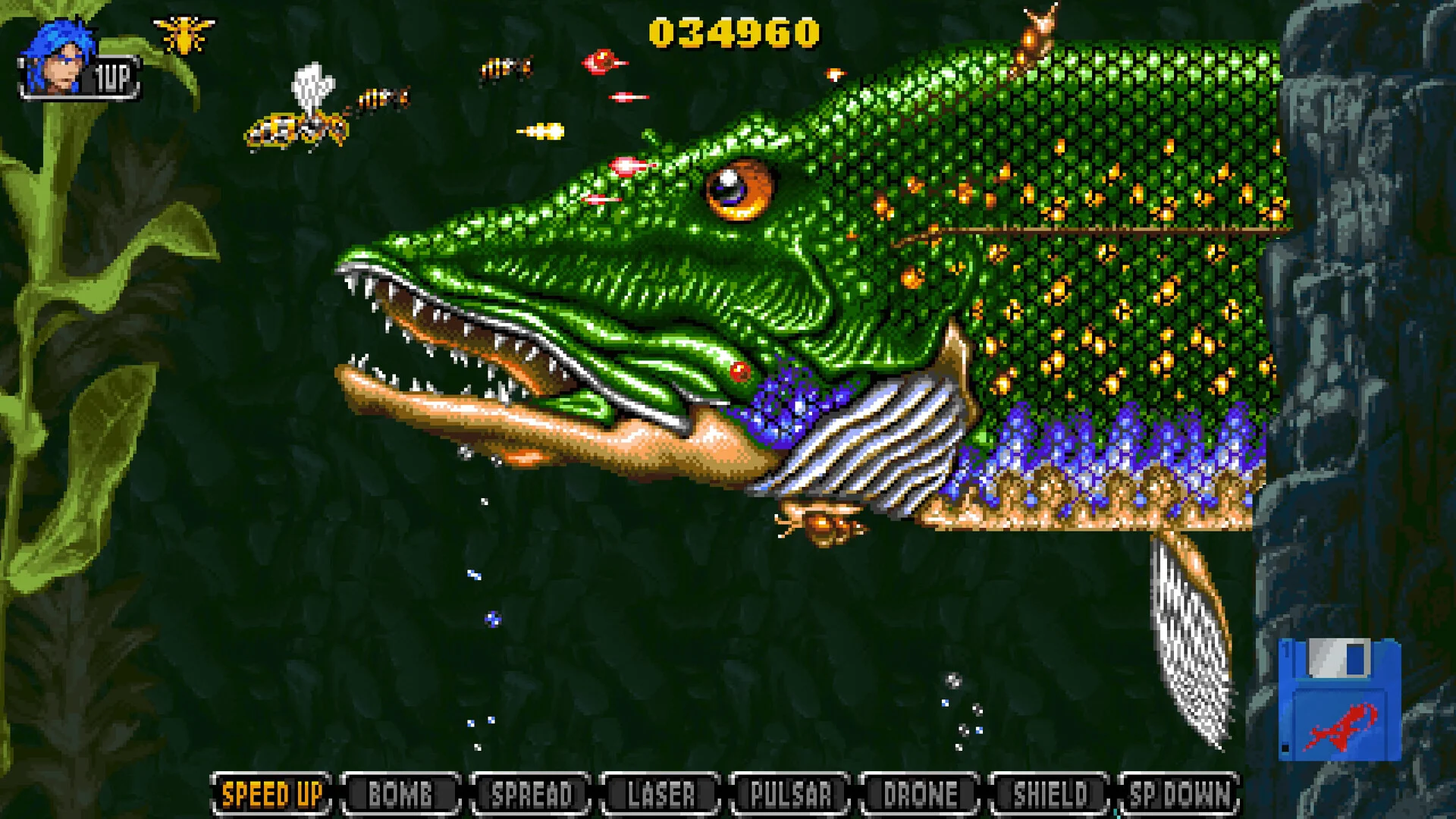
The escalation gets wonderfully ridiculous. A praying mantis feels almost conventional beside worms bursting from a dead rat. Cigarette smoke becomes something to dodge. Poison can flip the screen and invert the controls. A later mechanical sequence asks Ikuro to fly between the legs of a towering machine, carrying some of the playful genre mockery associated with Parodius.
This is also where Apidya’ Special distinguishes itself from modern bullet-hell shooters. Threat comes less from filling every empty pixel with projectiles and more from enemy placement, environmental traps, unexpected entrances, and learning the stage itself. Around 20 bosses and several hidden stages keep pushing that philosophy through the campaign.
The comparison becomes less flattering once the game reaches its Cyber material. Stage 4 can look busy enough to interfere with readability, and Stage 5’s tunnel-based boss rush feels plain beside the biological grotesquerie that preceded it. Even the final giant wasp struggles to match the absurdity of fighting around a decomposing rat. For a game about an insect warrior, normality is strangely disappointing.
Two Eras at One Button Press
The remake’s preservation work is easiest to appreciate by switching between versions during play. Its enhanced mode expands the game into 16:9, redraws the sprites in detailed 24-bit pixel art, and adds parallax to the environments. Switching back to the original-style 4:3 presentation reveals how carefully the new artwork follows the old compositions rather than replacing them with a different aesthetic.
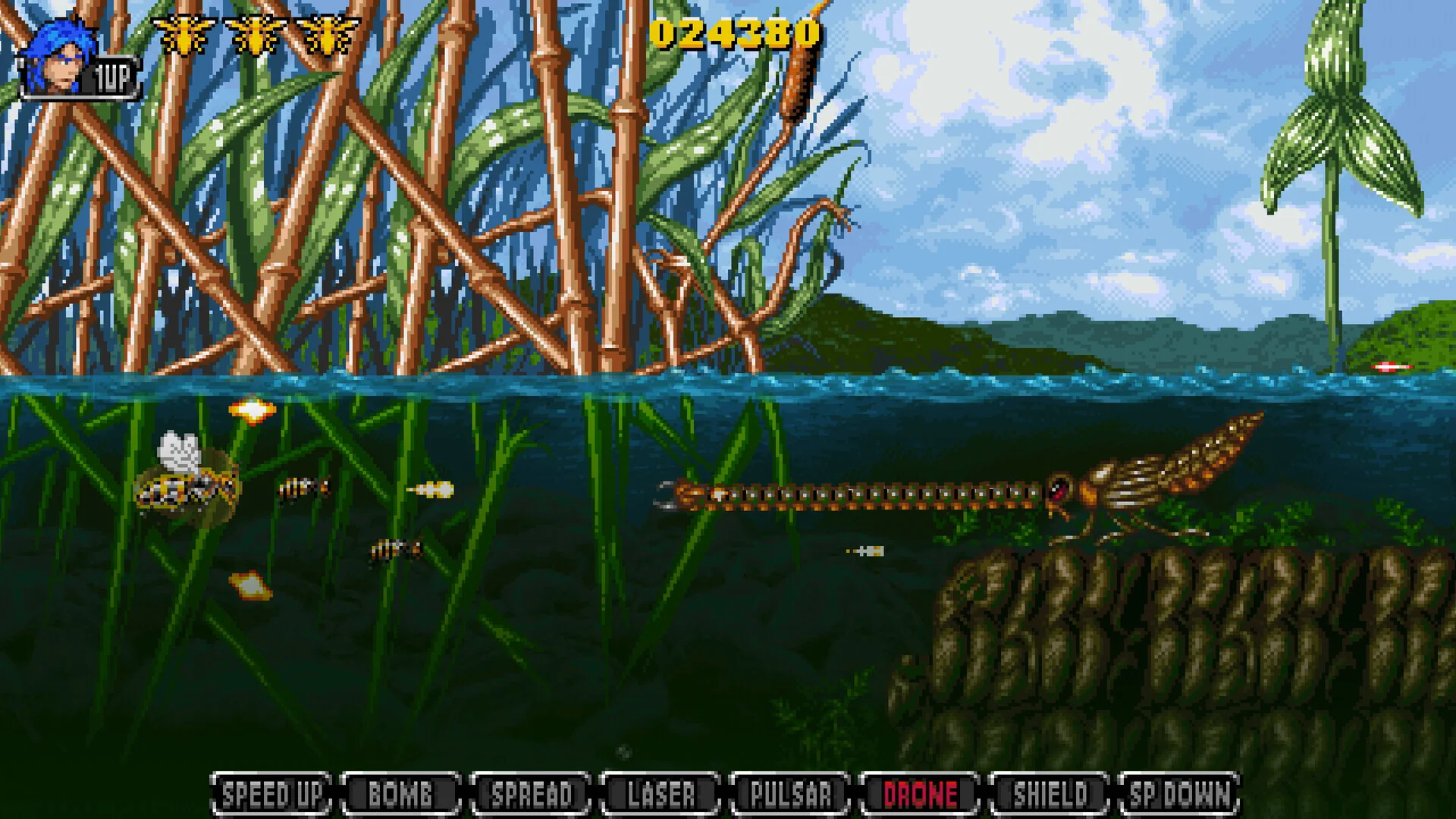
There are practical differences too. Enhanced graphics can make creatures emerging from water easier to read, while certain crowded scenes introduce the opposite problem, with projectiles occasionally disappearing against busy backgrounds. Optional CRT filters, including scan-line effects, provide another way to approximate the display conditions under which the Amiga game was originally seen.
Chris Hülsbeck’s music receives the same treatment. Players can alternate between the classic soundtrack and newly produced studio versions, with Stage 4’s energetic music giving its mechanical scenery some character that the visual design does not always supply. Sound effects can likewise be switched between old and remastered versions.
The package could have celebrated its history further. There is no substantial artwork archive, development gallery, or dedicated music player, all obvious fits for a remake involving members of the original team. A campaign can also be cleared fairly quickly with generous assists enabled.
That leaves harder settings, hidden stages, achievements, local co-op, and cleaner runs carrying much of the replay value. For players returning from the Amiga release, those are familiar incentives. The difference is that Apidya’ Special finally lets everyone else decide how faithfully they want to suffer with them.
The Review
Apidya' Special
Apidya' Special understands why its 1992 predecessor still has a cult following. The flower-driven upgrade bar retains the tactical rhythm inherited from Gradius, while stages involving rat corpses, inverted controls, and insect-filled waterways preserve the eccentricity that separated Apidya from its peers. Modern difficulty settings make its harsher checkpoints and enemy patterns easier to tolerate without rewriting the underlying shooter. The later mechanical stages lack the personality of the natural environments, and the archival package feels thin, yet this remains a careful restoration of a wonderfully strange Amiga shooter.
PROS
- Excellent rebuilt pixel art
- Flexible difficulty options
- Inventive nature-themed stages
- Superb remastered soundtrack
- Faithful Gradius-style progression
CONS
- Later worlds feel less distinctive
- Occasional projectile readability issues
- Limited historical bonus material
- Some punishing enemy placement