



















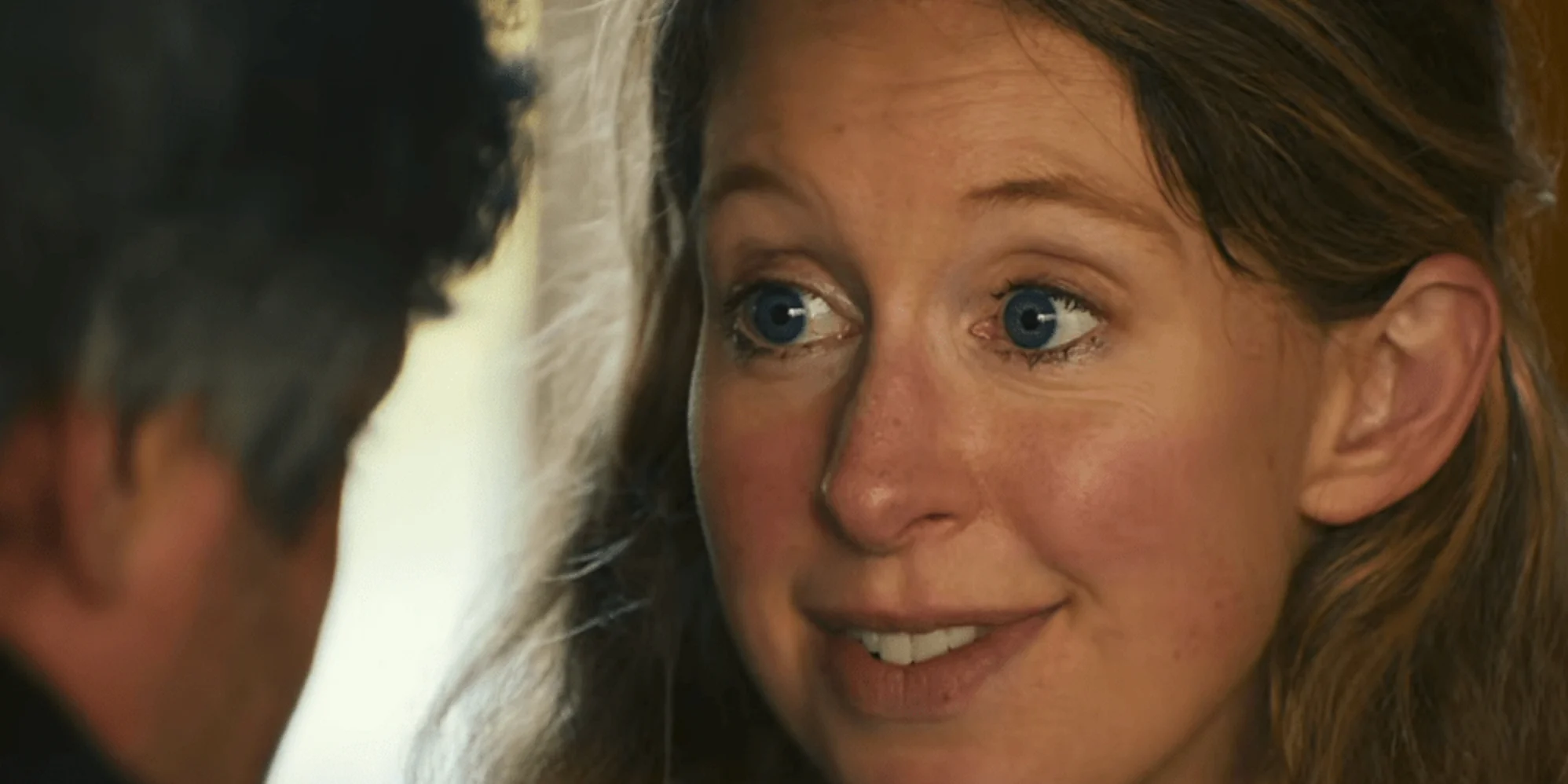

Elizabeth Holmes insists she has never lied, and the unsettling part is how little resistance the sentence seems to encounter inside her. She says it calmly, almost gently, as if guilt were merely an unfortunate interpretation imposed from outside. Nathan Fielder keeps listening.
That contradiction gives You Can See Everything its peculiar pulse. Fielder and Lance Oppenheim spend roughly a month inside the Del Mar home Holmes shares with Billy Evans and their two children before she reports to Federal Prison Camp Bryan in May 2023. The documentary runs 174 minutes, yet its great subject is absence: the distance between what a camera records and what another person can actually know.
Fielder appears on screen, sometimes lurking in doorways, sometimes sitting directly across from Holmes, refusing the false purity of an invisible observer. David Bolen’s camera catches domestic routines with almost indecent patience. Holmes folds motherhood, Theranos, prison, and innocence into the same quiet register. The effect is eerie because nothing announces itself as revelation.
The Vocabulary of Innocence
Holmes’ defense of Theranos often depends upon changing the scale of words. The machine worked, she argues. The unfinished chemistry required to perform its promised blood tests becomes, in her telling, a technical problem awaiting solution rather than evidence that the grand promise itself was false. Fielder responds with language stripped nearly bare. “What’s your definition of a lie?” sounds like a child’s question until Holmes begins answering it.
Their conversations create a strange philosophical trap. A person may believe her own sentence completely and still be wrong. Sincerity does not rescue reality. Holmes’ calm conviction makes that distinction increasingly uncomfortable because the film refuses the easy reassurance of a villain consciously twirling the facts in her hands.
The Abbott and Costello sequence crystallizes this problem through comedy. Fielder shows Holmes and Evans “Who’s on First?” and asks Holmes to explain why the routine works. She struggles with the joke’s shifting meanings, unable or unwilling to surrender words to ambiguity. It is funny for a moment. Then it grows colder. Theranos itself begins to resemble a language game whose definitions were controlled by the person selling it.
Her reaction to The Dropout follows the same pattern. Watching Amanda Seyfried play a public version of her life, Holmes rejects what she sees as fabrication. Later, she and Evans retrieve Theranos machinery from storage and arrange it as material proof that the company’s vision possessed substance. Machines sit on the table. The missing reality remains missing.
Billy in the Frame
Billy Evans first reveals himself through eggs. Holmes is whisking them when Evans takes over because her method, apparently, requires correction. Fielder immediately asks why. Evans calls it help. The scene barely needs editorial assistance. A hand reaches into another person’s task, claims competence, then provides its own justification.
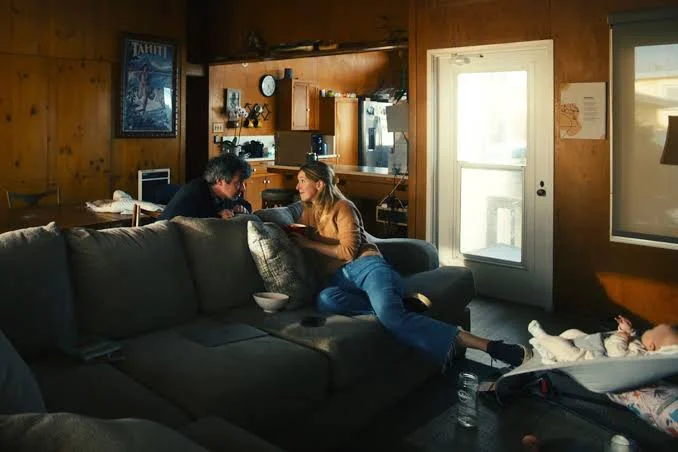
Similar moments accumulate. Evans enjoys the camera, invites it into his shower, absorbs compliments with visible pleasure, and gradually speaks with increasing authority about Holmes herself. Once she enters prison, his presence expands into the space she leaves behind.
Bolen’s framing becomes especially effective here. Slow zooms and prolonged silences let Evans keep talking after the useful answer has ended. The documentary understands one of observation’s darker gifts: people often reveal themselves while trying to repair the impression they have already made.
His control eventually reaches Holmes’ public voice. Evans posts through her verified social-media account, decides what sounds like her, and becomes involved in conversations surrounding A24 and the film’s financial future. Sympathy for Holmes flickers inside these scenes, particularly when his treatment of her appears possessive or dismissive. The film never converts that sympathy into absolution. A person can be harmed and still have harmed others. There is no moral arithmetic capable of cancelling either fact.
The Woman Who Is Missing
Holmes entering prison could have ended a conventional documentary. Here, it fractures one. Two years later, Amanda Seyfried enters the film and watches footage of Holmes watching The Dropout. The image folds representation back upon itself: Holmes observes Seyfried becoming Holmes, then Seyfried observes Holmes rejecting that transformation. The person at the origin of the chain is now physically unavailable.
Fielder and Oppenheim respond with transcripts, recreated conversations, reconstructed spaces, and performance. Seyfried reads Holmes’ words and begins inhabiting her rhythms again. What once appeared to be a documentary about a convicted fraudster becomes something stranger, a study of how quickly another person’s identity can become communal property.
Seyfried also turns questions back toward Fielder. His interpretations, his reactions, his editing choices, even the possibility of emotional attachment to Holmes become part of the material. The investigator enters his own investigation.
One particularly revealing moment arrives when Fielder and others object to an abrasive social-media message posted by Evans through Holmes’ account. It “does not sound like her.” They may be correct. Yet the certainty contains its own danger. After months of footage, conversations, reenactments, and analysis, they have started claiming knowledge of Holmes’ authentic voice too.
The title becomes almost cruel in that light. You can place cameras in bedrooms and kitchens. You can record twelve hours a day, preserve conversations, reconstruct missing rooms, hire an actress to speak absent words. You can watch a face until every blink begins to feel meaningful. And still, another human being remains somewhere behind it.
You Can See Everything premiered as a secret screening at the 53rd Telluride Film Festival on September 6, 2026, ahead of its theatrical release by A24. The documentary follows disgraced Theranos founder Elizabeth Holmes as she grants filmmakers unprecedented access to her life in the weeks before beginning her prison sentence.
Where to Watch You Can See Everything (2026) Online
Full Credits
Title: You Can See Everything
Distributor: A24
Release date: September 6, 2026 (Telluride Film Festival)
Running time: 2 hours 54 minutes
Director: Nathan Fielder, Lance Oppenheim
Cast: Elizabeth Holmes, Nathan Fielder, Billy Evans, Tatiana Bears, Maggie Ambrose, Jack Davis
Director of Photography (Cinematographer): David Bolen
The Review
You Can See Everything
You Can See Everything turns unprecedented access into a study of how little access can finally reveal. Holmes speaks with serene certainty, Evans slowly occupies the frame around her, and Fielder keeps asking questions that seem simple until language itself begins to rot beneath them. The later arrival of reenactment and performance makes the film stranger, riskier, and eerier. Three hours of cameras, transcripts, memories, and reconstructed rooms cannot deliver certainty. They leave behind something colder: the suspicion that sincerity and truth may live very far apart.
PROS
- Remarkable access to Holmes
- Fielder’s patient interrogation
- Evans’ disturbing self-exposure
- Bold second-half reconstruction
- David Bolen’s observant camerawork
CONS
- Demanding 174-minute runtime
- Reenactments sometimes blur factual footing