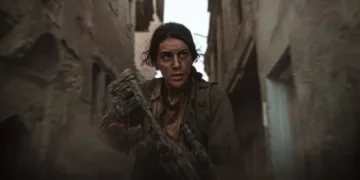





























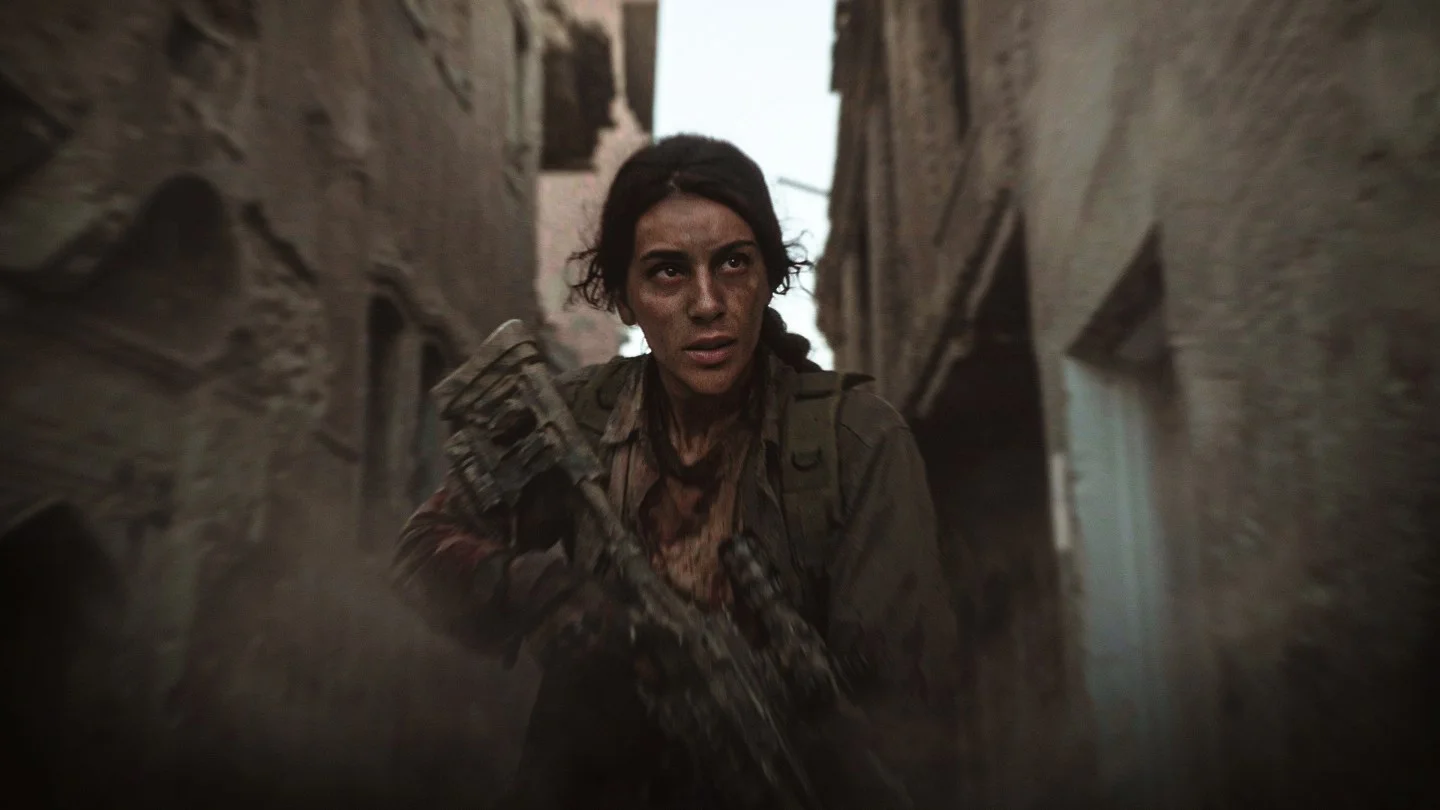

Halkawt Mustafa gets his clearest results whenever he lets geography create the danger. A broken wall, an exposed rooftop, a narrow tunnel, a church with too many unseen corners: each space tells Vyan exactly how vulnerable she is before a shot is fired.
No Paradise If You Are Killed By A Woman follows Vyan, played by Avan Jamal, a 24-year-old Kurdish-Norwegian Peshmerga sniper fighting Islamic State near Mosul in 2016. She has killed over 100 enemy fighters, earned a million-dollar bounty, and built a reputation around a grim belief invoked by the film’s title: an IS fighter killed by a woman will be denied paradise.
Her military objective is tangled with a much more personal one. Vyan believes her younger sister Helin, taken during the Islamic State assault two years earlier, remains alive somewhere inside Mosul with a fighter known as the Swedish Sniper.
Mustafa frames that search as a revenge thriller, rescue mission, and war drama at once. The combination gives the film real propulsion, yet it also creates its main weakness. Vyan is rooted in recognizably historical suffering, while the filmmaking sometimes presents her with the polish of an action icon.
The Sister Left Behind
The flashbacks to 2014 explain how far Vyan has traveled. She and Helin are visiting Iraqi Kurdistan with their parents after growing up in Norway when Islamic State fighters intercept the family. Their parents are murdered, and the sisters are taken captive and sold.
Mustafa keeps some of the worst abuse outside the frame, relying instead on screams, locked rooms, and the consequences written across Vyan’s face. It is a smart choice. Explicit imagery could easily turn suffering into spectacle, while Avan Jamal’s tight physical control makes the aftermath harder to escape.
Vyan eventually kills the man who bought her, reaches Peshmerga territory, and joins an all-female unit led by Kanar. From there, the film makes a huge leap. The frightened captive becomes an elite sniper capable of calculating distance, anticipating movement, and keeping her breathing steady under fire.
That transformation needed another scene or two. Mustafa shows us the result without giving enough attention to the training, failed attempts, or gradual hardening that created it. Trauma explains Vyan’s determination. It cannot explain technical mastery by itself.
The Norway material creates another structural bump. After Vyan is badly wounded stopping a suicide vehicle, she is returned to Norway and offered protection by Anders, a government official played by Thorbjørn Harr. She can accept a new identity or continue living with the legal and security consequences of her war. Then Helin calls. The scene does exactly what the plot needs, sending Vyan back toward Mosul, but the jumps between Norway, captivity, and the battlefield make the first half busier than the rescue story really requires.
Mosul Through a Rifle Scope
The opening sequence shows Mustafa working at his best. Cinematographer John Erling H. Fredriksen trails Vyan through destroyed streets and into a damaged church in an extended shot that forces us to study every doorway with her.
This is where camera movement becomes part of the suspense. Instead of cutting rapidly to announce danger, the film often lets Vyan move through a space long enough for us to understand where an enemy might be hiding. Once we know the layout, every uncovered window becomes a threat.
The later sniper sequences develop that idea further. Working beside an older Kurdish commander, Vyan has to locate three IS marksmen who are killing civilians trying to cross the city. Mustafa repeatedly gives us rifle-scope views, distant gunfire, radio chatter, and long stretches where Vyan simply waits.
That waiting matters. Sniping here is presented as patience and calculation rather than constant shooting. Vyan studies angles, searches windows, controls her breathing, then commits to a single movement.
Mattias Eklund and Jan Kasskawo’s sound design carries much of the pressure. Shots crack from places we cannot immediately identify. Violence often arrives as sound before image, especially when civilians are caught in exposed areas.
Fredriksen also benefits enormously from shooting in actual Mosul locations. The damaged streets do not feel arranged for a production. Dust hangs in the air, walls look genuinely unstable, and whole sections of the city seem capable of collapsing around Vyan. The problem is repetition. Stalk, wait, aim, fire. Mustafa finds several strong variations, including the underground tunnel passages, yet the rhythm begins to announce itself.
Heroism Under Fire
Jamal keeps Vyan human inside a film that occasionally wants to turn her into a legend. Watch the way she slows her breathing before a shot, or how little expression she gives Anders during their conversations in Norway. The restraint suggests someone conserving emotional energy because letting everything return at once would be unbearable.
Her scenes with the older Kurdish commander are especially useful because they allow her to exist beside another person rather than simply as a weapon pointed toward the next target. Small exchanges briefly expose the personality buried beneath the discipline.
The film’s cultural perspective gives Vyan’s role added force. She fights an organization that treated women as property, and her gender becomes part of the fear surrounding her reputation. Mustafa also connects her to Kurdish military tradition through references to the Peshmerga name and through music that uses instruments such as oud and duduk.
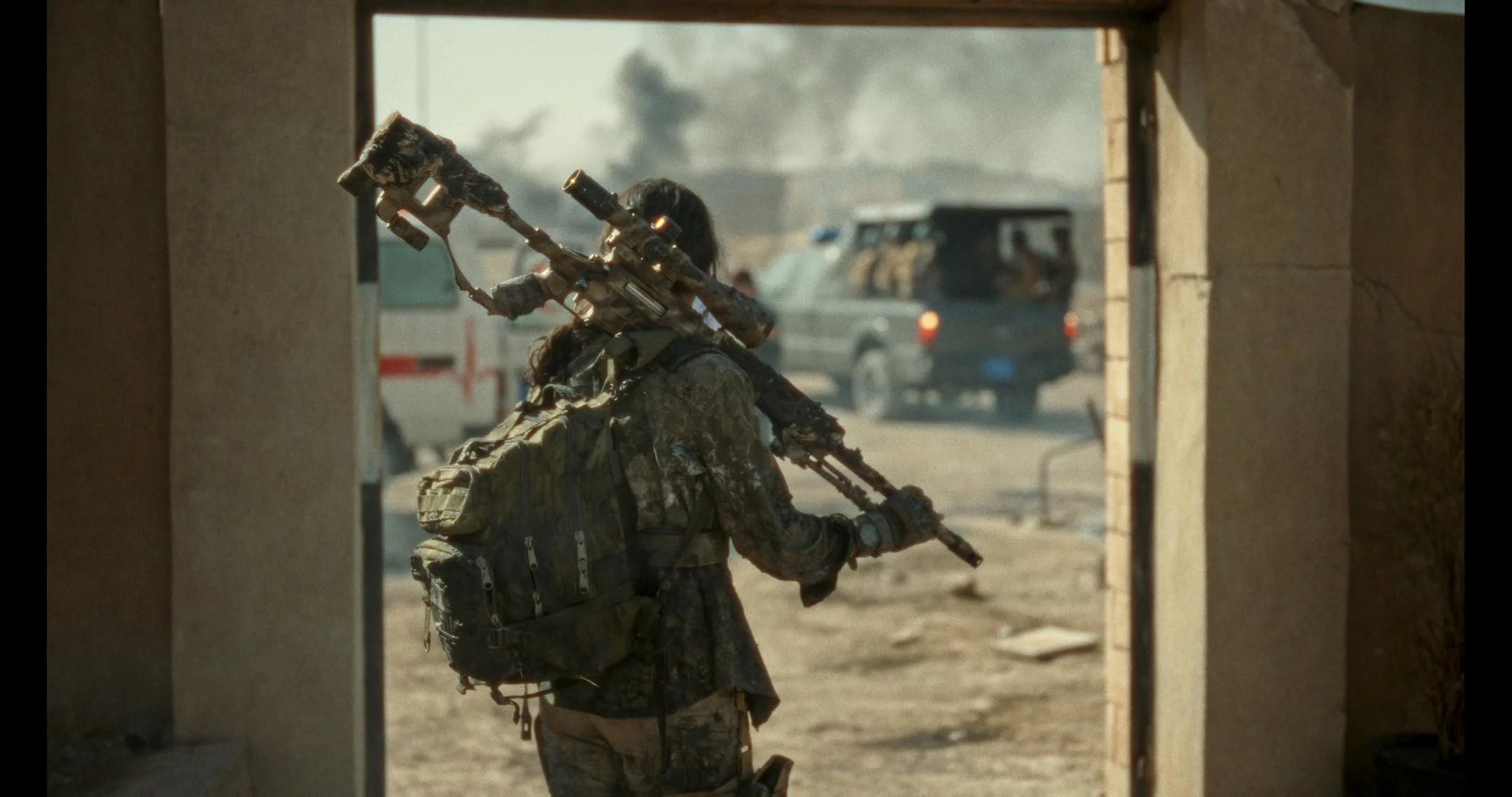
Still, the visual treatment sometimes pulls in another direction. Vyan is repeatedly framed with uncovered hair, rifle ready, standing apart from groups of helmeted men. Those images are striking, but they can push her toward action-movie mythology precisely when the story needs the scars, fatigue, and cost of survival to remain visible. The film is strongest when Mustafa trusts Jamal’s stillness, the ruined streets, and the distant sound of a rifle shot. Those elements need very little decoration.
No Paradise If You Are Killed by a Woman had its world premiere out of competition at the 83rd Venice International Film Festival on September 7, 2026. The war drama follows a Kurdish female sniper who returns to Mosul to rescue her younger sister from ISIS control.
Full Credits
Title: No Paradise If You Are Killed by a Woman
Distributor: Norsk Filmdistribusjon, Empire Entertainment
Release date: September 7, 2026 (Venice International Film Festival)
Running time: 1 hour 50 minutes
Director: Halkawt Mustafa
Writers: Halkawt Mustafa
Producers and Executive Producers: Halkawt Mustafa, Janne Hjeltnes, John M. Jacobsen
Cast: Avan Jamal, Thorbjørn Harr, Kanar Sarchl, Kader Jalal
Director of Photography (Cinematographer): John-Erling Holmenes Fredriksen
Editors: Wibecke Rønseth
Composer: Trond Bjerknes
The Review
No Paradise If You Are Killed By A Woman
No Paradise If You Are Killed By A Woman works best when Halkawt Mustafa trusts physical suspense: Vyan crossing exposed streets, waiting behind a rifle scope, or moving through Mosul’s tunnels while gunfire echoes somewhere beyond sight. Avan Jamal gives those sequences a controlled intensity that carries much of the film. The heavier voiceover, compressed character development, and glossy heroic framing sometimes simplify material that deserves greater complexity, yet the filmmaking remains tense, visually assured, and emotionally grounded in Vyan’s determination to find Helin.
PROS
- Avan Jamal’s restrained performance
- Strong Mosul location photography
- Precise sniper sequences
- Excellent sound-driven suspense
- Effective sister-rescue premise
CONS
- Repetitive action structure
- Abrupt transformation of Vyan
- Overstated voiceover
- Glossy heroic framing
- Thin supporting characters