




















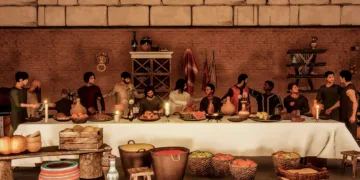



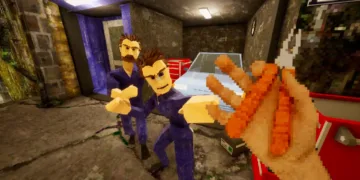

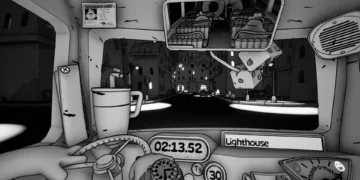

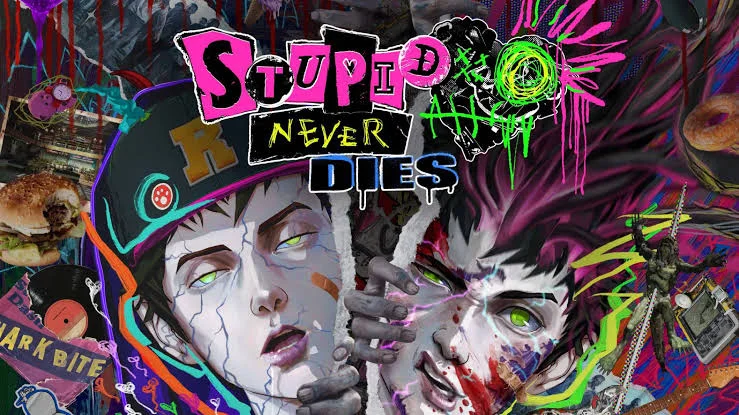

The pop-punk clothes and scratched stickers place Stupid Never Dies near Lollipop Chainsaw and No More Heroes on the action-game family tree. GPTRACK50’s debut also reaches further back, into monster movies whose creatures could carry an entire production on their silhouettes. Its introductions borrow from films such as Creature from the Black Lagoon, while story scenes mix film grain, drawings over photographs, and papercraft props. Those different references give the monsters somewhere to belong. They look like creatures recruited for a homemade music video.
That homemade quality extends into the repeated business of playing. Perks accumulate as stickers around the interface, turning a growing build into an increasingly cluttered surface. The entrance to the dungeon is a toilet that flushes the protagonist into another run. These touches make familiar roguelite activities feel connected to the setting: collecting upgrades decorates the screen, and restarting requires another undignified departure from the shopping mall. The visual personality survives beyond the cutscenes.
The unfortunate passenger is Davy, a timid zombie who avoided the monster uprising that nearly wiped out humanity. Its leader, KOM, has since withdrawn into subterranean realms. Davy acquires a reason to follow after discovering Julia, a girl frozen dead in an ice-cream-shop freezer, and falling for her. He then eats a Phoenix Egg, gaining the ability to absorb monster powers. Dr. Frank directs this newly useful idiot toward KOM with the promise that Julia might be revived.
Davy’s fighting style makes an interesting departure from the technical action games his appearance might suggest. The useful comparison is Final Fight: close-range disorder, persistent aggression, and keeping a crowd under control. Devil May Cry is a less helpful expectation. Stupid Parry sends Davy into an incoming attack, trading recoverable health for the opportunity to counter with Stupid Impact. Biting an enemy can restore that health. The sequence encourages staying close enough to repair the damage through another aggressive action, rather than withdrawing to recover.
Style Eat gives that basic exchange room to change. Exposed cores provide single-use Instant Skills or temporary transformations drawn from stronger monsters. Davy can carry two forms alongside his default zombie body, but they expire after a limited number of dungeon layers.
A harpy’s projectiles, double jump, and glide create a different relationship with distance from a lich’s ability to raise skeleton helpers. Forms occasionally affect exploration too, with elevated routes for harpies and breakable walls for cyclopes. Replacing an expiring transformation can mean losing a useful route-opening ability alongside a preferred attack.
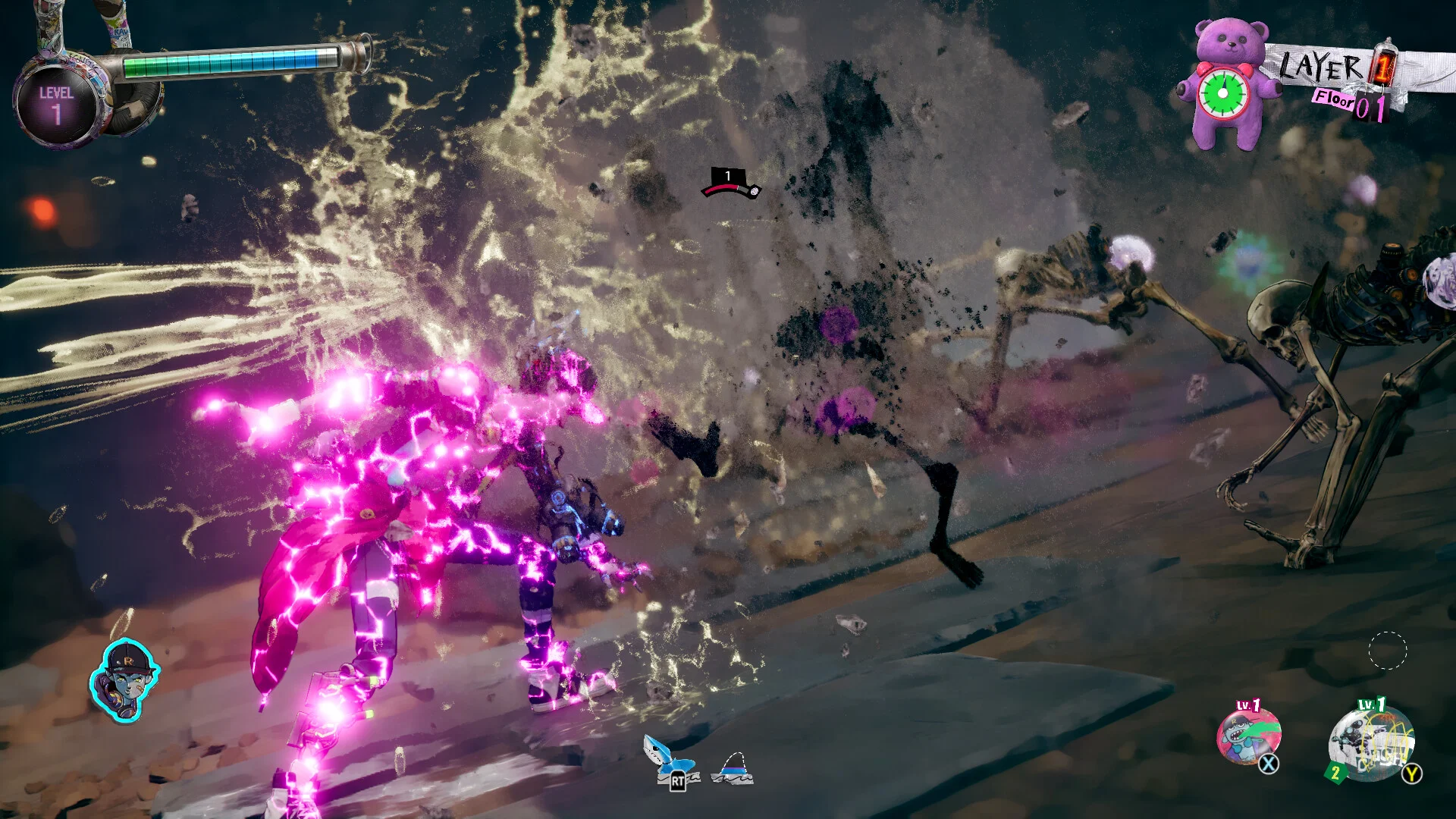
The trouble is getting the game to recognize which opportunity you want. There is no conventional manual lock-on, and the optional camera assistance only partly compensates. Automatic targeting can redirect a bite intended for an elite core toward a nearby skeleton.
Skeletons supply no healing, so the mistake spends bite gauge while potentially costing health recovery and a new form. Committed attack animations cannot be canceled, leaving Davy to finish an action aimed at the wrong recipient. Flying enemies and projectiles arriving from outside the camera view make that looseness especially frustrating. A scrappy brawler can accommodate simple attacks; choosing the intended target still matters.
Mistakes remain tolerable for a while because the progression system gives almost every attempt a lasting return. Each run begins at level one, but defeated enemies feed a permanent experience multiplier, including after failure. Eventually, an enemy that once supplied a small contribution can produce several levels.
Compared with the familiar roguelite reset, this creates a particularly visible sense of accumulated strength. Equipment and permanent upgrades support it, while burgers unlock additional perks for future level-up selections. Early encounters become quicker to clear, giving repeated visits a different pace.
The timer gives that generosity a useful complication. Runs begin with a 12-minute allowance, and limited extensions leave pressure to keep moving. Fighting everything produces experience and opportunities to acquire cores, but it also spends time needed to reach deeper layers.
Some encounters block the route; others can be passed. This makes skipping an enemy a practical decision about preparation rather than an admission that the fight is uninteresting. A transformation-specific detour has to justify its rewards against the same shrinking allowance.
That planning becomes less satisfying when learning what you need fails to give you dependable access to it. One freezing boss makes Freeze Immunity an obvious upgrade to seek. Unlocking it, however, only adds it to the randomized selection pool. It can remain absent through another attempt.
Buying further perks can dilute the pool with options that are less useful for the immediate obstacle, and limited rerolls offer little control. The relationship between knowledge and progress becomes awkward: understanding the encounter may still leave you waiting for the right selection or a larger experience multiplier.
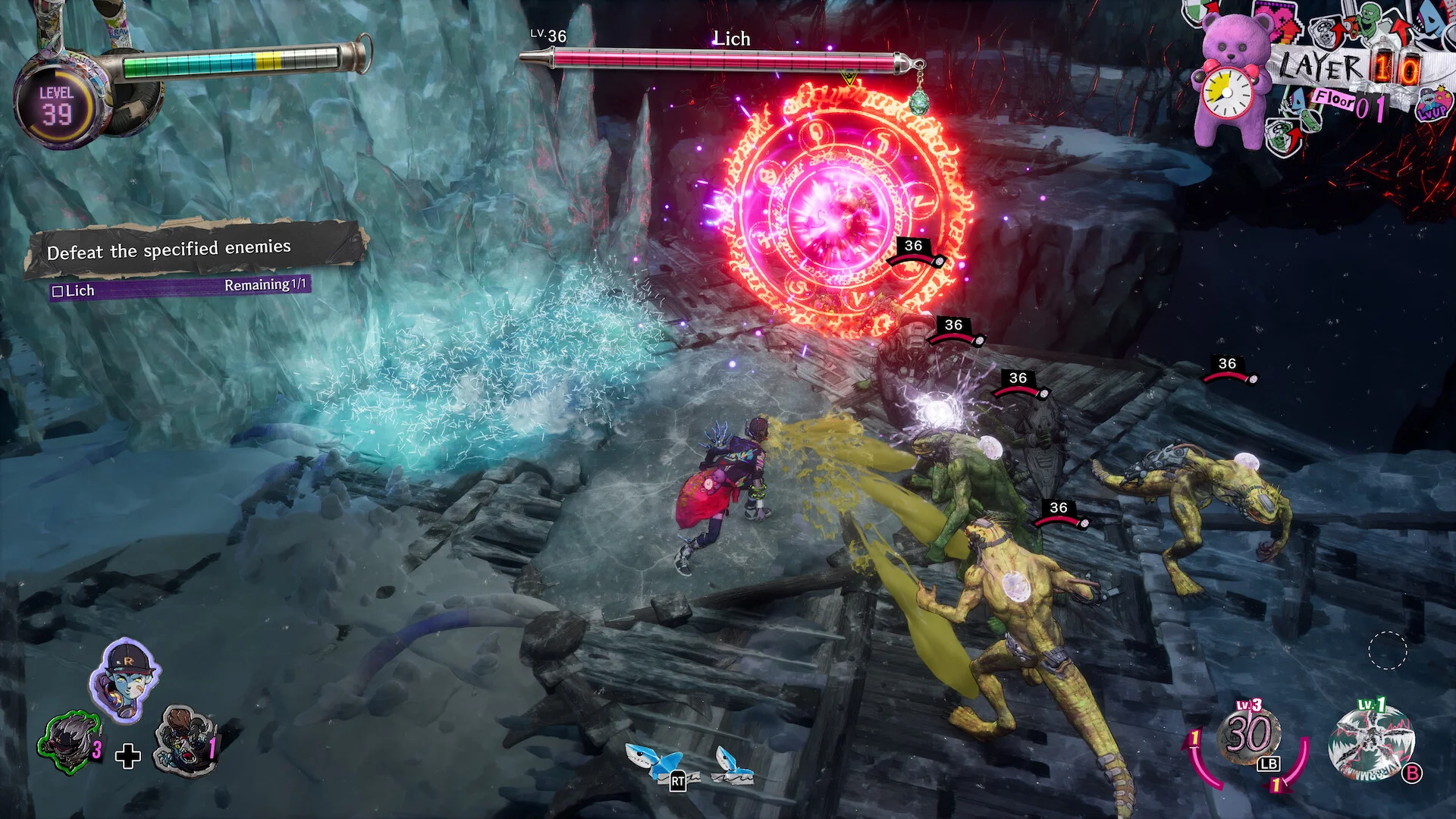
A later requirement to collect 30 randomly appearing resources stretches that problem into campaign pacing. Deeper layers offer better chances, but a run need not contain the required resource at all. Layer skipping reduces the return trip without making the objective itself more interesting.
The distinction is important for a game built around repetition. Returning with a new form or a better understanding of a boss changes the next attempt; returning because the campaign is still counting drops does less with the player’s time. Go Nuts mode offers increased power for players tired of resistance, though stronger attacks cannot make a random collection requirement dependable.
Davy himself supplies a better reason to care about his changing capabilities. In the mall he shuffles awkwardly, then gains a robot vacuum to ride; inside the dungeon he can move and fight with far greater freedom. His unlikely heroism has a physical expression before the plot needs to insist on it.
Julia is harder to accommodate within that underdog story. Her earlier social-media posts establish fragments of a life, but Davy encounters them by browsing the phone of someone who cannot answer him. The information develops his attachment without giving the relationship an equivalent exchange.
The gifts make that imbalance mechanically explicit. Bringing presents to Julia earns upgrade points for Davy Burst, his temporary enhanced state. It fits a protagonist whose devotion supplies the energy for another descent, yet the reward also makes his imagined courtship materially productive before Julia can participate.
The Review
Stupid Never Dies
Stupid Never Dies earns its place beside eccentric action games through handmade monster-movie imagery and transformations that change how Davy fights and explores. Its brawling is easier to appreciate without expecting Devil May Cry precision, but unreliable targeting remains a serious obstacle. Accelerating experience makes failed runs productive; randomized upgrades and mandatory collection turn some returns into waiting games. There’s an appealing oddity here, held back by combat control and uneven progression.
PROS
- Distinctive collage art and monster-movie influences
- Transformations change combat and exploration
- Failed runs contribute to lasting growth
CONS
- Unreliable targeting wastes attacks and resources
- Random perk selections restrict boss preparation
- Mandatory collection stretches campaign repetition
- Romance develops Davy’s attachment without reciprocal participation