





























The adults reciting Australian insults at the Delhi College of Linguistics approach their lessons with admirable seriousness. “Useless bastard” belongs on the syllabus; proficiency apparently requires knowing how to offend someone before knowing much about them.
How to Talk Australians finds a fruitful absurdity in this arrangement. Language instruction usually promises access to a culture, and here the route passes through swearing, suspicious food and enormous roadside attractions. The students’ diligence gives these lessons their comic force. They are preparing carefully for a country that seems unlikely to reward careful preparation.
The Delhi setting also gives Australian self-parody the appearance of an outside assessment. Director Tony Rogers and co-writer Rob Hibbert can make familiar national habits strange by placing them before Indian students, whose eagerness supplies a sympathetic reason to examine them.
Yet the distinction between an Indian perspective and Australian comedy performed through Indian characters matters. The college tells us plenty about the Australia these people imagine. Their lives beyond its classrooms remain faint. Their desire to visit is clear, while the experiences shaping that desire receive little attention.
Expanded from the YouTube series, the film sends Dean Devdan, his colleagues and their students on a study tour intended to begin in Sydney. A diversion deposits them near Dubbo, customs questioning separates the dean from his charges, and the group continues by bus through an Australia of roadside stops and depleted hospitality. This is an efficient way to turn classroom exercises into encounters. Every local becomes a possible examiner, and every exchange offers the students a chance to discover how badly a phrase can travel between its textbook meaning and its social use.
The strongest encounters expose different failures of cultural confidence. Asked what goes into a Chiko Roll, a local food server cannot account for the product being sold. The visitors’ perfectly reasonable curiosity reveals how little explanation familiarity requires.
A man who sees an Indian visitor and asks his wife if she has ordered a taxi makes a harsher assumption. He thinks he already knows why this person is there. One joke punctures everyday expertise; the other exposes the occupational category into which a stranger is immediately placed. The film is sharpest when it lets those assumptions betray the Australians making them, without requiring the visitors to deliver a corrective speech.
Chester complicates this arrangement because he is busy enjoying himself. Rohan Ganju gives him a relaxed confidence that keeps the character from becoming a permanent ambassador for bewilderment. His affection for Karen includes gratitude for his introduction to “meat pies, AFL, casual racism,” an account of romance that quietly incorporates an ugly social habit into the pleasures of local life.
Ganju’s delivery leaves the contradiction undisturbed. Chester wants intimacy, and his enthusiasm makes room for things that deserve resistance. The joke has an uncomfortable implication: becoming comfortable somewhere can involve learning which discomforts everyone expects you to accept.
Vikrant Narain gives Devdan a different kind of ease. His distracted, almost suspended responses to successive absurdities make the dean’s institutional authority pleasantly unreliable. The brown suit, long hair and moustache suggest a teacher whose cultural materials have aged alongside his wardrobe.
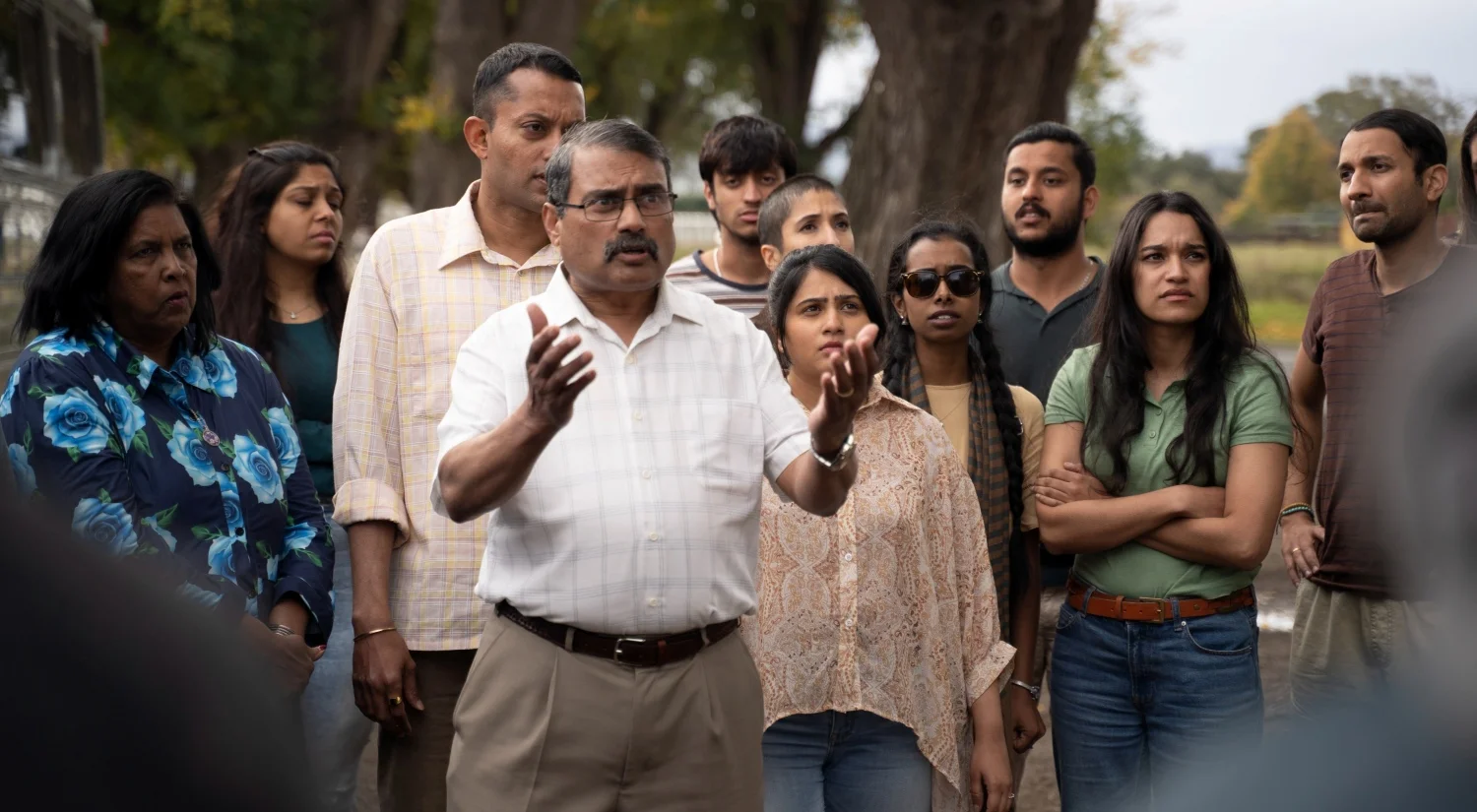
Narain allows the humiliations to reach him slowly, preserving an amiable presence even when the character’s confidence has little practical foundation. Together, he and Ganju provide a welcome counterweight to the writing’s reliance on confusion. Their performances leave room for temperament, pleasure and resignation inside roles that could easily have been reduced to exaggerated reactions.
The film’s visual world, however, largely confirms the dean’s dated preparation. Brownish colours, pay phones, worn accommodation and roadside businesses produce an Australia that seems to have been waiting for this particular class to arrive. The consistency suits the spoof, but it weakens the possibility of discovery.
Devdan’s understanding of the country might have been challenged by a place that had changed while he continued teaching its old habits. Instead, the locations and the broadly drawn locals repeatedly validate his peculiar curriculum. The students encounter inconvenience and hostility, yet the cultural picture itself remains reassuringly familiar to the film.
That limits the road trip as a feature-length form. The dean’s separate adventures and the group’s bus encounters create room for successive sketches, but another misunderstanding does not necessarily alter anyone’s understanding. The faux educational inserts are useful interruptions, especially the explanation of Australia’s competing names for beer-glass sizes.
Here the instructional format gives genuine linguistic disorder a tidy comic frame. These compact lessons retain the original premise’s economy. Around them, the longer excursion can feel like a succession of opportunities to demonstrate the same competence: the filmmakers know another Australian expression, another shabby stopping place, another way for prepared visitors to be caught out.
The late airborne emergency gives the language lessons a practical consequence. A student must meet a challenge, and an acquired Australian expression becomes part of the resolve to act. The payoff is modest beside the ensemble’s thin development, though it changes the student’s relationship to the material being taught. Repetition in the classroom has been a comic display of obedience; under pressure, the learned phrase becomes something the speaker can use for a purpose of their own. For that stretch, the film allows an Indian character to put the lesson to work and take responsibility for the situation.
How to Talk Australians was released in Australian cinemas on June 11, 2026, via Umbrella Entertainment, before becoming available on video-on-demand platforms like Amazon Prime Video. Directed by Tony Rogers and expanding on the hit satirical web series, the feature comedy follows a group of students and instructors from the Delhi College of Linguistics who travel to Australia to study its language and culture firsthand, encountering wild cultural misunderstandings along the way.
Full Credits
Title: How to Talk Australians
Distributor: Umbrella Entertainment, Amazon Prime Video
Release date: June 11, 2026
Rating: MA15+ / Unrated
Running time: 1 hour 30 minutes (90 minutes)
Director: Tony Rogers
Writers: Tony Rogers, Rob Hibbert
Producers and Executive Producers: Jason Byrne, Victoria Schaw, Phil Spencer, Chum Ehelepola, Ria Patel, Rohan Timlock
Cast: Vikrant Narain, Ria Patel, Esha Banavali, Ben Knight, Brendan Bacon, Eddie Baroo, Shane Jacobson, Rohan Ganju, Stephen Curry, Dave Lawson
Director of Photography (Cinematographer): Joey Knox
The Review
How to Talk Australians
How to Talk Australians finds affectionate comedy in visitors who study their hosts diligently and receive a dubious welcome. Narain and Ganju give the caricatures warmth, while the best encounters expose prejudice through everyday assumptions. Yet the Indian characters’ lives remain faint, and the deliberately dated Australia offers too few surprises to sustain the road trip. Its classroom premise produces sharper observations than its feature-length construction can develop.
PROS
- Narain’s unhurried charm and Ganju’s relaxed confidence.
- Pointed jokes about prejudice and cultural familiarity.
- Economical, amusing mock-educational inserts.
CONS
- Limited individuality beyond the visitors’ shared enthusiasm.
- Retro caricatures restrict cultural discovery.
- Episodic encounters repeat without enough development.