

























![Kingdom Hearts Collection [I-III] Review](https://gazettely.com/wp-content/uploads/2026/10/Kingdom-Hearts-Collection-I-III-1-360x180.webp "Kingdom Hearts Collection [I-III] Review: KHII Holds Steady as Newer Entries Fluctuate 37")



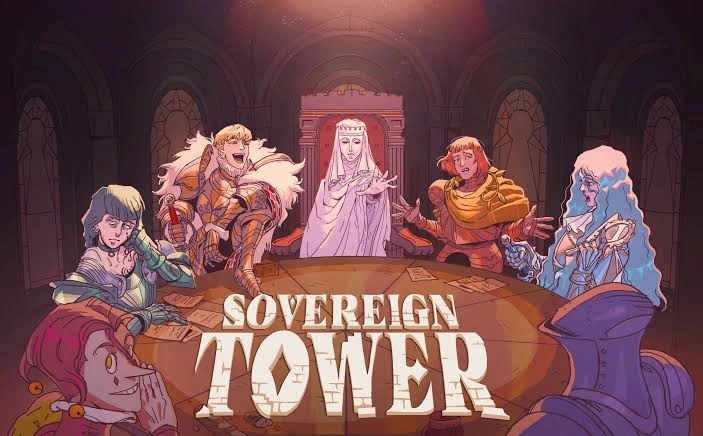

Send a knight on the wrong quest and the failure rarely stays contained. Their armor might break, your treasury may take the hit, a faction could turn against you, and the knight might simply die. Sovereign Tower understands that management games become interesting when systems refuse to respect their assigned compartments.
Developed by WILD WITS GAMES and published by Curve Games, this medieval management RPG casts you as an unlikely sovereign after a magical prophecy raises a leper to the throne. Your new kingdom has spent years without proper leadership, and fixing it means rebuilding the Round Table while keeping Nobles, Merchants, Scholars, and the People from tearing the realm apart.
Each day is split between political audiences and knight management. Petitioners arrive with problems, quests, complaints, and demands. Later, you decide who heads into the field, who needs equipment, and which expenses your strained treasury can survive. Then there is the demon downstairs. He can fix everything. Probably.
Managing People Is the Real Boss Fight
Sovereign Tower’s faction system works because approval is rarely treated as a simple morality meter. Supporting commoners can improve your standing with the People while irritating the Nobles. Repeatedly choosing that path can trigger an aristocratic uprising, yet the exact tools available for resolving it depend on decisions made elsewhere.
Recruit the right noble knight, for instance, and marriage can provide a political solution that prevents open conflict. Miss that recruitment opportunity and the same crisis has a different shape. The game remembers enough interconnected variables to make political decisions feel systemic instead of cosmetic. Your knights create similar problems.
Each character has values across Strength, Agility, Wit, Magic, Charisma, and Luck, and quests demand particular combinations. Bandits favor capable fighters. A ghost haunting a bathroom calls for someone with magical talent. Success comes from matching personnel to the job, then accounting for personality, equipment, urgency, and possible rewards.
That final layer is important. A knight can be statistically suited to a task and still hate being assigned to it. Nobles may resent your treatment of refugees. Other residents become uncomfortable if your Round Table fills with criminals. Arron or Ursula can return from missions unhappy because the assignment clashed with their principles. The game is constantly asking you to optimize people who resist optimization.
Armor creates another smart pressure point. Knights can die when it is destroyed, making repairs essential, but fixing several characters in a single day becomes expensive. Weapons, horses, consumables, audience requests, and upgrades compete for the same gold. Pawning unused equipment to finance the next crisis can feel sensible right until another system makes you regret selling it.
The Best Reload Button Has Horns
The demon living beneath the castle supplies Sovereign Tower’s strongest mechanical idea: rewinding time. Lose a favorite knight and you can return to an earlier point. Fail an alliance and you can reconsider the choices that led there. Send the wrong hero on a mission and you can make another assignment. The clever part is that your sovereign remembers.
Information learned in an erased timeline can unlock different dialogue options after rewinding. That transforms time travel from an external convenience into part of the RPG’s progression. Knowledge becomes a resource carried between discarded versions of history.
There is still a cost. Rewinding kills everything that happened after the point you return to, including positive relationships, successful quests, discoveries, and fortunate accidents. Saving one knight can erase another outcome you wanted to preserve.
Sovereign Tower also refuses to explain the complete price of using the demon’s power when it first becomes available. Mechanically, that uncertainty is effective because the immediate benefit is obvious. One dead character becomes one rewind. Another disaster makes the second easier to justify. Soon the player is treating forbidden temporal magic like customer support.
The weaker side of the system is repetition. A major rewind can require replaying audience sequences, assignments, repairs, and other routine work. When the daily loop has already settled into a recognizable pattern, recovering lost ground can feel less like manipulating history and closer to doing paperwork twice.
Beautifully Inefficient Government
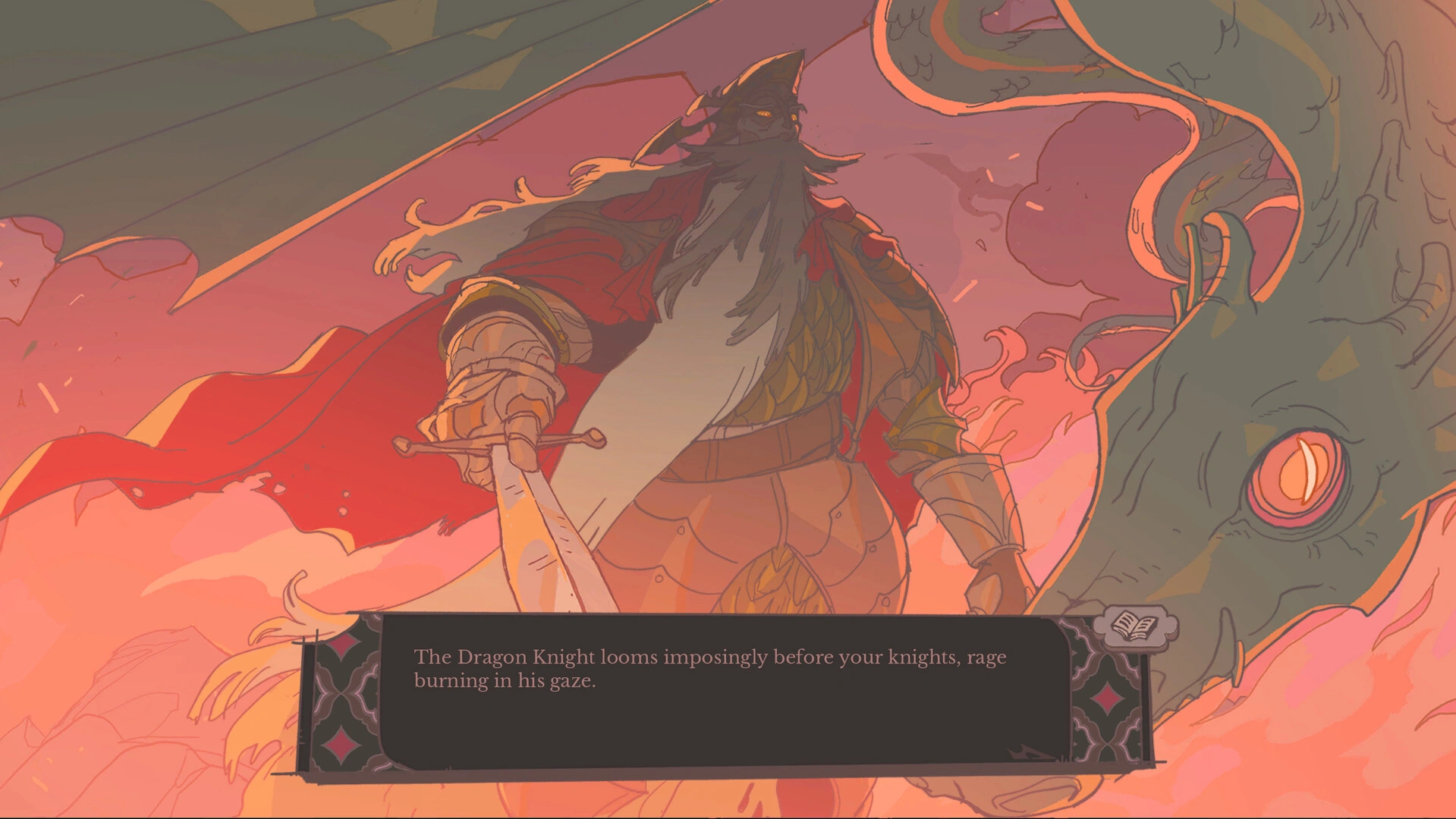
Sovereign Tower sells its strange kingdom through hand-drawn illustrations that resemble medieval manuscript art filtered through a rough graphic novel. The Dragon Knight looks dangerous before his stats become relevant, while Gwendan’s smug expression and gold armor communicate aristocratic excess before he finishes talking.
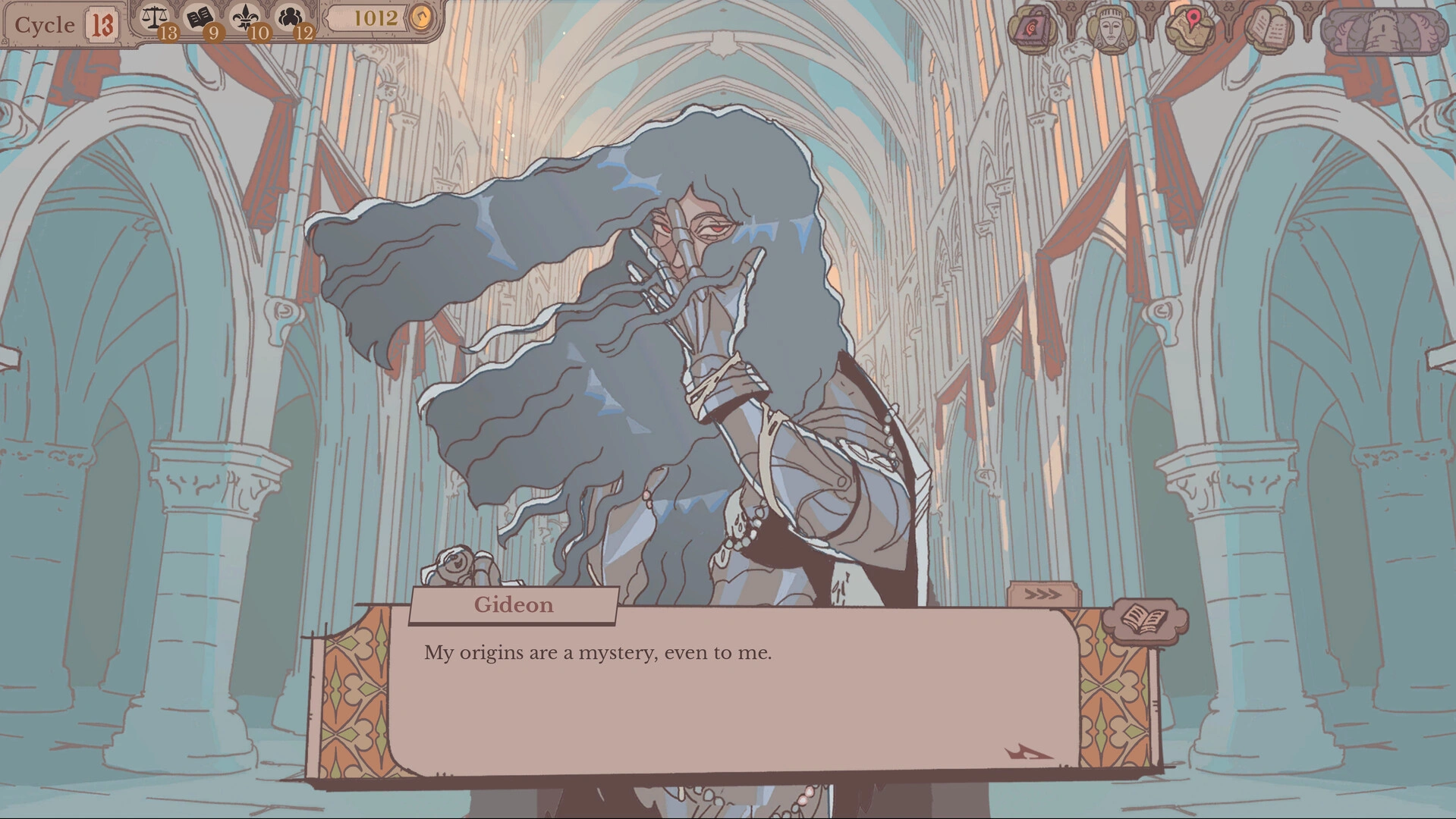
That visual personality matters in a game without voice acting. Audience scenes rely heavily on expressive portraits and sharp writing to give each petitioner an identity. The script comfortably jumps from political disputes to ridiculous errands and romantic possibilities, with enough specificity that knights feel like troublesome individuals rather than attribute containers.
The tone occasionally works against the consequences. A character can face a serious personal crisis shortly after a deliberately absurd exchange, and the transition can blunt the emotional weight of both scenes.
Some mechanical information is similarly obscured. Hidden traits can make failed assignments feel earned once you understand a knight, yet early mistakes sometimes come from information the player could not reasonably have known. Scripted threats such as the Dragon Knight can also expose the game’s structure, arriving at predetermined moments to force your developing court through a difficulty check.
Still, those rough edges rarely separate themselves from the game’s central pleasure. Politics affects recruitment. Recruitment affects quests. Quests damage armor. Repairs drain money. Financial decisions shape audience choices. A dead knight leads you downstairs to the demon, where the option to erase the entire mess waits patiently. Good management games make you solve problems. Sovereign Tower makes you decide which problems deserve to survive.
The Review
Sovereign Tower
Sovereign Tower makes its best ideas feed directly into one another. Sending the wrong knight can cost armor, gold, faction approval, or a life, and the demon beneath the castle turns fixing that mistake into another decision with consequences of its own. Hidden traits and repetitive daily routines occasionally make the management loop feel murkier than intended, while scripted challengers such as the Dragon Knight can expose its machinery. Still, few management RPGs make failure this mechanically useful, or this tempting to erase.
PROS
- Excellent choice-and-consequence systems
- Time rewinding changes future decisions
- Distinctive knights and faction conflicts
- Strong hand-drawn character art
- Resource management creates real pressure
CONS
- Hidden traits can frustrate planning
- Daily loop grows repetitive
- Some challengers feel artificially timed
- Serious moments clash with the humor







