

























![Kingdom Hearts Collection [I-III] Review](https://gazettely.com/wp-content/uploads/2026/10/Kingdom-Hearts-Collection-I-III-1-360x180.webp "Kingdom Hearts Collection [I-III] Review: KHII Holds Steady as Newer Entries Fluctuate 37")



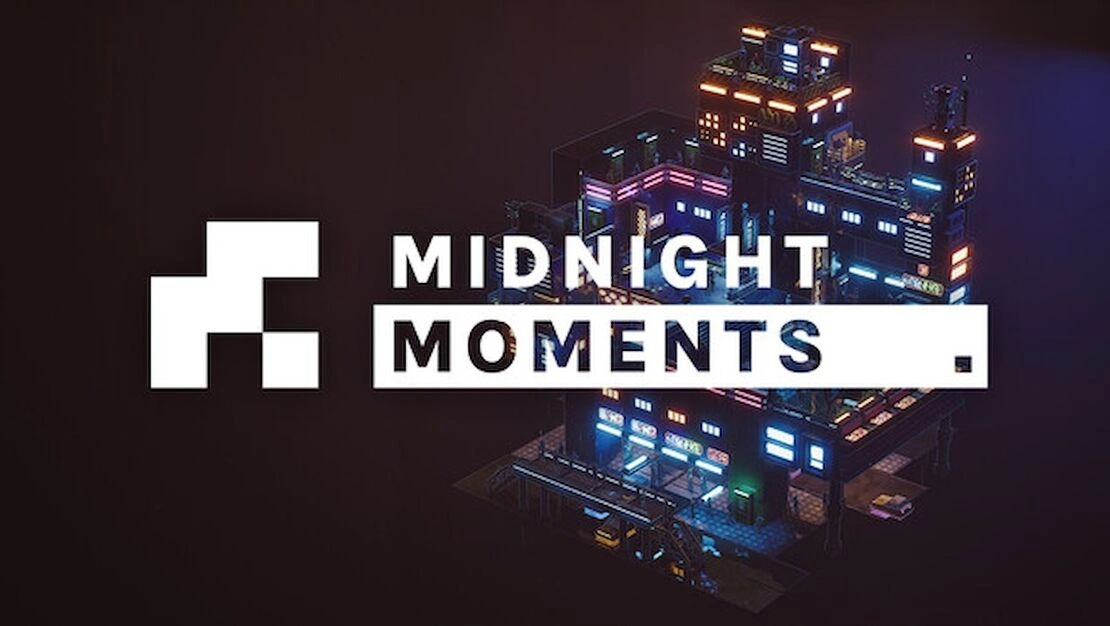

Rain can be turned up until the streets shine beneath colored signs, while a handful of citizens linger under lights you placed yourself. Midnight Moments has no mission waiting behind that scene. Happy Volcano simply hands you a small patch of cyberpunk city and asks what you want to build there.
You can start from an empty space or modify a pre-built structure, then assemble floors, walls, stairs, roofing, signs, lighting, and decorations without timers or scores. Compared with city builders built around economies and population management, this is closer to a digital diorama set. The scale is intentionally intimate. A nightclub tucked beneath an apartment block fits its tools far better than an entire futuristic metropolis.
That narrower focus gives Midnight Moments its identity, especially once its building pieces begin interacting in unexpected ways.
Building a Cyberpunk Snapshot
Construction starts with fairly ordinary components. Floors establish the base, walls give the scene shape, and pillars, stairs, fences, cladding, doors, signs, electrical equipment, plants, furniture, and lights fill the gaps. The clever part is how loosely Midnight Moments defines many of those pieces.
Its mostly textless interface groups objects through icons and basic shapes rather than rigid descriptions. Something that resembles a divider can become architectural trim. A decorative panel might serve as a window. That freedom recalls physical model building, where the interesting question is often what you can make from the pieces available rather than what each piece was originally intended to represent.
Placement has some useful flexibility too. If a wall section does not perfectly fit the remaining floor space, another piece can adapt instead of producing an ugly overlap or refusing placement. Objects can intersect when needed, which makes repairing small construction gaps much less irritating than it can be in stricter building games.
Citizens provide the final ingredient. You can scatter people around a street, place someone against a wall, or arrange groups near a club entrance. Some selections produce different models or poses when refreshed, and vegetation can vary in size or shape. These small changes help disguise repetition.
The human models themselves are less convincing as cyberpunk inhabitants. Their clothing largely resembles contemporary streetwear, with little of the exaggerated fashion, body modification, or technological ornament associated with the genre. Midnight Moments can construct a convincing futuristic street much easier than it can populate one.
Rain, Light, and Tiny Noises
Lighting is where the game’s simple construction kit becomes considerably richer. The default darkness gives every lamp, illuminated window, and glowing sign a practical role in composing the scene. Players can adjust brightness, environmental color, light direction, and rainfall, then zoom close enough to watch neon reflect across wet pavement.

Those controls can completely change identical architecture. A narrow alley surrounded by dark walls can feel neglected under weak lighting, then resemble the entrance to a busy nightclub after a few colored signs and brighter fixtures are added. Six neon color options provide enough variation to separate different zones without turning the lighting menu into another construction system to learn.
Midnight Moments also understands that placing objects needs to feel pleasant when placing objects is almost the entire game. Metal pieces land with a heavier clunk, lighter decorations produce smaller clicks, and deleting an object causes it to burst apart into pixels. These are tiny details, yet repeated hundreds of times during a build, they matter.
There is no traditional soundtrack carrying a session. Rain and distant city ambience leave space for a podcast or personal playlist, which suits the game’s unhurried structure. One strange inconsistency appears if visual rain is disabled while its ambient sound continues playing. For a game built around controlling atmosphere, that disconnect is surprisingly noticeable.
When the Tools Push Back
The interface becomes easier after a few sessions, but getting there involves unnecessary guessing. Icons have little descriptive labeling, so early building often means clicking through categories until you remember where everything lives. It is entirely possible to mistake one prop for another before understanding the library.

Camera movement creates another layer of friction. Zooming works well, yet moving across the scene while holding a selected object can require keyboard controls rather than simply pushing the cursor toward the screen edge. That interruption sounds minor until you are repeatedly moving pieces around a detailed build.
Snapping is the bigger issue. Components prefer certain orientations when connecting, while the rotation tools do not always provide enough control to fight those preferences. Try placing illuminated wall panels behind a character at a specific angle and the system can insist on facing them somewhere else. A creative sandbox becomes noticeably less relaxing when the software starts negotiating with you.
The available area creates similar limits. You can build upward with considerable freedom, but horizontal space is tight, reinforcing the game’s strength with compact street scenes while ruling out much of the sprawling-city fantasy its visual style initially suggests.
Repeated assets become increasingly obvious across several builds. Furniture is especially thin, with very few tables, chairs, or sofas, while signs and decorations soon reappear from one scene to the next. There are also few pieces suited to fights, chases, or other action-oriented compositions, so most dioramas naturally settle into slices of everyday city life.
Crowded scenes can place surprising pressure on hardware once rain, reflections, civilians, props, and multiple light sources accumulate. The missing autosave is harder to excuse. Midnight Moments warns you before quitting, yet a crash after a long unsaved session can erase exactly the kind of careful, incremental work the game encourages.
Its best building sessions happen when limited shapes provoke a clever solution. Its most frustrating ones happen when snapping, rotation, or the asset library decides that solution cannot quite exist.
The Review
Midnight Moments
Midnight Moments works best when its simple pieces stop looking like construction assets and start resembling a lived-in corner of a neon city. Happy Volcano gives players enough control over lighting, rain, architecture, and population to make small dioramas surprisingly expressive. The limitations appear once ambition grows: restrictive snapping, awkward rotation, repeated furniture, a cramped footprint, and the lack of autosave all interfere with its relaxed rhythm. Compared with deeper building sandboxes, its toolkit is modest, yet its focused scale gives the game a distinct creative identity.
PROS
- Excellent neon lighting and reflections
- Flexible use of simple geometric pieces
- Relaxing, pressure-free building
- Satisfying environmental sound design
- Strong freedom within small scenes
CONS
- Restrictive snapping and rotation
- Limited furniture and prop variety
- Awkward camera behavior
- Small horizontal build space
- No autosave







