



























Megan’s therapy disclosure barely has time to settle before Wild Hearts resumes the machinery of KATSEYE’s rise. Rehearsals expose the physical labor required to make a few seconds of choreography appear effortless. Doubt surfaces, fatigue becomes visible, and for a moment KATSEYE’s extraordinary rise looks less like a success story than a system placing six young women under continuous pressure. Then the film returns to the next performance, campaign, milestone, or declaration of perseverance.
Director Nadia Hallgren has access that many artist documentaries would envy. Katseye: Wild Hearts can enter spaces where professional polish has temporarily broken down, and its strongest passages come from the small disclosures that success cannot fully absorb. The limitation lies in how little time those disclosures are allowed to remain unresolved. Hardship tends to acquire a purpose almost immediately. Pain becomes discipline. Backlash becomes conviction. Exhaustion becomes evidence of commitment. The film exposes the cost, then folds that cost back into the mythology of earning everything that follows.
That tendency is clearest around Megan. Her discussion of mental health and physical injury gives Wild Hearts one of its sharpest opportunities to examine what constant visibility does to a performer barely into adulthood. She speaks with a directness that punctures the controlled language surrounding much of the group’s public image. The film lets the admission register, yet its editing rarely stays with the uncertainty such material creates. A polished beat waits nearby. Momentum resumes.
The rehearsal footage complicates any easy accusation of sanitization. Hallgren does show the work. Choreography is drilled until a sequence that looks instinctive has clearly become the product of repetition, physical correction, and stamina. The labor behind “Animal” makes effortlessness look like one of pop music’s most carefully manufactured illusions. Cameras also catch shoots pushing into uncomfortable hours. These moments give the documentary texture because they refuse the fantasy that charisma arrives fully formed.
The same process shapes the section around “Gnarly.” Early hostility toward the song becomes part of a story about KATSEYE learning to trust its own choices. Lara’s account of standing behind the track gives the episode genuine value. A group built through a highly controlled selection process discovers a measure of creative confidence by surviving public rejection. Yet the film prefers the completed arc. Criticism has a destination. Resistance is useful because it can later be identified as the obstacle that made success sweeter.
Some of the most revealing material is quieter. Yoonchae describes how she once relied on the same safe expression whenever a camera appeared, then gradually became comfortable showing other sides of herself. The detail says plenty without announcing its importance. A repeated pose becomes evidence of self-protection, and the change in that pose marks a shift in confidence that no motivational montage needs to explain.
Sophia’s role inside the group emerges through behavior rather than formal explanation. Questions drift toward her, and she accepts the responsibility with little ceremony. Her presence makes leadership appear less like status than accumulated obligation. Lara gets a different kind of space, including a failed mockumentary gag and discussion of writing “Unloveu,” moments that allow humor and creative instinct to exist without needing to prove resilience. Daniela’s connection to “Gabriela” carries another form of specificity, tying performance to the significance she places on singing in Spanish and representing Latin audiences.
These passages reveal the documentary KATSEYE’s personalities can sustain. The members rarely need a larger narrative imposed on them. Their gestures, jokes, creative choices, and small defensive habits already provide one.
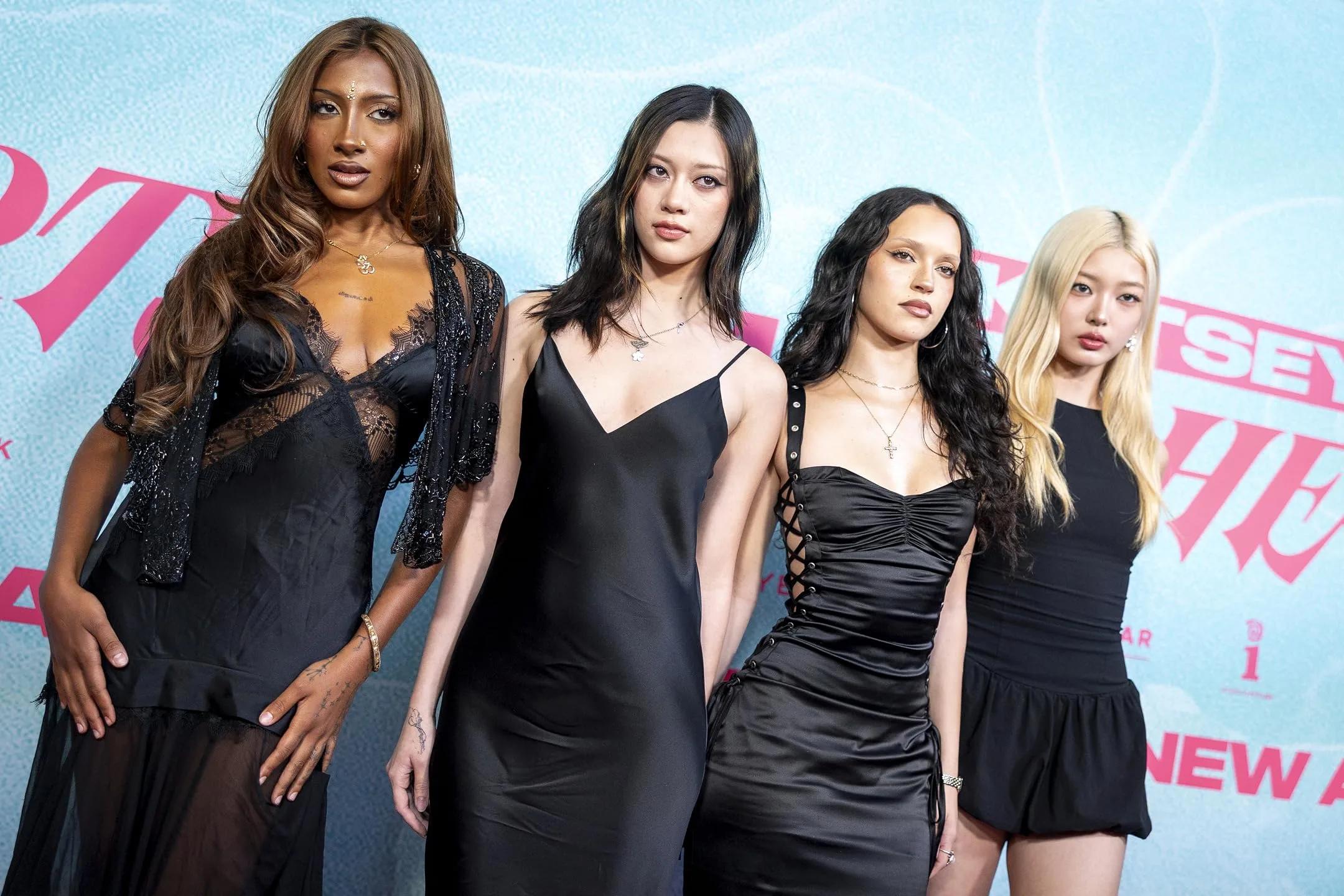
That makes the uneven treatment of Manon harder to ignore. She remains part of the film’s account of the group, yet her speaking presence is comparatively limited, with much of her visibility carrying an archival quality. Wild Hearts offers no secure basis for assigning a cause to that imbalance. The imbalance itself still matters. A documentary built around intimacy changes when one member is easier to see than to hear.
Creative disagreement receives similar treatment. The film can show rehearsal strain in great detail because rehearsal strain fits comfortably inside a professional ethic: work is hard, the members work hard, achievement follows. Messier questions about control, disagreement, or relationships inside the machine have no equally sustained place. The distinction reveals where the film’s curiosity begins to narrow.
Fan reactions, promotional footage, songs, campaigns, and career markers therefore perform two jobs at once. They document the environment KATSEYE actually inhabits, one in which fandom, branding, performance, and online judgment have become inseparable parts of daily work. They also provide the film with an escape route whenever vulnerability threatens to disturb its celebratory shape. There is always another stage waiting.
Hallgren’s access produces enough candid material to prevent Wild Hearts from becoming empty promotion. Its subjects repeatedly push past the neat categories prepared for them. The editing keeps catching up. Each time strain acquires weight, the film finds a way to make that strain useful again, converting fatigue, backlash, injury, or fear into proof that KATSEYE can keep moving.
That conversion is where Wild Hearts finally reveals the limits of its intimacy. Success is permitted to have a cost. The cost simply cannot remain a cost for very long.
Katseye: Wild Hearts premiered globally on Netflix on August 14, 2026. You can stream the docuseries exclusively on Netflix. The narrative offers an intimate, behind-the-scenes look at global girl group Katseye as they navigate the pressure of their breakout year, worldwide concert tour, and crafting their long-awaited debut album under HYBE and Geffen Records.
Where to Watch Katseye: Wild Hearts (2026) Online


Full Credits
Title: Katseye: Wild Hearts
Distributor: Netflix, HYBE, Geffen Records
Release date: August 14, 2026
Rating: TV-14
Running time: 48–52 minutes
Director: Nadia Hallgren
Writers: Nadia Hallgren
Producers and Executive Producers: Bang Si-hyuk, John Janick, Nadia Hallgren, Scooter Braun, Sara Bernstein, Justin Wilkes, Ryan Ruden
Cast: Sophia Laforteza, Lara Raj, Daniela Avanzini, Yoonchae Jeong, Megan Skiendiel, Manon Bannerman, Bang Si-hyuk, Son Sung-deuk
Director of Photography (Cinematographer): Nadia Hallgren, Bryan Gentry
Editors: Jennifer Tiexiera, Jessica Hernández
Composer: Kris Bowers
The Review
Katseye: Wild Hearts
Katseye: Wild Hearts has access rich enough to expose the strain beneath KATSEYE's polish, and its best moments let therapy, injury, rehearsal labor, leadership, and self-protection speak without decoration. Nadia Hallgren's film repeatedly pulls those disclosures back into a success narrative, limiting the uncertainty its subjects create. The result is candid, energetic, and often revealing, with a promotional instinct that keeps deeper questions about control and cost at a careful distance.
PROS
- Candid member disclosures
- Strong rehearsal footage
- Specific personality moments
- Thoughtful attention to physical strain
CONS
- Vulnerability quickly repackaged
- Limited creative disagreement
- Uneven Manon presence
- Promotional momentum curbs uncertainty