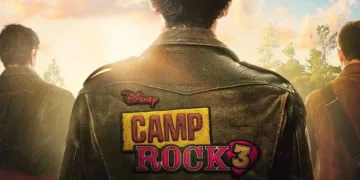






















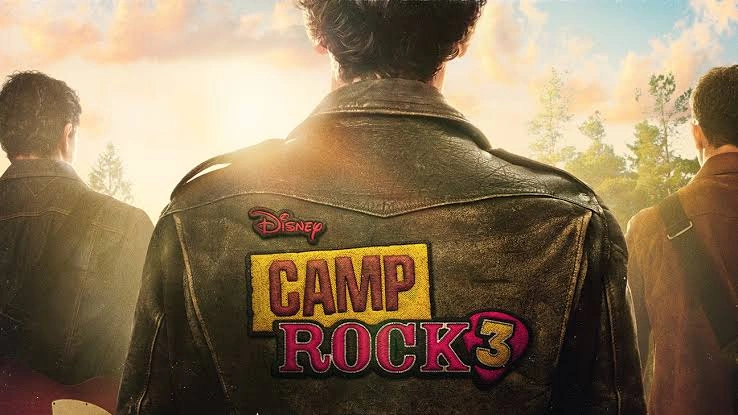

Camp Rock has somehow survived long enough to acquire mythology. The summer retreat where Mitchie Torres once nervously sang from behind a kitchen wall now possesses traditions, famous alumni and campers who speak about its history with the reverence usually reserved for institutions with marble plaques. Camp Rock 3 understands the joke. Mitchie’s old songbook collects dust, old chants have become camp folklore, and Sage arrives convinced that spending a summer here could alter the course of her life.
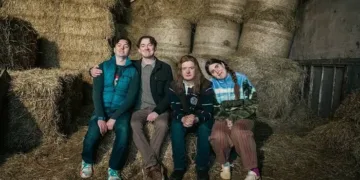
Sixteen years after Camp Rock 2: The Final Jam, Disney returns to the franchise with director Veronica Rodriguez and writer Eydie Faye handing its future to a new group. The Jonas Brothers reprise Connect 3, now preparing for a reunion tour while rediscovering how irritating brothers can become after decades spent working together. When their opening act disappears, manager Lark turns Camp Rock into an audition ground. Sage, her estranged brother Desi, classical cellist Rosie, drummer Cliff and mysterious guitarist Fletch emerge as the primary contenders.
The decision to keep Connect 3 near the edges immediately gives the movie a chance to escape the usual legacy-sequel trap. Their presence establishes continuity, then the camera stays with kids who regard the original characters as history rather than contemporaries. Nostalgia becomes part of the setting itself. That is a considerably healthier relationship with the past than simply asking forty-year-old characters to reenact their adolescence.
Ambition Has a Melody
Sage arrives carrying precisely the flaw Camp Rock tends to romanticize. She has talent, confidence and a tremendous appetite for recognition. Before she has settled into camp life, her songs already imagine the glare of the spotlight. Liamani Segura plays that confidence without turning Sage into a miniature diva. The tension appears when Desi arrives.
Their sibling relationship gives Camp Rock 3 its strongest dramatic material. Sage left the band she shared with her brother because she wanted something larger. Desi presents himself as the sibling who cared about playing rather than celebrity, until Connect 3 places a stadium-tour opportunity within reach. Suddenly his disdain for Sage’s ambition becomes harder to separate from his own desire to win.
The screenplay occasionally explains this conflict too plainly, yet Segura and Hudson Stone find smaller gestures that make it convincing. Their irritation carries the muscle memory of two people who know exactly which wound to press. When they finally sing “Rhythm’s Only Right” together, reconciliation arrives through the thing that divided them in the first place. Their voices cooperate before their pride fully catches up.
Sage’s relationships with the other campers gradually expose how narrow her thinking has become. Fletch initially appears through an absurd cloud of rumor after arriving in a sheriff’s vehicle. Campers discuss him like a teenage outlaw who has wandered into a Disney musical from another genre. Malachi Barton plays him with enough reserve to make the exaggeration funny while preserving the vulnerability underneath.
The overnight tour-bus challenge gives Sage and Fletch the quietest material in the movie. Removed from the competitive stage, their conversation makes Fletch’s guardedness legible and gives their attraction something beyond exchanged glances. His painful home history explains his reluctance to become attached to people. Sage, meanwhile, begins discovering that relationships cannot be treated as obstacles positioned between herself and applause.
Rosie’s conflict works through performance rather than romance. She arrives attached to classical discipline, with her cello functioning almost like an extension of the rules imposed by her parents. “Play It My Way” later lets Lumi Pollack break that posture apart physically and musically. Her movement becomes looser, her voice louder, her presentation less obedient. The transformation happens quickly, yet the performance itself sells the release.
Cliff occupies a simpler comic register. Casey Trotter’s drummer taps on every available surface until someone finally throws his drumsticks onto a cabin roof. It is a small gag, but the persistence gives the group some needed messiness. Teenagers spending summer together should occasionally irritate one another for reasons that have nothing to do with destiny.
Ninety Minutes, Fifteen Stories
Lark’s competition gives Rodriguez a functional structure. Campers reinterpret Connect 3 songs, face a dance challenge, survive an overnight tour-bus exercise and prepare original performances for the Final Jam. Each stage creates opportunities for alliances to change and personalities to emerge.
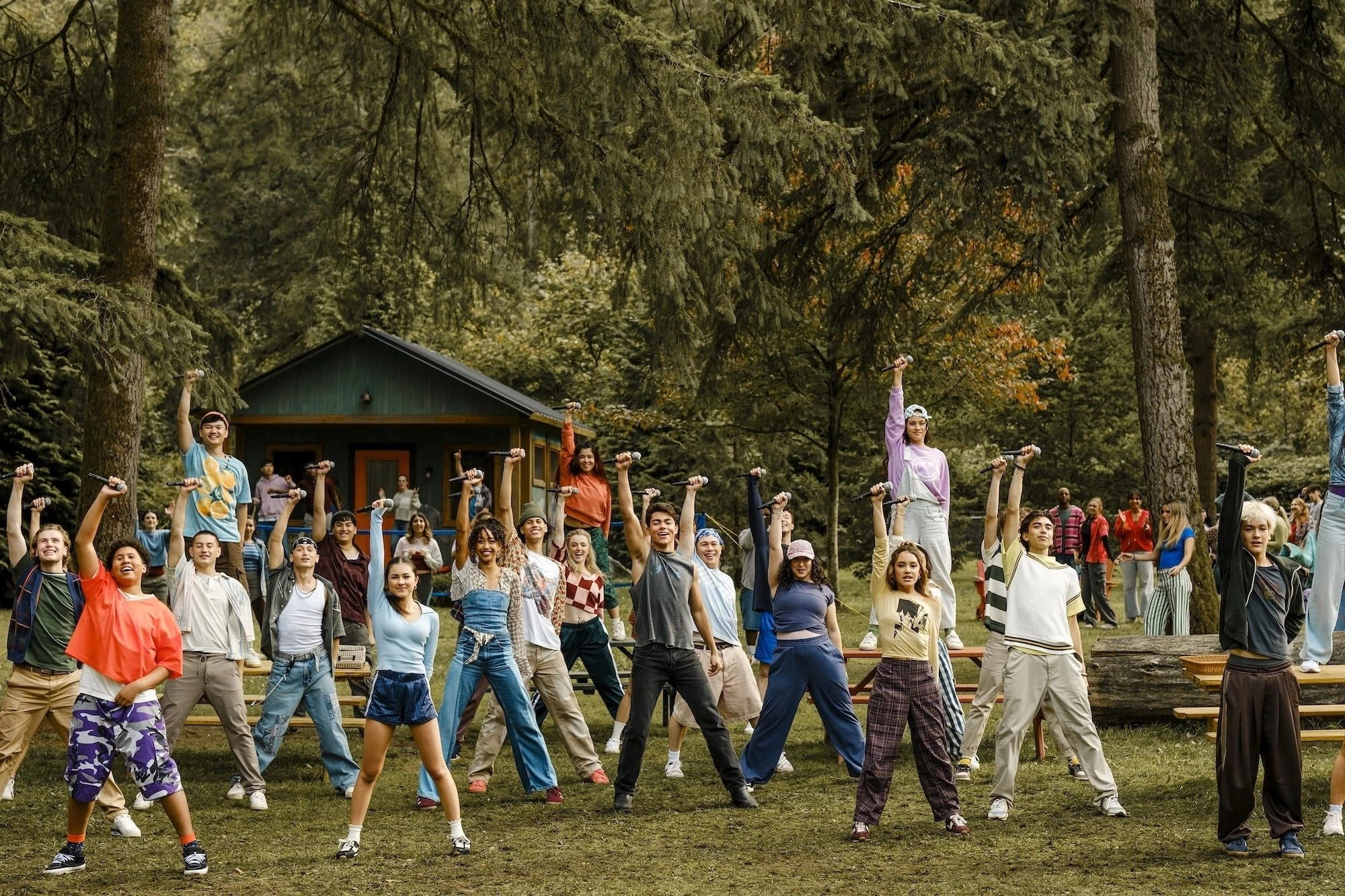
The tour bus is where the film briefly becomes the ensemble piece it keeps promising. Camp Rock’s phone ban has already removed the easiest escape route from uncomfortable conversations. Inside the bus, the five finalists have nowhere to hide.
Pairings form, tensions soften, and Fletch’s mystery finally gives way to something human. The sequence works because the competition momentarily stops functioning like a talent show. The problem is simple arithmetic. There are too many characters for a movie barely reaching feature length.
Callie begins developing a meaningful friendship with Sage while sharing dance scenes with Desi. Those lessons imply a relationship that the Final Jam later assumes has progressed substantially, yet several missing emotional steps can be felt between setup and payoff. Brooklynn Pitts makes Callie warm enough to warrant greater attention.
Madison receives even less complexity. Her influencer persona, complete with two followers who seem to operate from a shared nervous system, positions her as the designated antagonist. She steals belongings, decorates other people’s possessions without permission and schemes to have the central group removed from camp.
The sabotage eventually detonates into a paint fight inside the arts-and-crafts building, an appropriately ridiculous eruption of Disney Channel hostility. She never becomes dangerous enough to reshape the competition. Madison functions primarily as pressure applied wherever the screenplay needs an argument.
Fletch suffers from the opposite issue. His background carries enough emotional weight for a larger storyline, yet its revelation arrives partly to sharpen Sage’s development. Rosie’s parental conflict has similar compression. Her movement from disciplined cellist to “my sound, my rules” performer contains a full adolescent rebellion, squeezed into a handful of scenes and one showcase number.
The result frequently resembles the opening episodes of a television series compressed into a movie. These characters have enough personality to sustain further stories. The film keeps revealing doors and then walking past them.
New Voices Singing Old Songs
Musically, Camp Rock 3 faces the same problem as its characters. Everyone wants to establish an identity inside a place already saturated with famous voices. “Brand New Day” announces Sage’s arrival with little ambiguity about its purpose.
“One Beat Away” then gives Segura and the wider ensemble a bright declaration of intent. Both songs perform the necessary work of presenting this cast as a generation with its own sound. Then the old catalog enters.
“Play My Music” and “Start the Party” return through the competition, inviting younger performers to reinterpret material attached to Connect 3 and the franchise’s first era. The device makes narrative sense. These campers are effectively auditioning inside Disney history, so performing inherited songs becomes part of their examination.
Yet the strongest argument for the new cast comes from the songs written specifically around them. “Rhythm’s Only Right” belongs to Sage and Desi because its emotional function cannot be separated from their history. Rosie’s “Play It My Way” matters because Pollack performs it as a rebellion against the carefully controlled person introduced earlier. “Work in Progress” allows the group identity to replace the winner-takes-all mentality driving the competition.
Those numbers expose a strange limitation. Segura, Stone, Pollack, Barton and Trotter possess enough musical character that another two original songs might have done greater work than another familiar refrain. Some returning tracks receive glossy arrangements that sand away the appealing roughness of young performers testing their voices.
The final “We Rock” avoids that problem through scale. Bringing both generations together transforms a familiar anthem into a transfer ceremony. The song has already belonged to somebody else. The pleasure comes from watching ownership expand.
The Adults Finally Learn to Step Aside
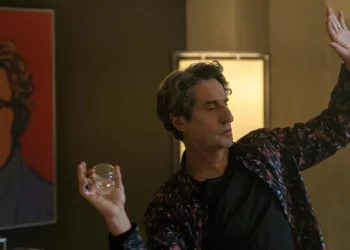
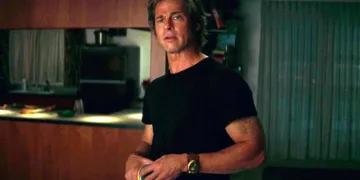
Legacy characters are often summoned to certify that replacements are worthy. Camp Rock 3 handles the ritual with unusual restraint. Connect 3 begin in a mild state of fraternal disrepair. Their reunion tour is commercially enormous, yet the brothers struggle to remember what making music together is supposed to feel like. Joe Jonas’s Shane voices frustration with performing some expected version of themselves, a line that gains extra texture from the real Jonas Brothers’ public history without requiring biographical explanation.
Nick and Kevin receive smaller comic and character beats, while the group’s limited screen time prevents their problems from consuming the younger cast. Their friction also mirrors Sage and Desi’s dispute. Both sets of siblings need to rediscover a relationship underneath professional ambition.
Maria Canals-Barrera’s Connie Torres offers a subtler bridge. Promoting Mitchie’s mother to Camp Rock director makes sense because Connie always understood the camp as a place where encouragement mattered as much as performance. Her scenes with Sage and Fletch allow her to occupy an active mentoring role instead of functioning as a nostalgia delivery system.
Sherry Cola’s Lark attacks the assignment from another angle. Her outsider status makes the camp’s absurd traditions visible again. Watching her encounter the institution’s mythology gives the movie permission to laugh at its own reverence.
Demi Lovato’s late appearance carries the heaviest historical charge. Mitchie is now an established artist, allowing the first film’s dream to exist somewhere beyond Camp Rock. Her scene with Connie restores the mother-daughter relationship before Shane enters the equation, a smart ordering choice that keeps Mitchie from returning solely as somebody’s former romantic interest.
The exchanges between Mitchie and Shane remain deliberately open. Their looks communicate familiarity, affection and years the screenplay declines to inventory. When Shane floats the possibility of returning at the same time next year and Mitchie accepts, Camp Rock 3 leaves the door unlocked without pretending sixteen missing years can be repaired with one cameo. Then Mitchie meets Sage.
For a franchise built around teenagers desperate to be discovered, the image carries an unexpectedly useful correction. Sage does not need to become Mitchie. Mitchie simply needs to recognize that another singer is ready to occupy the stage. The old Camp Rock spent much of its energy manufacturing stars. This one is most persuasive when its stars make room.
Camp Rock 3 premiered on Disney Channel on August 13, 2026, before its streaming release on Disney+. The musical film follows a new generation of campers arriving at the iconic summer music camp alongside returning favorites as they navigate fresh rivalries and creative ambitions.
Where to Watch Camp Rock 3 (2026) Online







Full Credits
Title: Camp Rock 3
Distributor: Disney Platform Distribution
Release date: August 13, 2026
Rating: TV-G
Running time: 92 minutes
Director: Veronica Rodriguez
Writers: Eydie Faye
Producers and Executive Producers: Tracey Jeffrey, Joe Jonas, Kevin Jonas, Nick Jonas, Demi Lovato, Tim Federle, Betsy Sullenger, Spencer Berman, Gary Marsh
Cast: Liamani Segura, Malachi Barton, Lumi Pollack, Casey Trotter, Hudson Stone, Brooklynn Pitts, Joe Jonas, Nick Jonas, Kevin Jonas, Maria Canals-Barrera, Sherry Cola, Demi Lovato
Director of Photography (Cinematographer): Vincent De Paula
Editors: Katie Abel
Composer: Tom Howe
The Review
Camp Rock 3
Camp Rock 3 understands that nostalgia works best as inheritance rather than imitation. Its sharpest choice is letting Sage, Desi, Rosie, Fletch and Cliff occupy the stage while Connect 3 and Mitchie linger at the edges as living history. The songs are catchy, the ensemble has chemistry, and the tour-bus sequence briefly gives these teenagers room to become people rather than Disney archetypes. Yet the 90-minute structure keeps compressing promising conflicts into tidy resolutions, leaving several arcs feeling like episodes from a series that never materialized.
PROS
- Strong new central ensemble
- Sage and Desi’s sibling dynamic
- Effective generational handoff
- Memorable tour-bus sequence
- Rosie’s musical breakout
CONS
- Overcrowded character roster
- Conflicts resolve too quickly
- Too few new songs
- Fletch remains underwritten
- Nostalgia occasionally overwhelms identity