

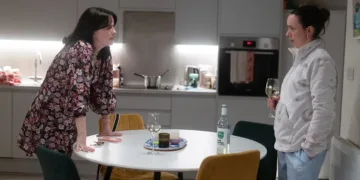
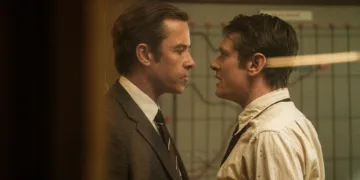











Frankie spends evening after evening parked outside the hospice and cannot make himself walk through the door. It is a wonderfully inefficient form of loyalty, which makes it believable. He wants to remain close to Taylor while postponing the moment closeness requires him to acknowledge that his best friend is dying. When he finally enters, he does so by breaking in.
That contradiction gives The State of Us its clearest idea. Jake Harvey, writing and directing alongside co-director Ollie Gardner, has constructed a buddy comedy around two young men whose friendship has become a mechanism for avoiding reality. Frankie, played by Samuel Bottomley, breaks terminally ill Taylor out of his Bradford hospice for one last night of drinking, parties and bad decisions.
Taylor, played by Callum Scott Howells, goes along with it partly because he wants the freedom and partly because Frankie plainly needs the escape even more than he does. The film is strongest whenever it recognizes this imbalance. Taylor is the person approaching death. Frankie behaves like the person being destroyed by it.
The Frankie Problem
Childhood explains some of that damage without completely excusing it. Frankie loses his mother young, watches his father collapse into alcoholism and eventually moves into Taylor’s family home. Taylor becomes friend, brother and emotional infrastructure simultaneously. Years later, cancer threatens to remove the person who supplied Frankie with the stability his childhood lacked.
Bottomley plays the consequences physically before the screenplay starts explaining them. Frankie talks too loudly, pushes jokes too far and treats every setback as an invitation to escalate. His hospice intrusion becomes a rescue mission in his own mind because rescuing Taylor for one evening is easier than admitting he cannot rescue him at all.
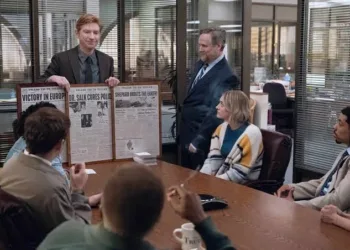
Their first hours outside follow familiar coming-of-age machinery. The pair manipulate a shopkeeper into giving them whisky, head to a chaotic house party and drift through drugs, aggression and juvenile comedy. Frances Barber supplies the funniest detour as an elderly hospice patient who needs their assistance getting to the toilet before entrusting them with a necklace for her granddaughter. Frankie approaches this responsibility with roughly the seriousness one would expect from a man breaking his dying friend out for a bender. Taylor, characteristically, cares.
The distinction matters. Howells refuses to play Taylor as a passive symbol of tragic purity. He can laugh, flirt and enjoy the idiocy around him, then turn sharply on Frankie when avoidance becomes cruelty. His brief connection with Rosie, played by Safia Oakley-Green, gives him a glimpse of ordinary youthful possibility. The subplot never develops enough to make Rosie feel fully dimensional, but Taylor’s interest in her has an ache precisely because the film allows it to remain incomplete.
Boys Who Cannot Leave
The overnight structure eventually forces Frankie and Taylor away from other people and into the conversations Frankie has been avoiding. Their exchanges in the car have greater force than the louder party sequences because Bottomley and Howells possess the easy hostility of people who know exactly where to hurt each other. An insult can become affection without changing tone. A joke can become accusation halfway through the sentence.
Taylor’s anger gives the friendship its necessary abrasion. Frankie has spent so much energy being terrified of losing him that he has effectively abandoned him already. Sitting outside the hospice night after night is devotion transformed into cowardice. Call it grief rehearsal: Frankie attempts to experience Taylor’s absence early, hoping repetition might dull the actual event. It does not work. Grief has rarely respected rehearsal schedules.
The return to the hill connected with their childhood gives Harvey’s screenplay its cleanest emotional symmetry. This landscape once held Frankie at the beginning of one catastrophic loss, and now it receives him as another approaches. Yunus Roy Imer photographs the Yorkshire surroundings without turning them into postcard consolation. The open space instead makes the boys look exposed, with nowhere left for Frankie to redirect the conversation.
Here the film also encounters its central structural weakness. Frankie processes years of buried grief, resentment and avoidance across a single night. Bottomley makes the emotional shift persuasive from moment to moment, particularly when Frankie loses the manic energy that has protected him through the earlier scenes, but the screenplay asks one evening to perform psychological labor that should probably take months.
Sentiment Versus Silence
Harvey and Gardner occasionally distrust the actors at exactly the moments when trust would serve them best. Brief childhood flashbacks keep returning after the essential history between Frankie and Taylor has already been established. Tom Ogden’s songs sometimes underline sadness that Bottomley’s face or Howells’s pauses have communicated perfectly well. Once the final third begins leaning harder toward tears, the film starts explaining emotions that were richer when left partially unspoken.
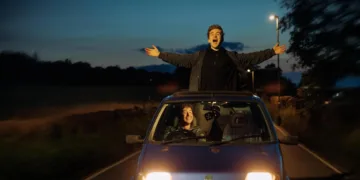
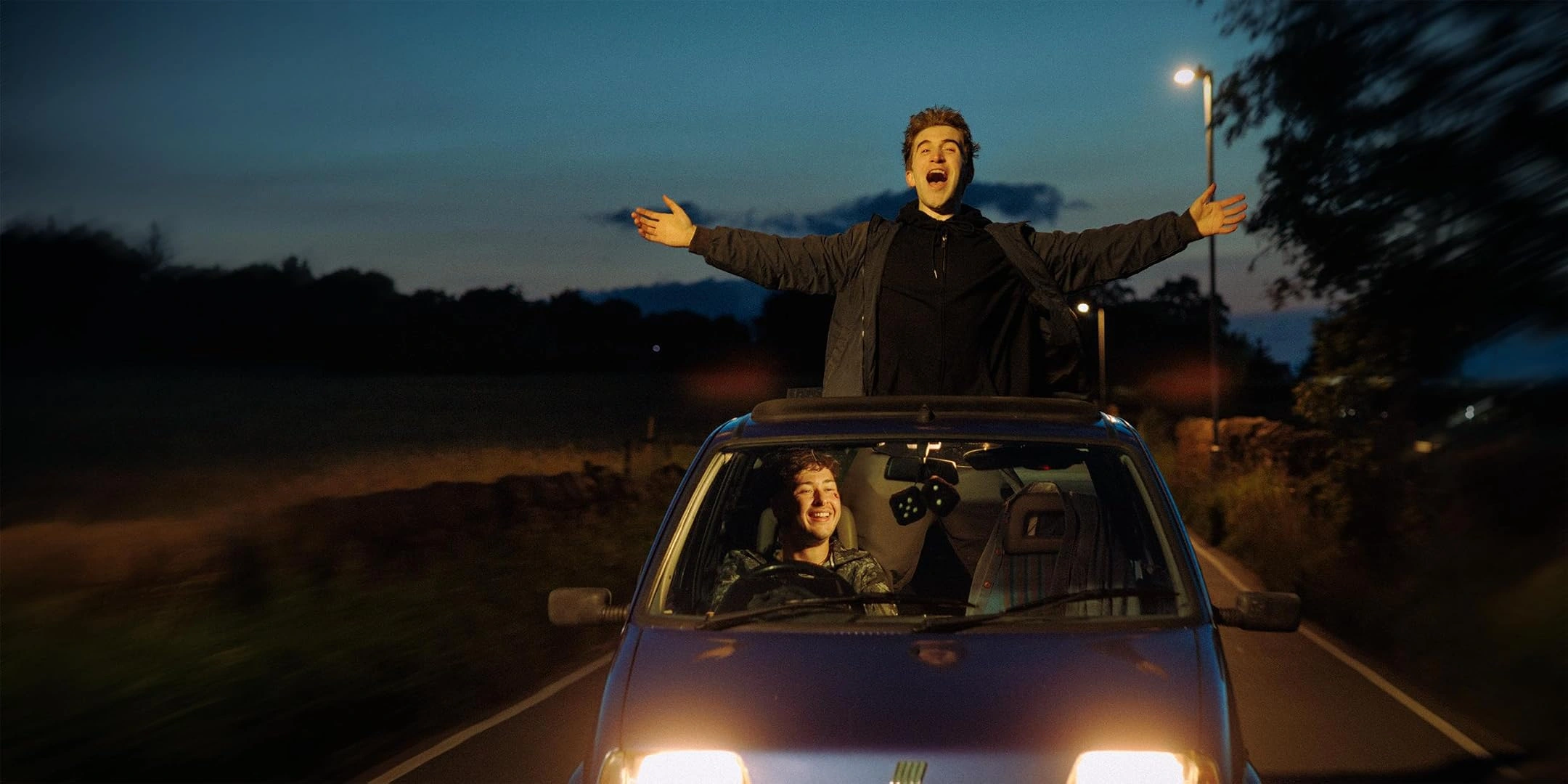
The sunroof sequence captures the contradiction. Taylor rises through the roof of Frankie’s battered car and lets the cold night hit him, arms extended in an image borrowed from decades of youth cinema. It is shamelessly familiar. It also works because Taylor is briefly behaving like the protagonist of a different film, one where boys his age have futures spacious enough to waste.
That fantasy cannot last. The best scenes never pretend it can. They let Frankie and Taylor occupy the same cramped car, trade insults, sit through uncomfortable silences and discover that affection cannot solve mortality. It can only remove some of the loneliness surrounding it. For two young men raised inside a culture where emotional fluency can still be treated like an embarrassing hobby, saying what they mean becomes the night’s most reckless act. The whisky was easier.
The State of Us premiered at the Edinburgh International Film Festival on August 14, 2026. The comedy-drama follows a boisterous and eventful night out in Bradford that turns sentimental for two young Northern lads.
Full Credits
Title: The State of Us
Release date: August 14, 2026
Running time: 90 minutes
Director: Ollie Gardner, Jake Harvey
Writers: Jake Harvey
Producers and Executive Producers: Pippa Cross, Jake Harvey, Dylan Rees, James Spring, James Scott, Alistair Mavor, Rachael Hunter, Janette Day
Cast: Callum Scott Howells, Samuel Bottomley, Frances Barber, Safia Oakley-Green, Seamus O’Hara, Bon Cooper
Director of Photography (Cinematographer): Yunus Roy Imer
Editors: Chris Gill, Abi Wright
Composer: Tom Ogden
The Review
The State of Us
The State of Us understands that Frankie’s worst fear is not Taylor’s death itself, but the possibility of surviving another abandonment. Samuel Bottomley makes that distinction painfully visible whenever Frankie converts panic into swagger, while Callum Scott Howells gives Taylor enough impatience to resist becoming a saintly symbol of mortality. The overnight transformation is tidier than the grief deserves, and the music occasionally insists on feelings already present in the performances. Still, those car conversations and the return to their childhood hill give the friendship a bruised, persuasive tenderness. Death approaches. The boys finally stop pretending otherwise.
PROS
- Bottomley’s fractured performance
- Natural chemistry between the leads
- Tender portrait of male friendship
- Strong Bradford and Yorkshire setting
- Effective dark humor
CONS
- Frankie changes too quickly
- Sentiment grows heavy late
- Rosie remains underwritten
- Music sometimes overstates emotion