
























Few games invite comparison as aggressively as Wild Blue Skies. Chuhai Labs has built an arcade rail shooter around anthropomorphic pilots, radio chatter, branching mission routes, laser upgrades, bombs, barrel rolls, rival squadrons, and a world map that changes depending on how well you perform. Anyone familiar with Star Fox 64 will recognize the family resemblance within minutes.
Bowie Stray leads the Blue Bombers alongside Thorne, Chuck Barbacoa, and Roe Whitetail, with the squad tasked with stopping the returning Grimclaw and his invading forces. The setup works perfectly well for an arcade campaign where story exists between sorties rather than driving them.
The problem is how often the resemblance extends past inspiration and into structure. That distinction matters because Wild Blue Skies has enough mechanical ideas to support its own identity. You can see them whenever the game stops recreating somebody else’s flight plan.
Arcade Rules, Modern Controls
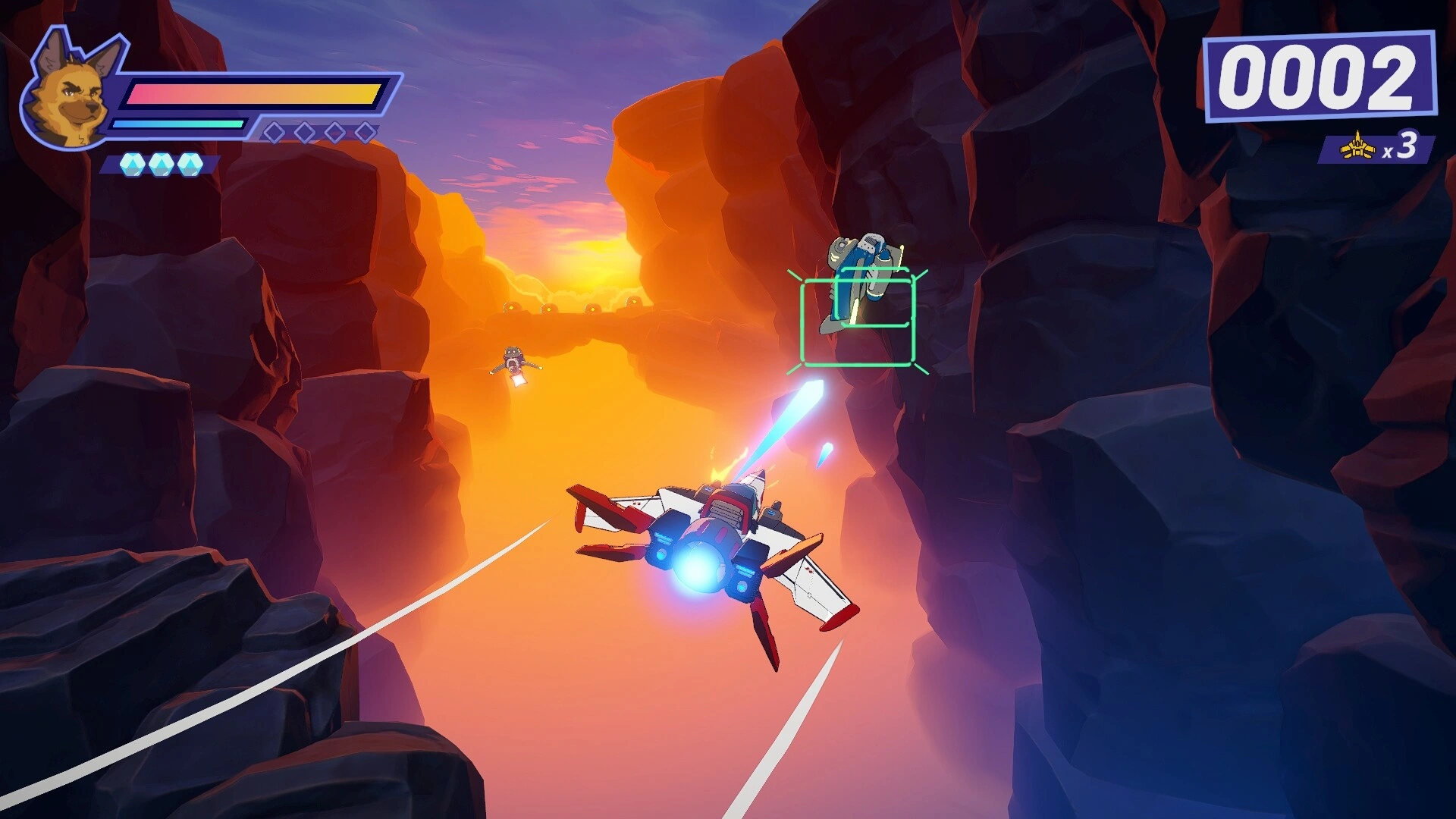
The basic shooting loop is smartly organized. Regular lasers and charged homing shots occupy separate buttons, letting you hold continuous fire while preparing a charge attack for clustered enemies. Bombs offer heavier crowd control, while a properly timed barrel roll can reflect incoming projectiles. Boosting and braking become increasingly valuable once missions start squeezing the Cloudcutter through tighter spaces.
The aircraft itself is less agreeable. Bowie moves quickly forward, yet lateral corrections can feel heavy, particularly before you learn to combine tilting and rolls into ordinary movement. Rail sections handle this limitation fairly well because enemy formations and obstacles are built around constant forward momentum. Free-flight encounters expose it. Chasing the rival Prowlers around an arena lacks the speed that makes the best linear missions snap into place, and repositioning can feel laborious once an opponent slips behind you.
Wild Blue Skies also builds much of its difficulty around resource attrition. Health pickups are scarce. Bowie receives only partial repairs between missions. Laser upgrades are valuable because the default weapon feels underpowered against tougher targets, yet taking several hits can strip those upgrades away. The trigger for losing them can feel inconsistent, which turns an understandable punishment system into something harder to plan around.
That has knock-on effects across an entire run. Limited lives mean repeatedly restarting a stage to chase a collectible or better score can weaken your position later. A bad encounter may leave you entering the next mission damaged and under-equipped.
The scoring systems are far better at encouraging repetition. Four WILD letters are hidden across each stage, ribbons reward high scores, and bonuses account for factors such as surviving wingmates, remaining health, and quick boss kills. Learning where enemies appear gradually turns a chaotic first flight into a rehearsed sequence of charged shots and positioning. The problem arrives when mastery becomes memorization. Missing one upgrade or collectible can make an optimal run feel effectively dead long before the mission ends.
Flying Someone Else’s Route
The clearest design problem is visible in the stages themselves. Archipelago follows Corneria remarkably closely, from early enemy placement to environmental obstacles and the alternate-route setup. Mines echoes Fortuna through its timed rival-squad encounter. Foundry borrows the rotating-arena structure of Bolse. Channel recreates much of Area 6’s fleet assault with water replacing space.
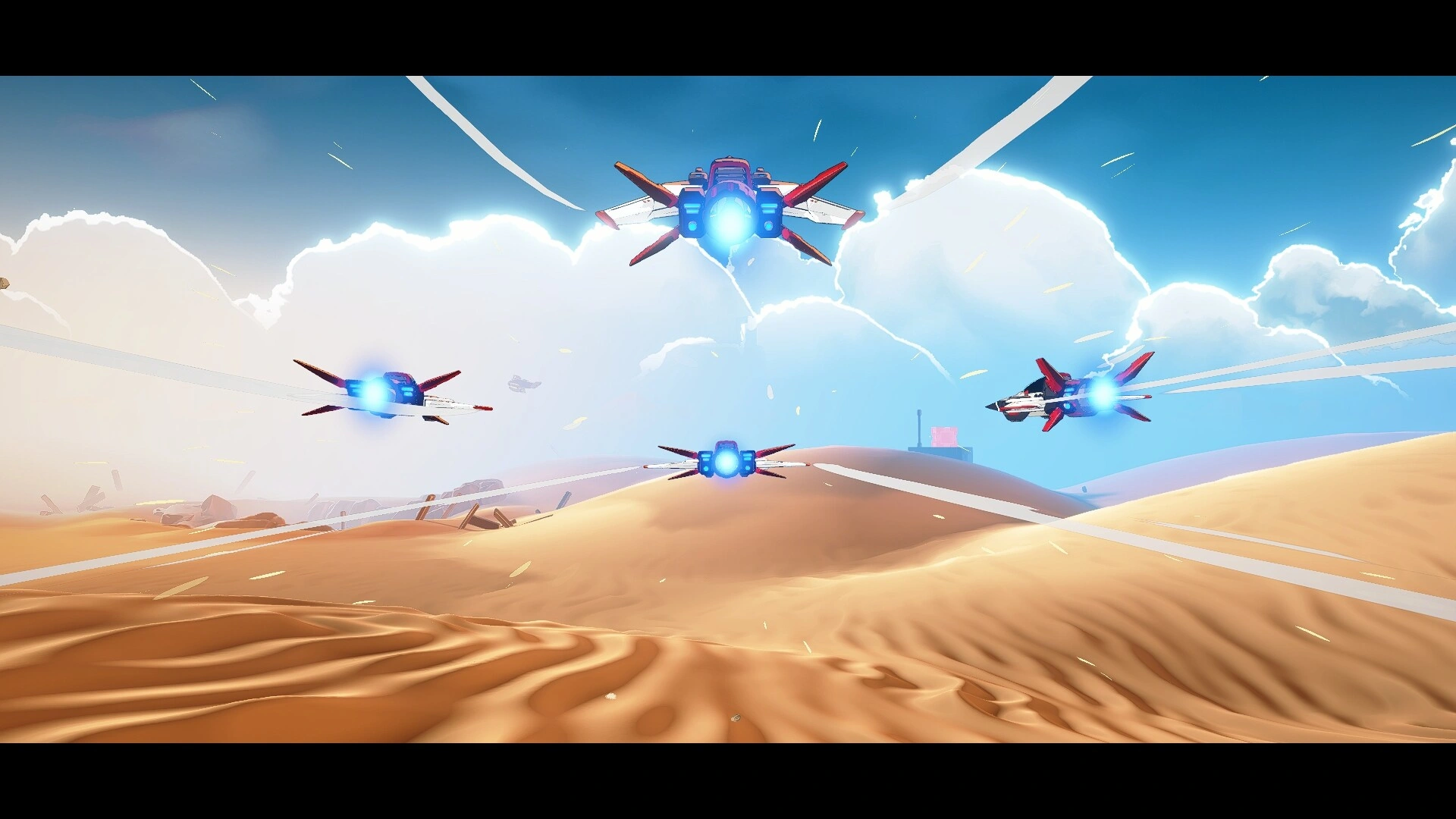
Iceberg reveals why copying a level’s ingredients is different from understanding its systems. Its searchlights recall Zoness, where avoiding detection was tied directly to how the mission developed. Here they function largely as score targets. The visual reference survives while the mechanic that gave the original device meaning has disappeared.
That pattern extends into the cast. Bowie occupies the dependable squad-leader role, Chuck serves as the veteran presence, and Thorne fills the louder supporting slot. Roe Whitetail, helped considerably by Suzie Yeung’s performance, fares better. Her restrained confidence gives the Blue Bombers a personality that feels less beholden to an existing archetype.
The villains receive less help from the script. Rival pilots appear, trade lines over the radio, and fight the squad, yet those encounters rarely have enough history attached to them to make shooting down a particular opponent feel different from destroying another target marker.
That thin characterization becomes especially apparent during sequences modeled after famous confrontations. The encounter has been reproduced. The relationship that made it matter has not.
Clear Air Ahead
Then Canyons arrives and shows what this team can actually do. Partway through the mission, the familiar horizontal flight path bends upward beside a waterfall. Bowie climbs while rocks tumble toward the ship and enemies attack from above, transforming the usual shooting rhythm into a vertical scramble through falling hazards. It lasts only a short time, yet the change alters how you read incoming threats and where you position the Cloudcutter.
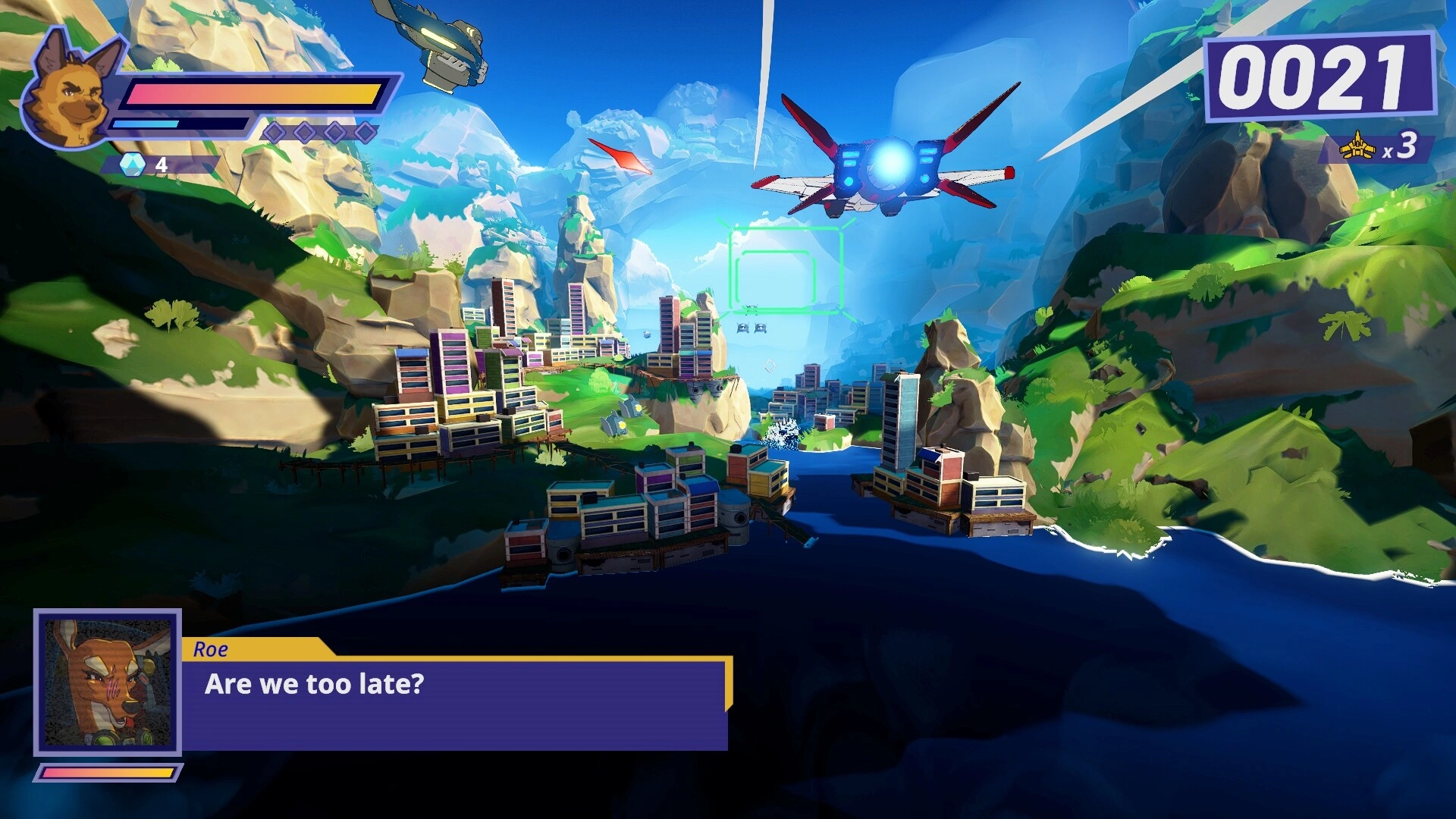
Its boss keeps that confidence going, pairing an absurd chicken adversary with committed voice work and unapologetic bird jokes. The encounter feels like Wild Blue Skies discovering the cartoon it wants to be rather than reenacting somebody else’s.
Cloudtop finds another strong idea by integrating its mechanical creature into the level itself, letting the enemy weave through the clouds before presenting clean opportunities to attack. Grottos reduces available flying space until movement becomes as dangerous as enemy fire. Hurricane carries recognizable genre influences, yet rearranges them enough that its hazards have their own rhythm.
The cel-shaded presentation helps these stages considerably. Aircraft cut clean silhouettes against pastel skies, caves, oceans, deserts, and volcanic terrain, while large formations give the rail sections the density an arcade shooter needs. Heavy action can produce frame-rate drops, particularly during some free-flight encounters, but the art direction retains its character when the screen fills with targets.
These missions make the derivative ones harder to excuse. Chuhai Labs clearly understands how to construct a memorable rail-shooter sequence. Canyons proves it with one waterfall, a vertical climb, and a ridiculous chicken waiting at the other end.
The Review
Wild Blue Skies
Wild Blue Skies has the machinery of a strong arcade shooter: branching routes, score-driven replays, useful separation between lasers and charge shots, and stages such as Canyons that turn flight itself into a satisfying challenge. Its systems falter when scarce healing, fragile weapon upgrades, and limited lives make one mistake disproportionately expensive. The larger problem is structural. Too many missions reproduce Star Fox 64 without carrying over the design logic that made those encounters work. Whenever Chuhai Labs builds something of its own, the difference is immediate.
PROS
- Excellent score-chasing structure
- Strong original stages
- Rewarding branching routes
- Stylish cel-shaded presentation
- Satisfying rail-shooter combat
CONS
- Excessively derivative level design
- Punishing upgrade loss
- Scarce healing
- Sluggish free-flight encounters
- Thin character development