





























There is something pointedly contemporary about a university where feminist slogans, influencer branding, men’s-rights resentment and institutional cowardice all compete for the same patch of grass. He Had It Coming turns Cecil James University into a pressure cooker of gender politics, then drops a castrated corpse into the quad before anyone has time to pretend the atmosphere was healthy.
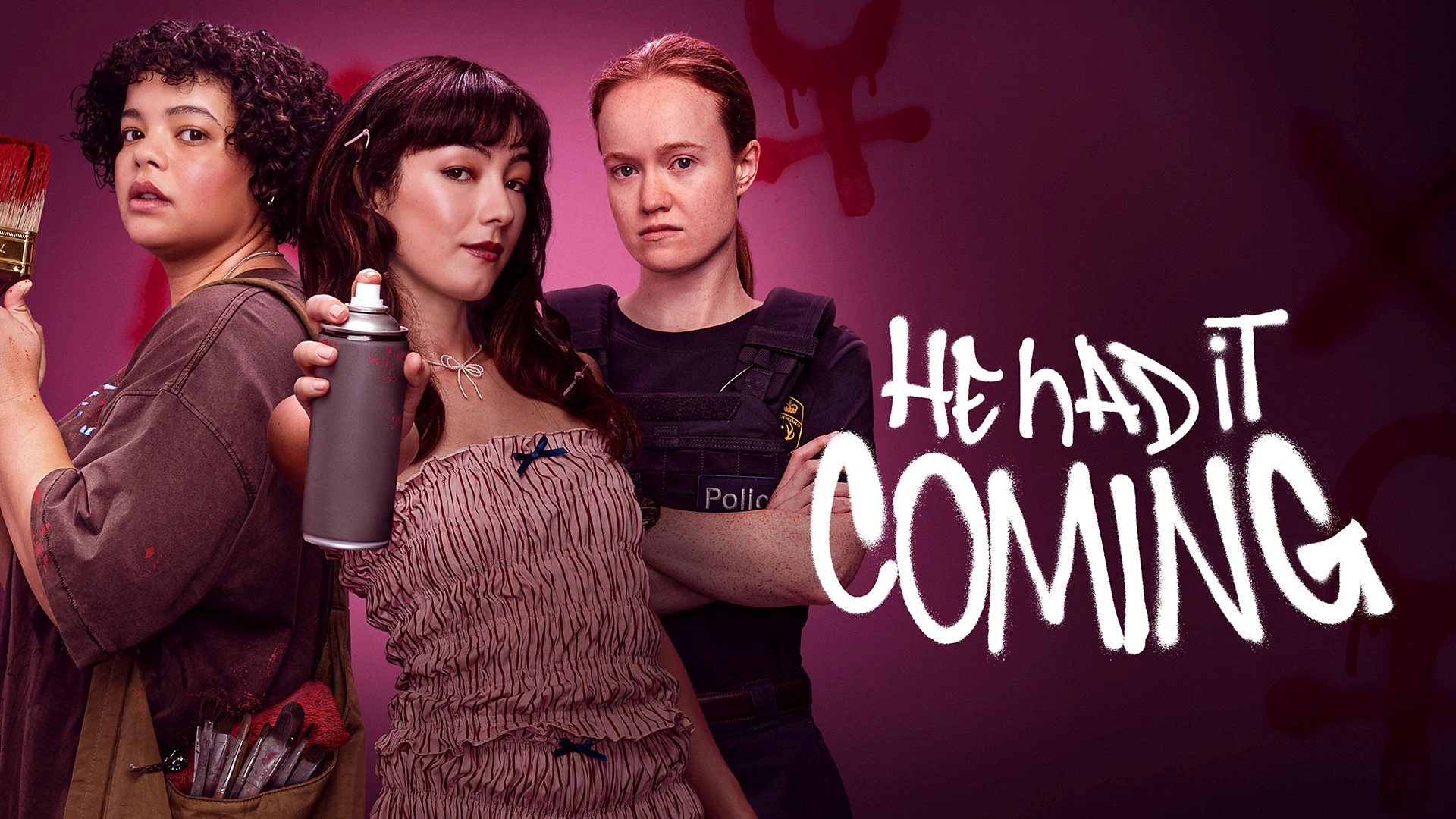
Elise, played by Lydia West, arrives as an English exchange student with a bagpipes scholarship and very little evidence that art school has been waiting for her. Professor Phoenix fails her attempt to repaint clothing onto famous female nudes, dismissing the work as insufficiently radical.
His suggestion that she should “be radical” becomes funnier once Elise meets Barbara, Natasha Liu Bordizzo’s fashion influencer, and the pair drunkenly attack the university founder’s statue while spraying feminist slogans across campus property.
The joke turns dangerous the next morning. A rugby player lies dead beneath the statue, mutilated in precisely the area Elise and Barbara had attacked with a hammer. Elise risks losing her scholarship if their vandalism becomes public. Barbara risks turning her carefully monetised identity into a political liability. Their sensible options vanish almost immediately because sensible people would make a very short television series.
Two Women, Several Terrible Decisions
West plays Elise as someone whose thoughts seem to arrive half a second before her ability to control them. She stress-vomits, carries neon-pink walkie-talkies normally used to communicate with her mother and imagines herself following in the footsteps of radical artists while repeatedly demonstrating terrible instincts under pressure. The comedy works when those contradictions collide, particularly when she and Barbara return to hide evidence rather than tell investigators what happened.
Bordizzo gives Barbara a different kind of instability. She knows how Cecil James University works because she has spent years benefiting from its social economy. Her followers, endorsements, MMA-loving boyfriend and glamorous friends provide status, yet every new death makes that status harder to defend.
The memorial party for the murdered rugby player captures the problem sharply. Barbara tries to say something respectful about a man widely known for predatory behaviour, producing the familiar social contortion in which misogyny becomes unfortunate only after someone dies.
Their chemistry gives the series a relationship stronger than its whodunnit machinery. Elise is socially misplaced enough to question rules Barbara has learned to survive inside. Barbara can see how Elise’s political grandstanding collapses once consequences arrive. Their friendship becomes increasingly credible because both women are capable of recognising the other’s hypocrisy without possessing much immunity to their own.
Feminism by Megaphone
The series finds its strongest satirical image when male students begin worrying about walking across campus at night. Fear suddenly requires committees, outrage and public recognition once men become its primary subjects. Women already accustomed to harassment can only watch the discovery unfold with grim familiarity. It is a blunt reversal, yet the bluntness suits a campus where “Kill All Men” and “Dead Men Don’t Rape” appear on protest signs while a men’s-rights faction marches nearby.

The institutional characters sharpen that picture. Professor Phoenix performs progressive sophistication while patronising Elise. Prue leads a militant feminist faction whose rhetoric easily becomes spectacle. Lyle represents organised male grievance before joining the growing list of victims.
The Vice Chancellor mostly wants the problem converted into something administratively manageable. Television has spent years turning universities into miniature battlegrounds for generational conflict, and He Had It Coming understands that the institution itself benefits from treating every moral crisis as a communications issue.
Its confidence weakens around the subjects requiring patience. Barbara’s history with Maya, her friends’ involvement in assault and Barbara’s own unresolved experience carry far heavier implications than the series gives them space to absorb. A stalker who begins as an expression of social media harassment gradually loses narrative weight. These ideas enter loudly, then compete with winking dogs, obscene ceramics, bra-size clues and falling trousers for oxygen.
The Mystery Keeps Wandering Off
The murder investigation functions less like a puzzle than a delivery system for Elise and Barbara’s escalating panic. Detective Shepherd, played by Liv Hewson, brings an intensity that suggests a richer procedural strand, yet the series rarely allows the investigation to become rigorous. Suspects accumulate, motives multiply and evidence appears, while viewers receive little opportunity to work through the crimes alongside the detectives.
That looseness becomes harder to ignore around episodes five through seven. Jenny’s knitting subplot, factional squabbles and assorted campus absurdities occupy time that could have deepened Barbara’s past or the social consequences of the killings. Elise’s stress vomiting works as an early expression of anxiety, then largely disappears, another sign that comic ideas are often introduced before the series has decided what they reveal about the character.
The tonal shifts can still produce inspired collisions. A serious discussion of radical feminism might be followed by someone losing their trousers, or a conversation about sexual intimidation might sit beside an absurd clue concerning a C cup. The show clearly wants irreverence to prevent its politics from hardening into a lecture. That instinct gives the comedy its manic personality. It also allows difficult material to escape scrutiny whenever the next gag arrives.
Episode eight leans on a cliffhanger rather than allowing the first season’s murder plot to provide a fully satisfying endpoint. Streaming television has developed a peculiar faith that unresolved business automatically generates appetite for renewal. Here, the choice leaves Elise and Barbara standing inside a story whose friendship has developed much further than its mystery. The women have learned to see each other more clearly. Cecil James University is still busy discovering what fear looks like once the wrong people are afraid.
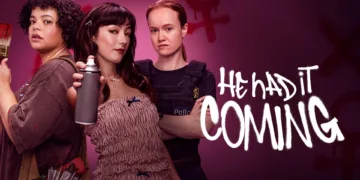
He Had It Coming premiered on the streaming platform Stan on November 20, 2025. This black comedy crime mystery follows two university students who find themselves caught in a serial killer’s path after an evening of drunken vandalism, touching on themes of campus politics and female anger.
Full Credits
Title: He Had It Coming
Distributor: Stan
Release date: November 20, 2025
Rating: TV-MA
Running time: 45 minutes per episode
Director: Craig Anderson, Sian Davies
Writers: Gretel Vella, Craig Anderson
Producers and Executive Producers: Gretel Vella, Nick Batzias, Virginia Whitwell, Amanda Duthie
Cast: Lydia West, Natasha Liu Bordizzo, Liv Hewson, Roxie Mohebbi, Harry Greenwood, Michael Sheen
Director of Photography (Cinematographer): Tyson Perkins
The Review
He Had It Coming
He Had It Coming has the instincts of a sharper campus satire than the series it finally becomes. Its reversals of gendered fear land best when male students suddenly discover what “unsafe after dark” feels like, while Elise and Barbara’s friendship gives the chaos a human center. The trouble is that the show keeps abandoning its hardest questions for slapstick, side plots, and a murder mystery too thin to carry eight episodes. Lydia West and Natasha Liu Bordizzo keep it watchable, but the satire rarely develops past provocation.
PROS
- Strong chemistry between the leads
- Sharp reversals of campus fear
- Energetic comic tone
- Barbara’s character development
CONS
- Uneven tonal shifts
- Thin procedural mystery
- Serious themes rushed
- Midseason pacing drags