
























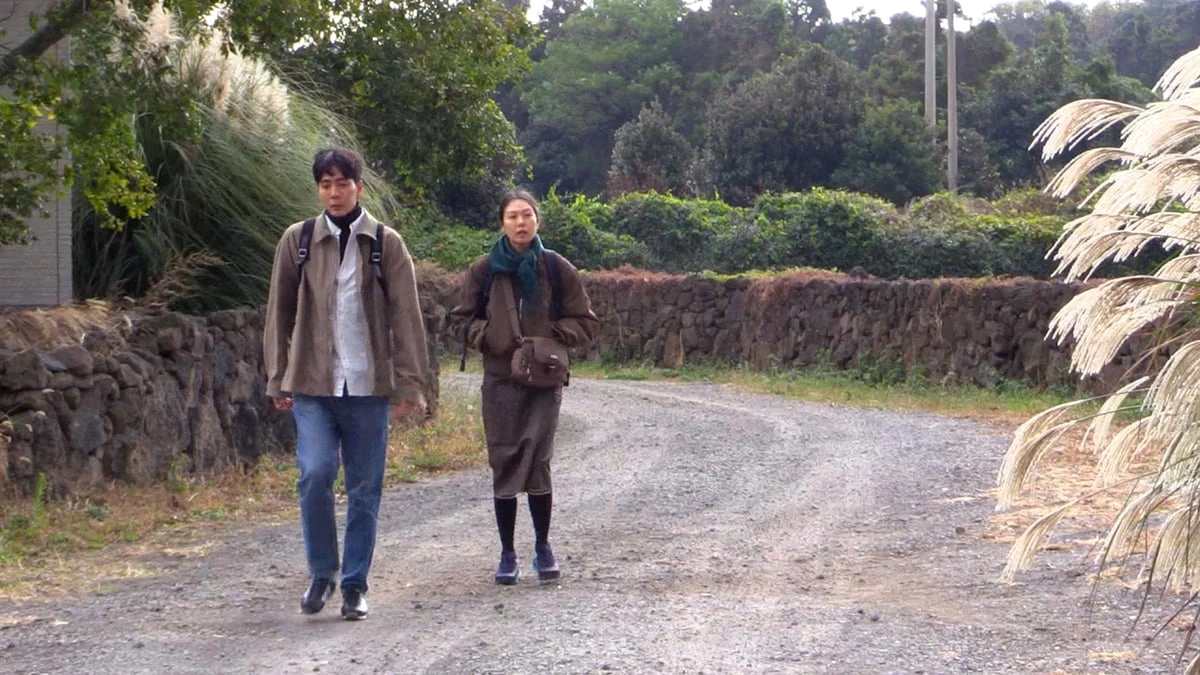
Jeju Island carries the visual promise of escape, yet Hong Sang-soo treats its coast as hostile emotional terrain. Sang-hee arrives from Seoul with her younger brother Sang-won after roughly ten years away from their mother, and the island greets them with hard wind, shifting clouds, and waves loud enough to compete with conversation. The scenery belongs to a tourist postcard. The family gathered inside it does not.
Sang-hee was largely raised by her grandparents after her parents separated. Her mother has since assembled a prosperous second life on Jeju, running a restaurant, developing a rental cottage, and living with her documentary-filmmaker husband and his daughter. Nobody stages the reunion as a reckoning. Sang-hee’s mother welcomes her politely, Sang-hee answers politely, and Hong lets good manners become a form of pressure.
That choice gives the film a distinctly Korean family tension that still travels easily across cultures. Deference, parental authority, career expectations, and filial obligation remain present without being announced. Sang-hee has crossed water to visit her mother, yet each careful exchange makes the emotional distance feel continental.
The Family Business of Judgment
The sharpest wounds arrive disguised as ordinary questions. Sang-hee works for a company importing foreign snacks and makes experimental shorts in her spare time. Her mother learns that she abandoned her original art studies for filmmaking, then asks if cinemas actually screen what she makes. The question sounds almost innocent. Kim Min-hee’s pause makes it land as something else.
Her mother measures adulthood through visible stability. She has a thriving restaurant, property, and a household she can point toward as evidence. Sang-hee’s low-paying employment and uncertain artistic practice barely register within that value system. By the second day, her mother is already proposing an alternative future: leave Seoul, move to Jeju, and eventually take responsibility for the restaurant.
Hong finds dry comedy inside this control. During an awkward conversation about complexion, the mother insists that her children inherited their good skin from her, certainly not from their father. It is funny because the claim is petty. It is revealing because she seems determined to establish ownership over every successful trait her children possess.
Sang-won has maintained closer contact, which creates another quiet imbalance. Sang-hee discovers that he previously visited Jeju without her knowledge, something their mother helped keep secret. No explosion follows. Kim lets the information settle behind Sang-hee’s eyes, and the absence of confrontation becomes its own accusation.
Two Ways of Making Pictures
The film becomes unexpectedly lively when Sang-hee talks with her stepfather about cinema. He has spent roughly a decade developing a documentary about Jeju’s grass tombs. His method depends on patience, extended observation, and a willingness to remain with one subject for years. Sang-hee works from almost the opposite instinct. She begins without knowing exactly what she will find and trusts beauty to appear during the act of filming.
Their exchange places two artistic traditions beside each other. His approach resembles the patient ethnographic impulse found across documentary cultures, where duration can become evidence of seriousness. Sang-hee distrusts the authority that factual cinema often claims. During a discussion that reaches Israel and Palestine, she attacks documentaries that package political positions as objective truth and praises work that leaves room for uncertainty.
That conversation could have sounded like Hong speaking through his characters with a lecture prepared in advance. The scene survives because the argument grows naturally from who these people are. Sang-hee resists fixed definitions in filmmaking for the same reason she resists her mother’s plan for her life. A predetermined answer makes her suspicious.
Her new stepsister responds differently. Recently drawn to painting, the younger woman eagerly admires Sang-hee’s films and reaches for a creative kinship. Sang-hee barely reciprocates. The hesitation matters. Being misunderstood by one’s mother does not automatically make someone generous toward another person’s need for recognition.
Later, roadside flowers become part of Sang-hee’s artistic philosophy. Their quiet presence suggests an acceptance she rarely encounters inside the house. Hong gives the thought no grand visual punctuation. The flowers remain flowers.
Wind Against the Dialogue
Hong’s filmmaking is stripped down even by the standards of his own small-scale cinema. Meals and conversations unfold in locked-off long takes, leaving actors to negotiate pauses, interruptions, drinking, and tiny changes in posture without editorial rescue. Walks across Jeju loosen that stillness, yet the landscape never becomes reassuring.
Sound gives the island its strongest personality. Wind batters the microphones and sometimes seems ready to swallow whole stretches of dialogue. Most filmmakers would clean that interference away. Hong keeps it, allowing weather to become an unruly participant in a family gathering built around people struggling to hear one another correctly.
The sparse music works similarly. Its slightly discordant quality appears in brief strokes, refusing to instruct the audience how to read each encounter. A noodle soup, a strange compliment, too much alcohol, discussion of furniture, and an accidental pratfall can occupy the same dramatic space as buried resentment.
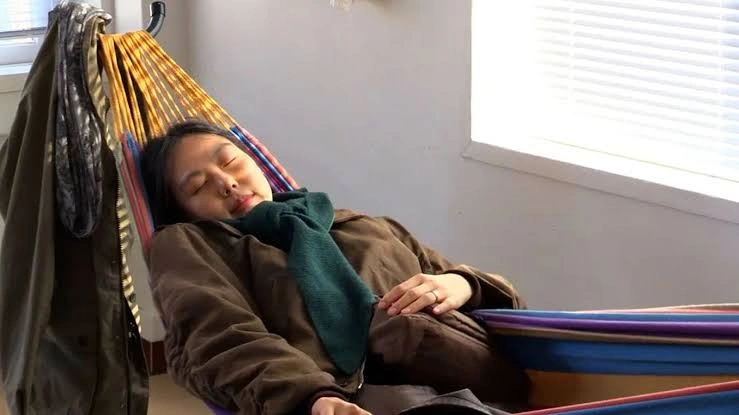
Kim Min-hee understands that scale perfectly. Sang-hee rarely announces anger or sadness. A delayed response to her mother, a tightened expression after being judged, the faint discomfort produced by her stepsister’s enthusiasm, and the matter-of-fact way she refers to her stepfather as “that man” carry the emotional load. Her occasional voice-over exposes a somewhat softer interior without converting the character into an explanatory device.
Hong has returned to artists, alcohol, family discomfort, and conversations about cinema many times. Familiarity does make the 72-minute film feel slight beside his richer variations on similar material. Yet Sang-hee’s divided existence gives these recurring elements a particular shape: Seoul and Jeju, commercial work and private art, biological family and improvised family, certainty and instinct. She spends the weekend surrounded by people trying to tell her where she belongs. The wind, wonderfully, refuses to stay where anyone puts it.
Nowhere to Lay My Eyes premiered at the Locarno Film Festival on August 15, 2026, with North American distribution handled by The Cinema Guild. The narrative follows Sanghee as she visits her family on Jeju Island after ten years apart, examining the lingering echoes of their estrangement.
Full Credits
Title: Nowhere to Lay My Eyes
Distributor: The Cinema Guild
Release date: August 15, 2026 (Locarno Film Festival)
Running time: 93 minutes
Director: Hong Sang-soo
Writers: Hong Sang-soo
Producers and Executive Producers: Hong Sang-soo, Kim Minhee
Cast: Kim Minhee, Choi Myeonggil, Kwon Haehyo, Shin Seokho, Park Miso, Ha Seongguk
Director of Photography (Cinematographer): Hong Sang-soo
Editors: Hong Sang-soo
Composer: Hong Sang-soo
The Review
Nowhere to Lay My Eyes
Hong Sang-soo turns Jeju Island into uneasy family territory, where wind, meals, and polite conversation expose a decade of estrangement without forcing reconciliation. Kim Min-hee’s restrained performance gives Sang-hee’s silences their sting, while her exchanges with her documentary-filmmaker stepfather connect a private dispute over belonging to larger questions about artistic truth and authority. The film’s familiar Hong rhythms can make its 72 minutes feel slight, yet its attention to how people inherit, reject, and reinvent family roles gives the modest scale real weight.
PROS
- Kim Min-hee’s finely controlled performance
- Sharp mother-daughter tension
- Jeju weather used expressively
- Thoughtful debates about artistic truth
- Naturalistic long-take conversations
CONS
- Extremely slight narrative
- Familiar territory for Hong
- Some conversations feel deliberately mundane