




























Netflix promises observation without interference, then supplies a schedule for changing the balance of power. Across The New Stanford Prison Experiment, volunteers move through transition, hierarchy, role reversal, and self-governance. Guards elect leaders; some participants exchange uniforms and authority.
These interventions give the six episodes fresh sources of friction whenever the existing arrangement threatens to settle. Calling them phases makes the production sound methodical. They also perform the familiar work of a reality television twist, disturbing relationships that viewers have begun to understand.
The monitoring room supplies another kind of authority. Behavioral psychologist Alison Wood Brooks, corrections professional Michael Cantrell, and journalist Trymaine Lee watch screens and interpret the participants’ behavior.
Their different backgrounds could support a useful conversation about the distance between psychological theory, institutional practice, and lived experience. Too often, their contributions explain a power struggle whose terms are already visible. Between the retrospective participant interviews and the expert commentary, Netflix has insured itself against the possibility that viewers might form an interpretation unassisted.
Thirty volunteers have entered a working correctional facility in Georgia for a planned two-week simulation, divided into guards and prisoners. The title invokes Philip Zimbardo’s disputed 1971 study, abandoned after six days, and inherits its enormous cultural recognition.
That association gives the series a ready-made question about power’s corrupting effects. Yet each alteration to the arrangement introduces another question: how do people respond when a television production changes the conditions under which they have agreed to perform authority? The series is much better equipped to show those responses than to establish anything universal about human nature.
Its participant protections deserve credit. Volunteers undergo psychological screening and can withdraw by saying “Pineapple,” an option several exercise. The right to stop matters far beyond its effect on dramatic tension. A production borrowing the name of an ethically notorious study should make continued participation voluntary. Departure can interrupt a conflict, but a television format has no entitlement to a person’s distress. Nor would removing that protection transform an entertainment program into credible science.
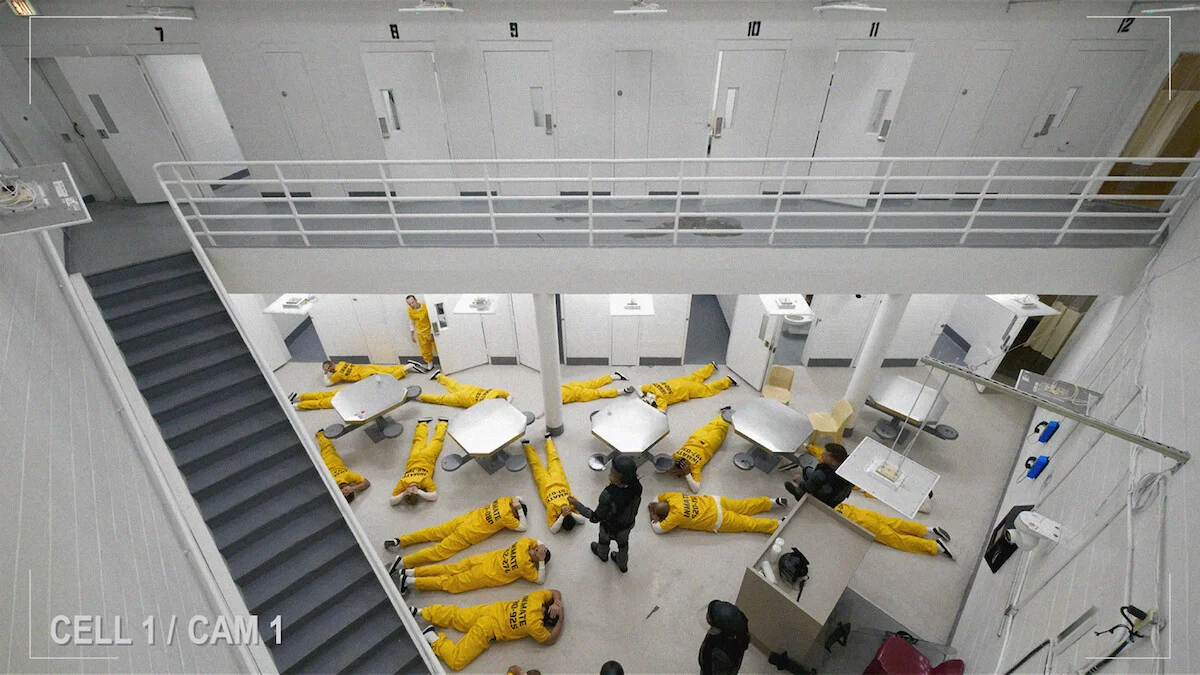
The setting nevertheless encourages viewers to feel the weight of actual imprisonment. During intake, sounds from people incarcerated elsewhere in the facility reach the volunteers. Yellow jumpsuits, institutional food, bunks, and restrictive routines give the simulation physical substance.
The unequal arrangements extend to the guards returning to a hotel between shifts while their charges remain inside. Such conditions can produce meaningful frustration and resentment. They exist alongside an exit available to every volunteer, a distinction that the real jail’s atmosphere cannot dissolve. The people heard elsewhere in the building lend the production a disturbing authenticity while remaining outside its principal field of attention.
The series becomes most revealing when a participant explains something that its broad question about corruption cannot adequately contain. Anthony Terry connects his response to guards with being a Black man in America, where disobedience can carry the threat of lethal consequences. His willingness to cooperate has a history. Reading it simply as submission to a newly imposed hierarchy would discard the experience he has brought into the room. The format assigns a role at intake; Anthony’s account makes clear how much of his relationship with authority predates the yellow uniform.

Teacher Pete Zaremba approaches the same arrangement with a different appetite. Accustomed to supervising children, he wants a release from responsibility and an opportunity to disrupt proceedings through pranks and resistance. That desire gives the prisoner disputes substance: participants disagree about what they are there to do.
Some want to test the guards, some want order, and some want to get through the experience without unnecessary trouble. Their competing approaches can be absorbing because cooperation itself becomes contested. Fellow prisoners help enforce expectations, making pressure within the group as consequential as instructions from above.
The guards also arrive with different models of leadership. Chris Lee’s team-building approach treats cooperation as something to cultivate through relationships; Chet Hudson favors stern discipline and punishment. Their competing methods give the day and night shifts different temperatures.
The later role exchanges provide opportunities for participants to confront inconsistencies between the authority they resisted and the authority they exercise. Those recognitions have interest at the scale of particular people making particular choices. The academic packaging keeps encouraging them to bear the weight of an explanation for everyone.
Casting and editing further complicate that ambition. All three women are assigned guard roles, placing gender within the production’s allocation of authority before the simulation develops. Meanwhile, a handful of participants receive sustained attention, and much of the group remains lightly identified. Selection is necessary in a cast this large, but it determines which responses become available for analysis. Thirty people in the facility do not amount to thirty developed perspectives on screen. The series’ claims need to remain proportionate to the stories its edit actually lets viewers follow.
There is watchable television in the resulting disagreements, including the apparently small ones over food, rules, and a microwave. Shared confinement gives minor irritations an audience and turns everyday decisions into tests of allegiance. The difficulty is the amount of explanation wrapped around them.
We watch a dispute, hear participants revisit it, then receive commentary from the observers. Across six episodes, that accumulation can make a narrow encounter feel laboriously processed. Role changes restore momentum, though their effectiveness also exposes how heavily the program depends on rearranging its own conditions.
The warmer late turn offers welcome relief from the expectation that a prison simulation must keep uncovering cruelty. Participants can revise their conduct, discover inconsistencies, and find reasons to cooperate; those possibilities deserve room on television too.
The shift toward self-governance gives their choices a different setting and allows the series to develop an emotional direction beyond punishment and resistance. It also leaves a specific complication in place: the production has already scheduled self-governance as its fourth phase, so the volunteers’ growing capacity to organize themselves unfolds within another arrangement chosen for them.
The New Stanford Prison Experiment premiered globally on Netflix on October 21, 2026. The unscripted reality series places thirty participants into randomized guard and prisoner roles inside a decommissioned correctional facility to reexamine the controversial psychological dynamics of the infamous 1971 study under modern supervision.
Where to Watch The New Stanford Prison Experiment Online


Full Credits
Title: The New Stanford Prison Experiment
Distributor: Netflix
Release date: October 21, 2026
Rating: TV-MA
Running time: 45 minutes per episode
The Review
The New Stanford Prison Experiment
Netflix’s prison simulation finds its strongest material when participants explain what authority has already taught them. Anthony Terry’s account gives compliance a specificity the show’s grand question about power lacks. Participant protections are welcome, and the warmer late turn earns interest. But engineered role changes, repetitive commentary, and selective attention leave the academic packaging carrying claims the television cannot sustain.
PROS
- Participant experiences complicate easy judgments about obedience.
- Clear safeguards protect the right to withdraw.
- Role exchanges provoke revealing self-examination.
- Cooperation offers a welcome emotional shift.
CONS
- Scientific ambitions exceed what the format establishes.
- Interviews and expert commentary repeatedly overexplain events.
- Limited attention to much of the cast narrows the inquiry.