
























Sean Penn’s character wants a cleaner recording. Somewhere in Ukraine, a field recordist is trying to capture an eagle for a nature project, but an intrusive sound refuses to disappear. The remote collaboration in “Eagle,” the opening installment of Animals in War, makes a technical problem out of an impossible separation: nature cannot be extracted from the violence occupying its habitat. As warfare overwhelms the audio, the distinction between subject and background collapses. What the American collaborator hoped to remove from the recording becomes the thing he must hear.
Then Penn falls to his knees and screams. The sound design has already breached the listener’s apparent safety; his extravagant physical response explains the breach until there is scarcely any interpretive space left. Worse, the dramatic emphasis shifts toward the distress of the man receiving the transmission.
The Ukrainian collaborator faces the danger, yet the distant witness supplies the spectacle. Penn’s performance makes empathy conspicuous at the expense of attention. The scene’s acoustic construction asks us to listen across a distance, while its acting invites us to watch someone demonstrate that he has listened.
That imbalance gives the seven-part Ukrainian anthology an awkward point of departure. Across its stories of animals caught in Russia’s invasion, its strongest changes of perspective redistribute attention with greater precision. “Rabbit: There and Back Again” organizes events around a displaced pet whose understanding cannot accommodate the human explanations for its predicament.
The restriction matters. Danger arrives without strategic context, and the people encountered along the way become readable through their conduct toward a frightened creature. Viewers have knowledge the rabbit lacks, but that knowledge offers it no protection. Help must take the form of somebody doing something.
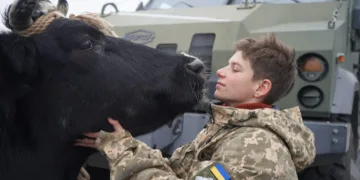
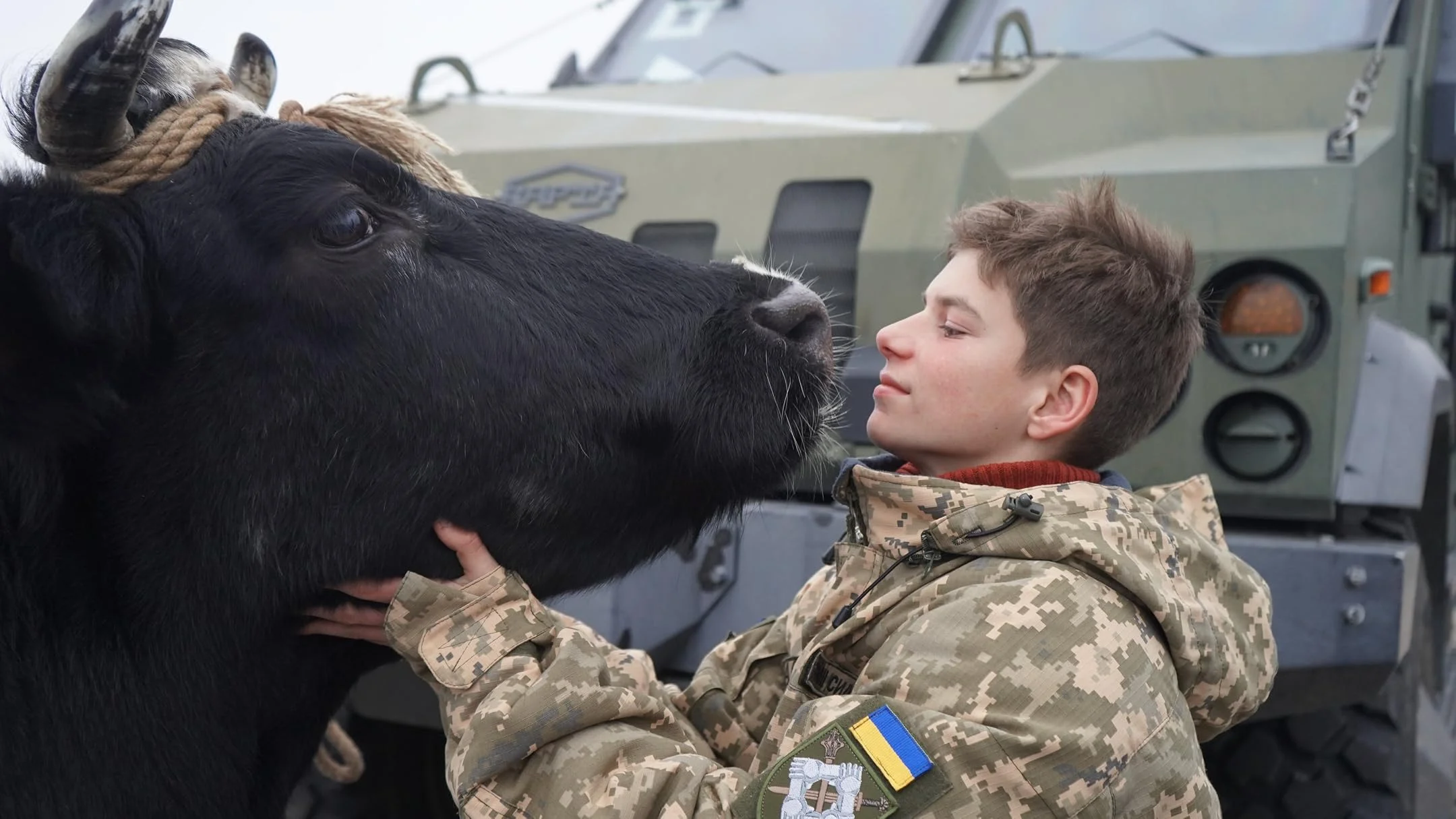
There is an obvious sentimental advantage in placing a rabbit in peril, and the film does not forfeit it. Yet the succession of people offering shelter gives the emotion a practical basis. “Cow in the Fog” complicates that arrangement through reciprocal need. A boy sent away from an occupied village finds himself exposed to the cold; a wandering cow becomes a source of warmth and company.
His attempt to secure shelter now carries another dependent life with it. The animal changes the conditions of survival. Care costs effort, and abandoning care would mean abandoning a relationship that has helped keep him alive. The boy cannot occupy the comfortable position of an entirely self-sufficient rescuer.
“Sonny” moves into more treacherous territory through a discrepancy between what is visible and what a character perceives. A bereaved mother speaks toward an empty space in her car’s back seat. Her address gives the absence a presence, while the visible vacancy prevents us from sharing her perception without reservation.
The scene establishes two realities within the same situation: the conversation she continues and the loss the viewer can recognize. Her subsequent attachment to an injured wolf cub develops from that division. Maternal attention persists, seeking a living recipient after the death of her son.
The danger here is that the cub will become an instrument for resolving the woman’s suffering, its own injury absorbed into a therapeutic function. The encounter with a military doctor gives the story firmer ground. Exhausted by death, he agrees to operate on the animal.
Her attachment produces an obligation outside her private experience: another person must decide how to respond to a wounded creature. Whatever cannot be repaired in her understanding of the world, the cub’s need for treatment is immediate. The doctor’s participation makes care possible without requiring the viewer to endorse every perception that brought her to him. The operation has a patient.

“Underwater Adventure” approaches protective perception from another direction. Its initial use of sound and camera presentation encourages an understanding that the evacuation story then revises. The viewer experiences a small correction of knowledge before watching an older brother manage a much larger discrepancy for his preschool-age sister.
He tries to preserve an imaginative account of their circumstances while confronting the danger himself. His protection depends on an unequal distribution of knowledge. She can remain inside the story because he accepts responsibility for what it excludes. The device has an ethical cost even when its intention is tender: someone must keep attending to the danger that the reassuring fiction leaves out.
The anthology’s animal premise stretches here toward the human need to mediate catastrophe. That shift is productive when the filmmaking makes the mediation itself perceptible, as the sibling relationship does. The contrast with “Eagle” is instructive. Penn’s collapse dictates the magnitude of a response; the brother’s behavior requires us to recognize what one person is concealing for another. Both involve an experience crossing between people, but only the latter leaves a meaningful gap between what a character knows and what he permits someone else to see. Suspense resides in the maintenance of that gap.
“We Are Alright” finds a quieter way to make an internal decision visible. A young Kyiv man preparing to leave for Prague must first arrange care for a cat. The animal runs off, and an administrative loose end becomes the activity through which his departure begins to dissolve.
His relief when he finds the cat carries a weight the practical problem alone cannot explain. The film lets staying become legible through conduct before it becomes a declared position. This is a persuasive treatment of agency because the character appears to discover his decision while carrying out its consequences.
Staying gives him no immunity, and the story would lose its delicacy if his choice became an instruction for everyone else. His attachment belongs to him. At the party, the lights go out and people move outside, interrupting the social space in which ordinary life has continued. The domestic problem has been settled; the larger danger remains beyond his control. When someone asks why he is not on his train, the question restores the abandoned possibility to the scene. He has found the cat, missed his departure, and remained available to whatever happens next.
Animals in War premiered at the Tribeca Film Festival on June 9, 2025, and was released in North America on June 26, 2026, via Film Movement and Omnibus Entertainment. Directed by an ensemble of Ukrainian filmmakers including Myroslav Slaboshpytskyi, this seven-part anthology drama examines the human and ecological toll of conflict through the eyes of animals caught in the crossfire.
Where to Watch Animals in War (2026) Online






Full Credits
Title: Animals in War (Ukrainian: Війна очима тварин)
Distributor: Film Movement, Omnibus Entertainment, Sota Cinema Group, Essence Film
Release date: June 9, 2025 (Tribeca Film Festival), June 26, 2026 (United States)
Running time: 1 hour 38 minutes (98 minutes)
Director: Sviatoslav Kostiuk, Andriy Lidahovskyi, Alexei Mamedov, Ivan Sautkin, Yuliya Shashkova, Myroslav Slaboshpytskyi, Maksym Tuzov
Writers: Myroslav Slaboshpytskyi, Sviatoslav Kostiuk, Alexei Mamedov
Producers and Executive Producers: Oleg Kokhan, Alexey Makukhin, Krzysztof Zanussi, Sean Penn
Cast: Sean Penn, Olga Korotyayeva, Andrii Isaienko, Maryna Koshkina, Alexander Kobzar
Director of Photography (Cinematographer): Serhiy Mykhalchuk
The Review
Animals in War
Animals in War earns its strongest emotions by making care visible as work: finding shelter, treating an injured cub, accepting responsibility for a frightened creature. Its shifts in viewpoint give compassion practical weight, while “We Are Alright” lets a consequential choice emerge without announcing it. Penn’s overwrought response in “Eagle” mistakes visible distress for attentive witnessing. Elsewhere, the anthology gives viewers room to recognize what its characters cannot say.
PROS
- Animal perspectives make human conduct newly legible.
- “Sonny” grounds grief in a concrete demand for care.
- The closing story reveals choice through behavior.
- Sound design makes distant violence impossible to exclude.
CONS
- “Eagle” lets Penn’s demonstrative distress overshadow the person facing danger.