








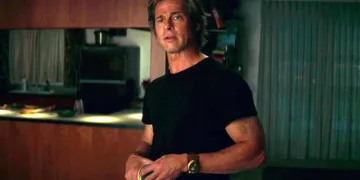













Simon Farnaby spends much of his time inside a teenager’s hoodie, occupying a body the film frequently allows us to see as his own. Julian, Button House’s deceased Conservative MP, has possessed Jack, played by Scott Ellis Watson, yet the image keeps restoring the familiar performer to view.
This is an efficient comic arrangement. We recognize the occupant without requiring Watson to impersonate Farnaby throughout. It also distributes our sympathy before anyone has argued the case: the man borrowing the body gets the reassuring face, the established comic history, and the pleasure of finally leaving the grounds.
Watson complicates that arrangement. His imitation of Julian supplies the necessary continuity between the two actors, but his work as Jack, a teenager in care, gives the displaced boy a presence that survives the substitution. Possession here has two simultaneous meanings: an excursion for someone confined for decades, and an alarming loss of physical agency for someone still alive. The film is considerably happier with the excursion. Julian acquiring jeans after spending his afterlife without trousers is an excellent visual joke, dependent on the absurd persistence of his old disgrace. A change of clothes can accomplish a remarkable amount when a character has been denied one for thirty years.
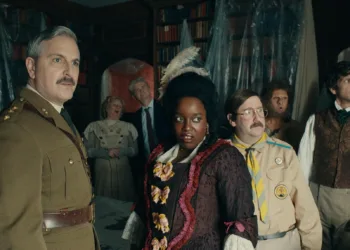
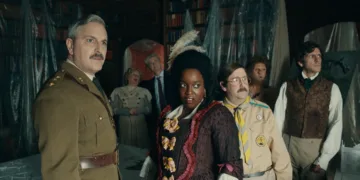
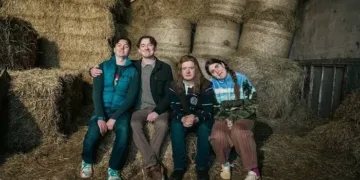
Ghosts: The Possession of Button House finds its household a few months after Alison and Mike have moved away with their daughter, having sold the mansion for conversion into a hotel and golf resort. Work has stalled. The ghosts miss Alison, the living person who can see and hear them, and Pat’s organized activities offer limited relief from an eternity without her. Teenagers breaking into the house bring the discovery of possession; environmental protesters bring a competing claim on its future. The former residents have lost their human connection before the building has acquired its new purpose. They are stranded between uses.
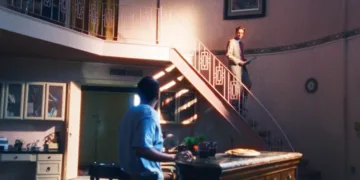
Director Simon Hynd and cinematographer Alvaro Gutierrez preserve the warm palette and uncomplicated framing associated with the series. The occasional crane shot supplies scale without transforming Button House into an ominous architectural presence. That restraint matters.
A possession story can make the familiar body frightening through visual estrangement; this film repeatedly makes an unfamiliar body comfortable through recognition. Farnaby remains Farnaby, and the house remains hospitable to the viewer even as its inhabitants appropriate a visitor. The photography helps hold the material within family comedy. It also softens a premise whose moral discomfort the film acknowledges chiefly through Jack’s predicament.
There is something very Julian about treating another person’s body as an opportunity to get out. His entitlement requires little adjustment to accommodate supernatural assistance. Farnaby’s pleasure in the character’s renewed mobility gives the comedy an appetite, while Watson’s mimicry prevents the device from becoming solely a return to the familiar actor.

The wider ensemble supplies different answers to the prospect of renewed contact with the living. Robin’s attraction to Sian Clifford’s protester gives him an immediate, personal interest in the arrivals. Fanny’s exposure to modern feminism unsettles the assumptions she has carried into death.
These encounters let historical identities remain comic without treating them as entirely sealed. The ghosts can learn, misunderstand, desire, and embarrass themselves. Their continued existence gains texture from those unequal capacities for change. Robin’s interest in the protesters is especially useful because it interrupts any easy division between the household and the people obstructing the development outside.
The property dispute extends that uncertainty. Button House is simultaneously an intended commercial development, the object of environmental protest, and a home whose longest-standing residents have no legal presence. Rufus Jones’s corrupt MP adds a living political operator to a story already equipped with Julian.
The resemblance gives the satire a practical function: death has preserved one politician’s appetites while the world continues producing suitable company. The screenplay connects these parties through a caper rather than asking each to sustain a separate thematic argument. That keeps the competing interests legible.
Possession earns the move beyond television most persuasively by changing the characters’ physical possibilities. Julian can travel; the action can develop into a high-speed car chase; Alison and Mike can be drawn back into events without simply reversing their departure.
The increased camera height is incidental beside that expansion of agency. Yet movement alone cannot keep every complication equally buoyant, and the late plotting feels stretched. Sunna Wehrmeijer’s energetic score, including variations on the television theme, helps maintain continuity as the action grows. Its familiar musical material reassures us that the expanding caper still belongs to the same household.
That reassurance has an admission price. Character reintroductions are sparse, and the film expects viewers to recognize personalities whose comic force has accumulated across the series. Julian wearing ordinary trousers is immediately legible as an incongruity to an established audience; a newcomer has considerably less history available to make the sight funny.
The ensemble’s confidence partly compensates. Nobody seems to be laboring to recover a performance left behind, and the affection between these difficult people emerges through their habitual interference with one another. Charlotte Ritchie and Kiell Smith-Bynoe fit back into that interference without making Alison and Mike’s earlier departure feel meaningless.
Jack’s encounters with Kitty and Pat give the familiarity a less self-satisfied purpose. Kitty’s eagerness and Pat’s instinct to organize are inadequate tools for a teenager separated from his body, yet both are attempts to respond to someone whose distress interrupts their own loneliness.
Watson gives those clumsy attentions a person to reach. Having spent so long missing the woman who could acknowledge their existence, the ghosts now find themselves responsible for acknowledging a frightened visitor, with Kitty bringing considerably greater enthusiasm than practical competence to the task.
Ghosts: The Possession of Button House premiered at its London world premiere on October 14, 2026, before opening in UK cinemas on October 23, 2026, via Lionsgate. Directed by Simon Hynd and continuing the story of the acclaimed BBC comedy series, the feature film follows the eccentric spectral residents of Button House as an amateur séance goes awry, prompting a frantic effort to reach their former living friends when a ghost possesses a visiting teenager.
Where to Watch Ghosts: The Possession of Button House (2026) Online
Full Credits
Title: Ghosts: The Possession of Button House
Distributor: Lionsgate
Release date: October 23, 2026
Rating: PG
Running time: 1 hour 37 minutes (97 minutes)
Director: Simon Hynd
Writers: Mathew Baynton, Simon Farnaby, Martha Howe-Douglas, Jim Howick, Laurence Rickard, Ben Willbond
Producers and Executive Producers: Not publicly specified
Cast: Charlotte Ritchie, Kiell Smith-Bynoe, Mathew Baynton, Simon Farnaby, Martha Howe-Douglas, Jim Howick, Laurence Rickard, Ben Willbond, Lolly Adefope, Scott Ellis Watson
The Review
Ghosts The Possession of Button House
Farnaby and Watson make possession both a comic opportunity and a question of whose experience the image privileges. The familiar warmth occasionally cushions that question, but Jack’s encounters with the household give the affection substance. Expanded physical freedom earns the cinematic excursion, even when the late plotting stretches. Button House remains excellent company, provided you already know its residents.
PROS
- Farnaby and Watson’s clear, witty shared performance.
- Visual familiarity gives possession an unusual comic perspective.
- Jack brings emotional purpose to the ensemble’s affection.
- Possession creates meaningful scope beyond the house.
CONS
- Late plotting feels stretched.
- Sparse reintroductions leave newcomers at a disadvantage.