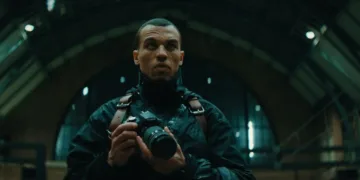
























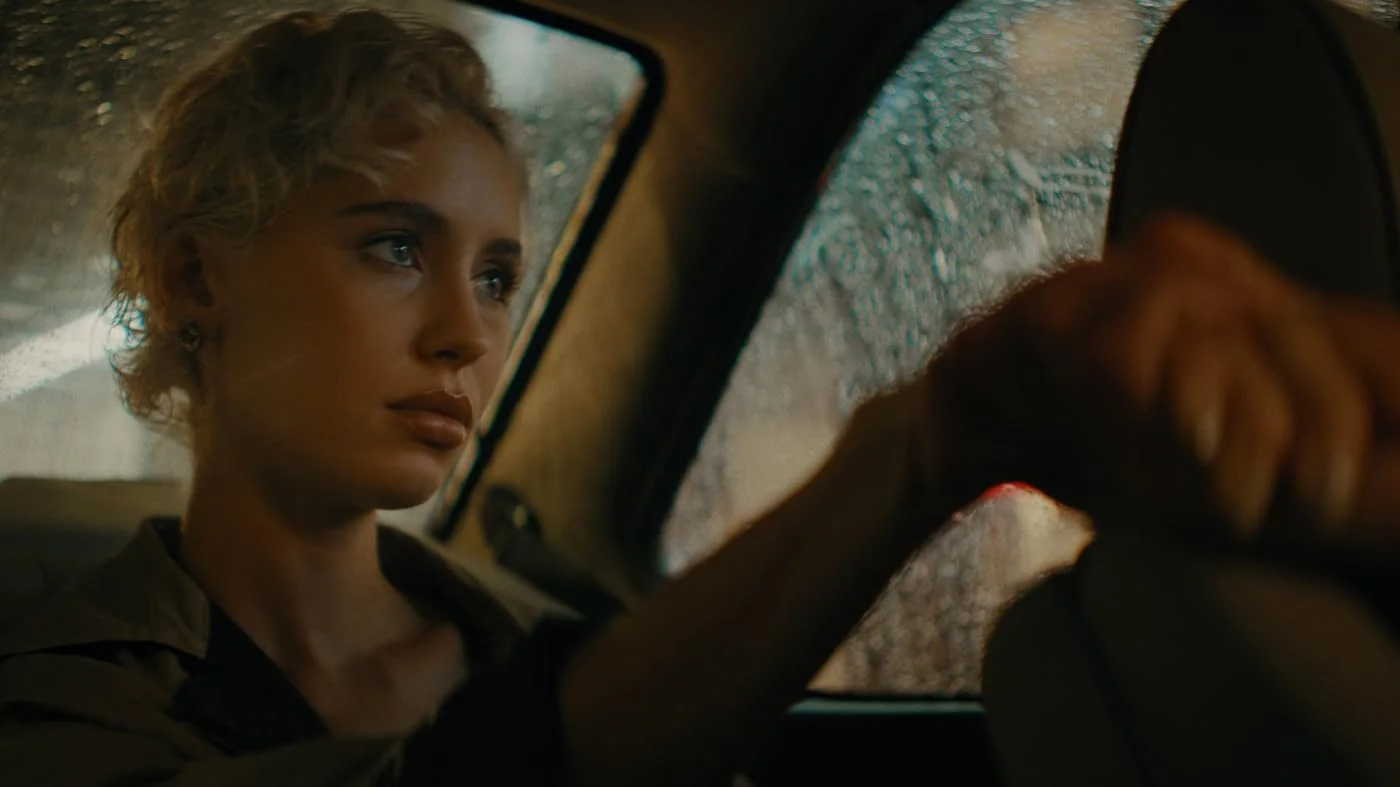
Cassie has to sit in the room with the man. Miles gets to watch from a rooftop. The sting that sets Michele Fiascaris’s Rain Catcher in motion depends on this uncomfortable arrangement: an aspiring singer exposes herself to a predatory music producer while her photographer boyfriend waits with a long lens. As Nico pressures her to perform, offers cocaine, and propositions her, the prospect of catching him becomes less satisfying. You want Cassie out of there. Getting the photograph has started to feel like an awfully inadequate response to what she is experiencing.
When she raises the alarm and the operation falls apart, Miles loses the distance that made his participation manageable. He cannot contact her afterward. That absence troubles his subsequent retreat into photography, because we have already seen someone endure the encounter he was recording. Dudley O’Shaughnessy gives Miles enough vulnerability to keep us close to his anxiety, without making that closeness comfortable. His distress invites concern; his role in placing Cassie there makes concern difficult to give freely. The film establishes that awkward emotional position before introducing anything that might belong in a nightmare.
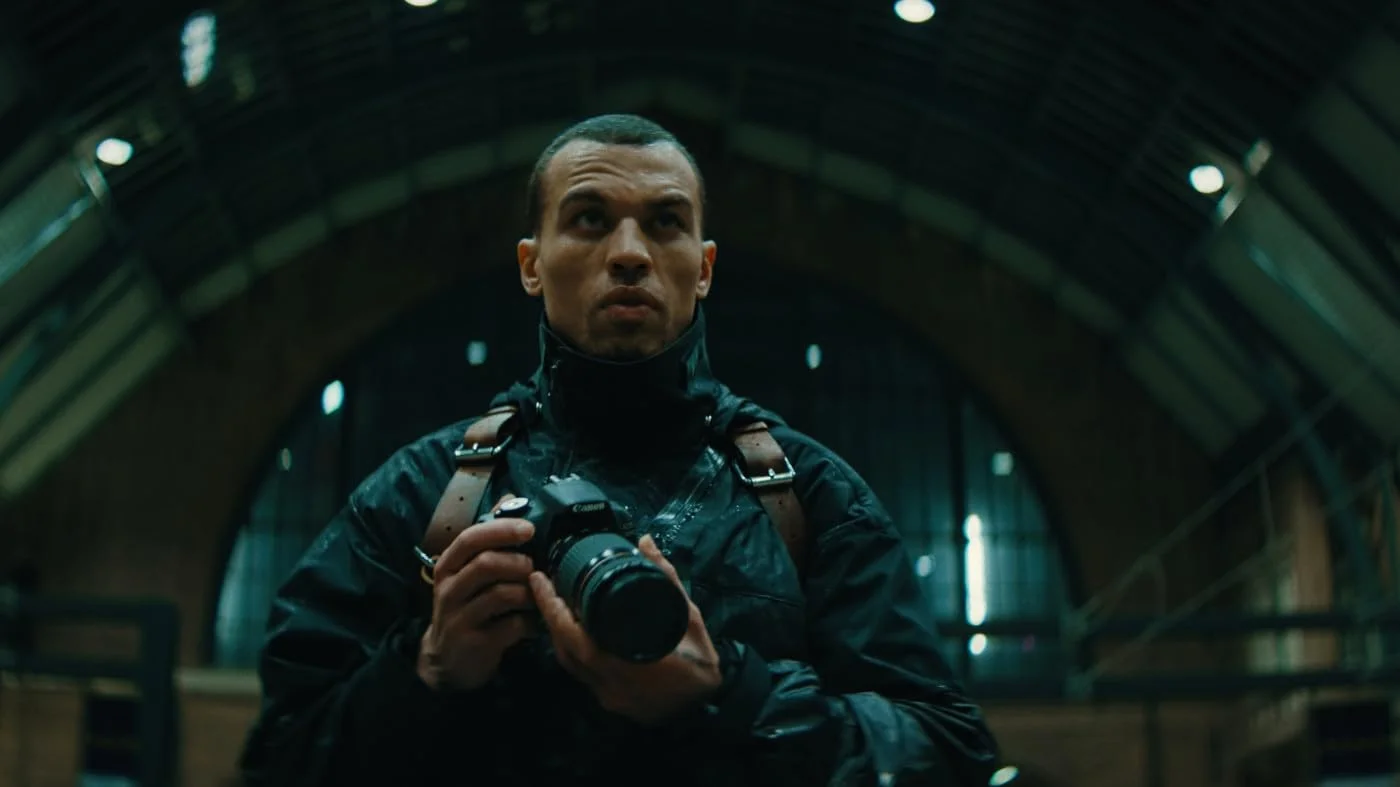
Miles publishes his photographs anonymously as Rain Catcher, collecting a substantial following through images of people who have never agreed to become his subjects. Windows and telephoto lenses let him enter private lives without introducing himself. Recognition has brought little financial security, though, and a photography competition offering £30,000 becomes an urgent possibility for a man behind on his rent. This gives his persistence a practical pressure. It also makes his attachment to anonymity telling: he needs strangers to surrender something that he remains determined to protect.
The appearance of a woman played by Kate Dickie inside his photographs unsettles that arrangement with pleasing economy. Her repeated presence encourages the same scrutiny Miles brings to everybody else, but looking harder provides no reassuring explanation.
Then she appears beyond the photographs, including behind an elevator door. An image can be put aside; someone occupying the building around you cannot. Dickie’s restraint lets recognition do much of the frightening work. We become alert to the possibility of seeing her again, sharing Miles’s habit of searching while losing confidence that searching will help.
The attacks on his anonymity make that fear painfully ordinary. His account is compromised, photographs reveal his face, and leaflets circulate around his neighborhood accusing him of being a danger. The scale contracts from an online audience to people living nearby. It is easy to understand the panic of having an identity distributed without permission, even while remembering how he acquired his audience. Fiascaris makes that contradiction uncomfortable to inhabit. Miles’s exposure carries the practical terror of losing control over what strangers think they know about you.
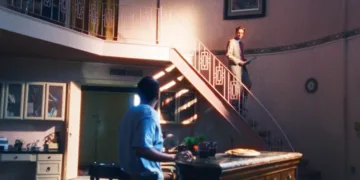
Evgeny Sinelnikov’s photography gives this anxiety somewhere persuasive to live. The Barbican’s towers and elevated walkways allow people to see across considerable distances while remaining physically separated. Illuminated windows suggest lives within reach of a lens, with little assurance of companionship.
The nighttime city can feel enormous until the same buildings begin enclosing Miles’s movements. Reflections in glass, mirrors, and rain complicate his attempts to inspect his surroundings. Aeph’s uneasy electronic score sustains the agitation, making those spaces difficult to settle into. Some of the shadowy imagery becomes muddy, reducing the pleasure of searching the frame, but the setting’s appeal and hostility remain closely connected.
Yumi, played by Jessie Mei Li, offers a different reason to look toward the opposite block. Miles intervenes when she is about to jump from her balcony, and their developing connection introduces the possibility of being needed by someone who can answer him. Her discovery of his photography matters enormously here. She initially recoils from it, giving his behavior a response that follower counts and artistic ambitions cannot absorb. The person across the way has her own judgment. For a film so invested in the intimacy of looking, this is where actual intimacy should become difficult, unpredictable, and worth pursuing.
Their movement toward companionship and romance takes some convenient steps, however. Yumi’s initial horror establishes a considerable emotional distance, and the film crosses it with less care than it brings to making Miles’s surroundings threatening. His assurance that he is not a monster expresses a recognizable wish to be accepted. It cannot supply the trust the relationship needs. O’Shaughnessy’s exposed loneliness helps explain the appeal of that acceptance for Miles, but understanding his need leaves a question about hers. The relationship offers warmth without making every stage of its development equally convincing.
That weakness becomes sharper as the mystery grows busier. Miles’s efforts to identify the woman lead him toward increasingly destructive choices, while recurring nightmares of blood and scorpions make his perception less dependable. The movement into psychological horror has an absorbing, unpleasant logic: the photographs that once appeared to secure his knowledge now belong to a world he cannot confidently interpret. Fiascaris keeps changing the terms of his fear. Discovering who is responsible gradually becomes entangled with uncertainty about Miles himself, allowing the mystery to disturb his self-understanding rather than merely obstruct his investigation.
Across roughly 110 minutes, though, those changes sometimes prolong unease without giving it a fresh emotional consequence. Another threat or reversal can hold attention while the less secure connection with Yumi remains underdeveloped. The later shift toward fantasy asks us to reconsider the experience of watching him, and Fiascaris’s willingness to move beyond a straightforward stalker mystery gives the film an appealing instability. The repeated woman in the photographs makes us search; the blood and scorpions make us suspect something Miles cannot contain through observation.
Rain Catcher premiered at the Karlovy Vary International Film Festival on July 3, 2026. Directed by Michele Fiascaris, the UK neo-noir thriller follows a voyeuristic London street photographer whose obsessive pursuit of his craft leads him down a dark, psychological spiral when he accidentally captures something he was never meant to see.
Where to Watch Rain Catcher (2026) Online


Full Credits
Title: Rain Catcher
Distributor: Yellow Pill, Cercamon / Vorteks
Release date: July 3, 2026 (Karlovy Vary International Film Festival)
Running time: 1 hour 49 minutes (109 minutes)
Director: Michele Fiascaris
Writers: Filippo Polesel, Michele Fiascaris
Producers and Executive Producers: Julien Loeffler, James Kermack, Filippo Polesel
Cast: Dudley O’Shaughnessy, Jessie Mei Li, Iris Law, Kate Dickie, Youssef Kerkour, Lorenzo Richelmy
Director of Photography (Cinematographer): Evgeny Sinelnikov
Editors: Mike Pike
Composer: Aeph
The Review
Rain Catcher
Rain Catcher makes the fear of exposure surprisingly easy to share with a man who routinely violates other people’s privacy. The Barbican’s nighttime spaces, Kate Dickie’s unnerving presence, and Dudley O’Shaughnessy’s vulnerability sustain that uncomfortable involvement. Miles’s relationship with Yumi needs firmer development, and the accumulating threats sometimes extend anxiety without deepening it. Still, this is an atmospheric psychological thriller worth seeking out for the way it makes familiar windows and photographs feel unsafe.
PROS
- Nighttime photography turns the Barbican into a threatening space.
- Kate Dickie’s restrained, unsettling presence.
- O’Shaughnessy sustains uneasy sympathy for Miles.
- Exposure becomes a tangible source of dread.
CONS
- Yumi’s developing trust feels insufficiently earned.
- Some shadowy imagery becomes muddy.
- Repeated threats occasionally prolong rather than deepen unease.