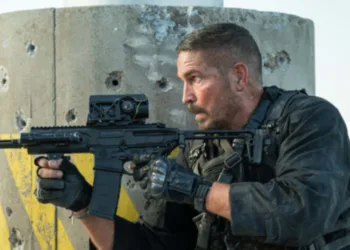





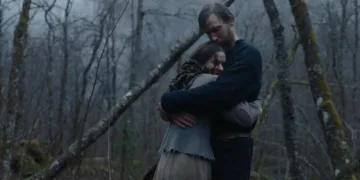


















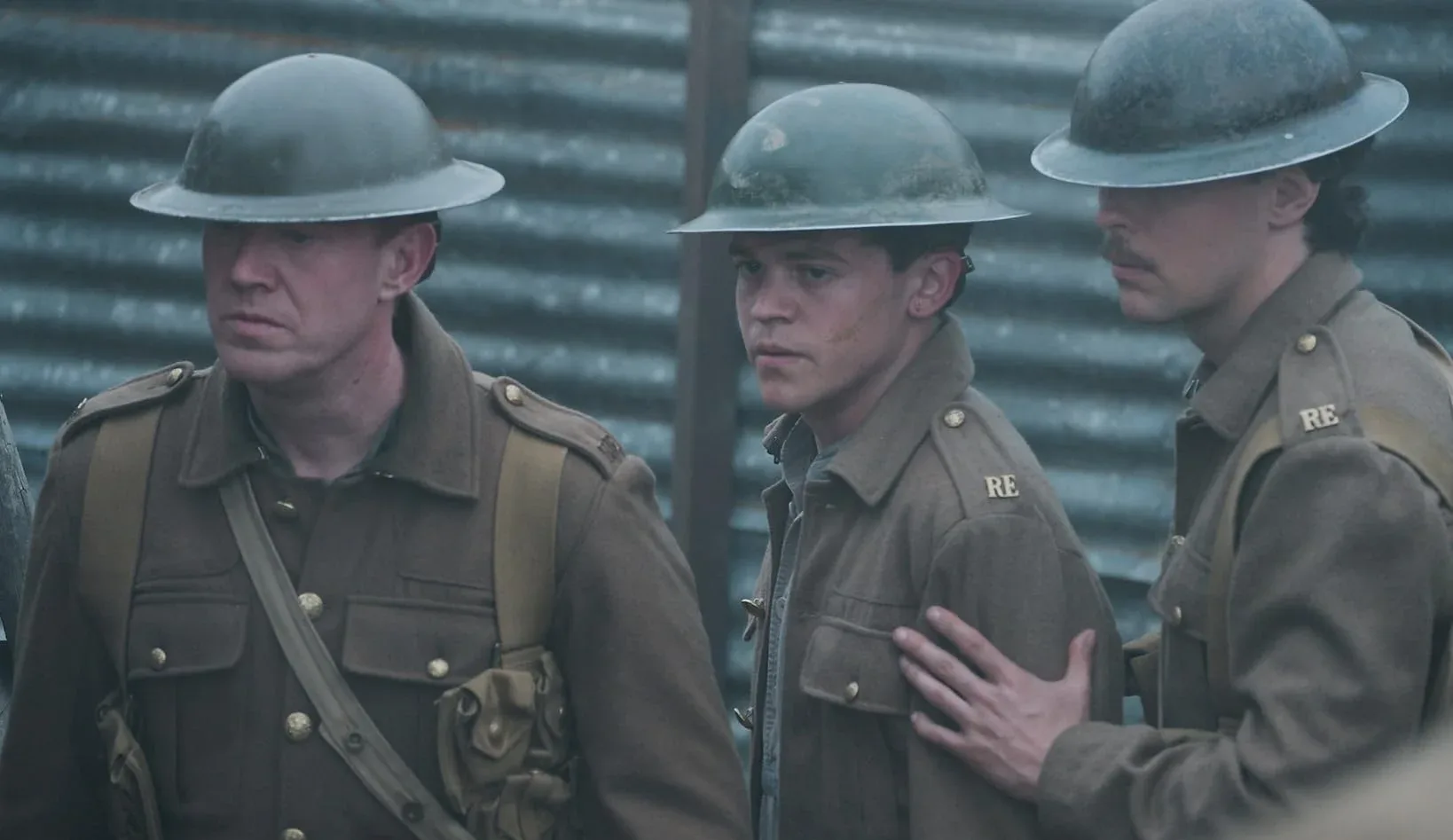

William Hawkins’s lungs are good enough for the work that damaged them, but they fail the army’s medical examination. Sam Hazeldine plays his rejection with the shame of a man who has accepted that service will determine his worth. When Colonel John Norton-Griffiths recruits Yorkshire workers to tunnel beneath German positions, Hawkins eagerly accepts. J. P. Watts’s The War Below finds a telling contradiction in this route to the Western Front: the military needs knowledge acquired through civilian labor, yet the men possessing it arrive with their legitimacy still in question.
Hazeldine makes that insecurity difficult to separate from Hawkins’s courage. Disobeying an order to rescue a soldier stranded in No Man’s Land, Hawkins presents his decision as an ordinary obligation to another human being. His restrained manner keeps the explanation plausible, while his earlier desperation to serve gives it an uncomfortable second meaning. Saving someone offers an opportunity to prove that he belongs. The performance allows generosity and self-vindication to occupy the same action, without making his concern for the wounded man feel fraudulent. Even Jane’s support at home cannot relieve a judgment he has learned to carry himself.
The hostility awaiting the recruits gives that private burden a recognizably British social setting. Their Yorkshire origins and civilian occupations expose them to officers’ condescension, while regular troops resent their uncertain place within military life. These reactions come from different positions in the hierarchy, and the film is most interesting when they expose how little practical ability guarantees acceptance.
Tom Goodman-Hill’s Norton-Griffiths, known as Hellfire Jack, supplies a bridge between those worlds. His respect for the workers rests on a straightforward understanding of the task: soldiers cannot acquire years of excavation experience simply by receiving an order. Goodman-Hill gives that recognition warmth, though the officer remains largely defined by his advocacy.
Once the men descend, their expertise becomes easier to understand without anyone speaking on their behalf. In candle-lit passages, bags of earth must be removed through spaces that barely accommodate the workers. The material has weight, and progress requires repetitive, unglamorous acts. These passages offer the film’s strongest answer to the contempt directed at the recruits. Watts lets their occupational knowledge become visible, turning the underground setting into a place where the army’s usual assumptions about authority have limited practical use. The men know how to proceed because they have done this kind of work before.
That familiarity also gives the danger a particular character. Gas pockets and cave-ins belong to the risks these workers understand; German tunneling nearby brings the possibility of an enemy into the same restricted environment. Pauses of near silence make proximity unsettling. Underground, a short distance can leave almost no room for retreat or defense. Watts draws effective suspense from that cramped geography, allowing the soldiers’ war above to intrude upon the specialists’ working space below. Their competence can help them read the ground, but it cannot make the person digging toward them predictable.

The difficulty is how quickly the film moves across the months required to complete the operation. Excavation appears on screen, yet abrupt jumps reduce the sense of accumulating fatigue and dependence. We understand that the task is exhausting before we have spent enough time with its routines to feel how exhaustion changes the group. This matters to a film organized around the recognition of labor. Its images make individual actions credible, while its narrative keeps pushing toward the moment those actions will produce a military result. The workers’ usefulness receives fuller attention than the experience of remaining useful under prolonged strain.
Sam Clemmett briefly supplies the missing sense of a life extending beyond the assignment. As Charlie MacDonald, he talks about receiving letters and the appreciation he would have for the postman if he returned home. The speech gives an ordinary service a value that distance and danger have made newly apparent.
Clemmett’s sincerity keeps the thought from becoming a convenient announcement of innocence. Charlie has a brother beside him, George, played by Elliot James Langridge, but his anticipation of familiar life does the more precise work of making him an individual. The film could use further moments with that degree of personal definition.
Its British focus is useful precisely because underground warfare does not belong to one national account. The Australian Beneath Hill 60 also takes First World War tunneling as its subject, placing Watts’s film within a shared history that cinema can approach through different groups of workers. Here, the revealing particulars are the recruits’ regional status, Hawkins’s wounded sense of duty, and the army’s dependence on men it initially dismisses. Those details travel beyond Britain without requiring the Yorkshire squad to stand for everyone who fought below the trenches.
As the operation approaches Messines in 1917, the promise of shortening the war gives the work an urgency the film sometimes treats too readily as a guarantee of its meaning. The culminating explosion has impressive scale, making the effect of concealed labor suddenly visible across the battlefield. A successful operation, however, cannot settle the larger promise made to the men. The war continues, and the spectacle leaves a question about the terms on which their sacrifice was solicited that patriotic speeches can acknowledge only imperfectly.
The medals offered at the end carry real weight for workers whose standing has been repeatedly doubted. Yet the ceremonial recognition also lets the military determine the language in which their value will be remembered. The earlier contempt receives little further examination once their usefulness has become an achievement the institution can celebrate. Hawkins is granted the public identity he wanted, with limited attention to the shame that made him pursue it so fiercely. Charlie’s talk about letters has allowed another measure of service to remain present: the small habits of civilian life that he hopes to appreciate again.
The War Below was released in the United Kingdom on September 10, 2021, and is available for streaming on platforms such as Amazon Prime Video and Netflix. Directed by J.P. Watts, the gritty historical war drama follows a group of British coal miners recruited during World War I for a dangerous covert mission to tunnel beneath no man’s land and plant explosives beneath the German front lines.
Where to Watch The War Below (2021) Online






Full Credits
Title: The War Below
Distributor: Signature Entertainment, Vertical Entertainment
Release date: September 10, 2021
Rating: 13+
Running time: 1 hour 36 minutes (96 minutes)
Director: J.P. Watts
Writers: J.P. Watts, Thomas Woods
Producers and Executive Producers: Luis Guerrero, William Knochel, Chris Lemos, Mark Jacobs, Grace Hartley, David Kirkup
Cast: Sam Hazeldine, Tom Goodman-Hill, Kris Hitchen, Elliot James Langridge, Sonny Ashbourne Serkis, Joseph Steyne, Sam Clemmett, Anna Maguire
Director of Photography (Cinematographer): Nick Cooke
Composer: Anné Kulonen
The Review
The War Below
The War Below gives British wartime duty a revealing regional accent: Yorkshire workers must prove their worth to an army dependent on their skills. Sam Hazeldine makes Hawkins’s courage inseparable from his hunger for acceptance, while cramped tunnels give that expertise physical weight. Abrupt time jumps diminish the accumulated strain, and the closing honors soften the class conflict. Its strongest moments make service personal, through a dangerous rescue or Charlie’s anticipation of ordinary life at home.
PROS
- Hazeldine connects courage with Hawkins’s need for acceptance.
- Confined tunnels and near silence create effective suspense.
- Physical work makes the recruits’ expertise visible.
- Charlie’s letter speech gives sacrifice a personal scale.
CONS
- Time jumps weaken the sense of sustained labor.
- Norton-Griffiths remains largely a functional advocate.
- Closing honors leave earlier class hostility underexamined.