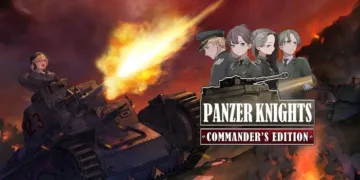



























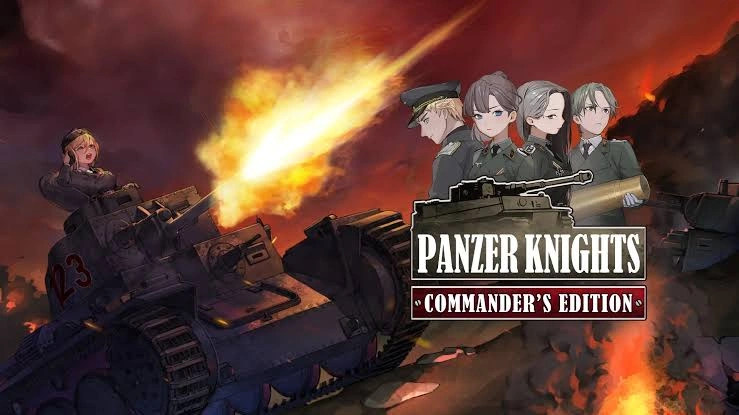

The quickest comparison for Panzer Knights: Commander’s Edition is Valkyria Chronicles, but the resemblance fades once the tank starts moving. Joy Brick borrows the anime-adjacent military look, then trades character-driven tactics for direct vehicle control, armor angles, slow turret rotation, and ammunition management. This console release packages the PC game with its downloadable content.
You play a newly trained German Panzer commander moving through World War II campaigns beginning with the invasion of Poland, with later missions touching France, Britain, and the Soviet front. The historical frame gives the game a serious posture, yet its anime crew portraits pull in another direction. Those identities never quite settle together.
History Without Enough Context
Each story mission begins with a military briefing that explains the immediate operation: take a position, destroy reinforcements, rescue allied tanks, survive artillery fire. The campaign focuses almost entirely on German battlefield activity, stripping out Nazi symbols and softening several direct references while retaining enough German terminology to establish the setting.
That narrow perspective is the story’s biggest limitation. The campaign reproduces operations without giving much space to the political violence surrounding them, and it stops before Germany’s final defeat, leaving later events to brief explanation. A push across France becomes a sequence of objectives rather than part of a larger human catastrophe.
The crew system tries to give those battles a personal thread. Characters grant bonuses to reload speed, hull strength, movement, spotting, and other statistics. Certain pairings trigger extra dialogue during missions, followed by “memory” scenes that unlock another ability. The structure recalls relationship bonuses in squad-based strategy games, but the payoff remains slight. Static portraits, repeated expressions, awkward German phrases, and thin exchanges leave most crew members defined by their perk before their personality.
Aim, Angle, Disable
The tank combat has far stronger ideas. Driving is deliberately heavy, and the turret rotates independently at a pace determined by the vehicle. Two reticles make that distinction visible: one marks where you want to aim, the other shows where the cannon is actually pointing. Swing the camera too quickly and the gun has to catch up before the shot is ready.
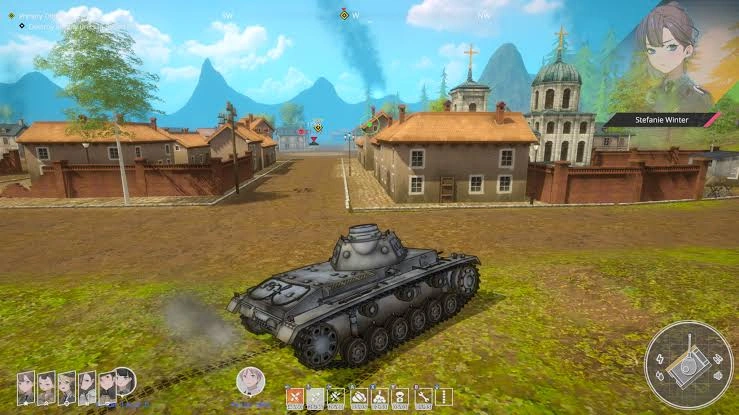
That delay matters because armor positioning matters too. Turning the hull at an angle can reduce incoming damage or cause shells to ricochet, rewarding players who think about exposure rather than treating every encounter like a circle-strafing duel. World of Tanks players will recognize the logic, though Panzer Knights wraps it inside a smaller single-player structure.
Component damage gives each shot another purpose. Hitting tracks can immobilize an enemy. Damaging the turret can prevent it from responding properly. Different shell types trade penetration power against limited reserves, while smoke, repair kits, supply drops, artillery, and air strikes have to be rationed. Line-of-sight rules can hide enemy tanks when nobody in the squad can see them, so scouting a treeline or street corner carries real risk.
The problem is consistency. Some enemy tanks reposition and punish a bad angle. Others sit still while you pick them apart from long range. Allied vehicles can drive into the player, block a retreat, or get stuck when a mission requires them to survive. Invisible walls in open fields and tanks snagging on scenery make the battlefield feel less trustworthy than the combat rules deserve.
The absence of checkpoints magnifies every failure. Losing the tank, or a required ally, near the end of a twenty-to-forty-five-minute mission means restarting from the beginning. Careful resource management can make that pressure exciting. Watching an AI ally throw itself away during the last objective makes it exhausting.
A Bigger Garage, Same Battlefield
Commander’s Edition expands the vehicle list with machines such as the M4-748 Sherman, M26 Pershing, Churchill VII, Valentine XI, Panzer VIII Maus, and Elefant. Medals unlock additional tanks, crew members, upgrades, and camouflage, and differences in speed, armor, turret handling, firepower, and crew capacity give the garage a useful progression curve.
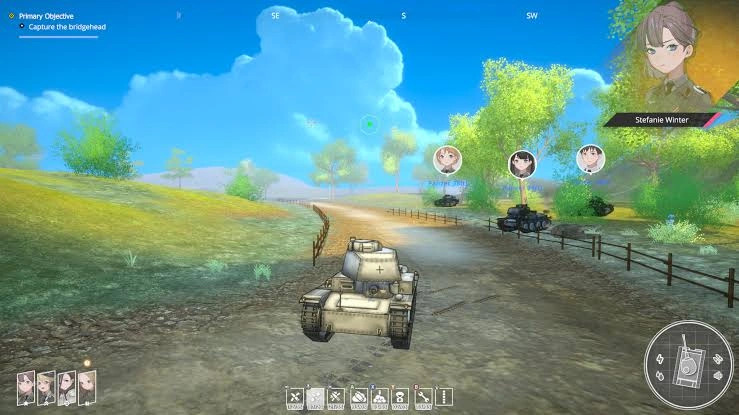
The bundled DLC creates a strange comparison with that curve. Several high-level tanks are available early enough to flatten missions clearly tuned around weaker vehicles. Taking a heavily armored DLC machine into an early campaign can turn threatening encounters into target practice. Players can voluntarily choose weaker equipment, but asking them to repair the difficulty balance is hardly elegant.
Skirmish mode provides an alternative, letting you choose a map, crew, tank, side, AI allies, and enemy force. Yet it exposes the same limits as the campaign. Most battles still settle into spotting targets, finding a favorable angle, and shelling them before they can answer.
The presentation shows the same split. Character illustrations are crisp, and the tanks carry enough detail to make their silhouettes recognizable. Cel-shading gives the game a distinct identity from sober military simulators. Sparse environments, severe pop-in, short draw distances, and bland terrain belong to an earlier generation of 3D war games. Buildings and trees can often be smashed apart, yet bushes and invisible barriers can stop a tank cold. For a game so interested in the physical behavior of armor, the world around that armor is oddly unreliable.
The Review
Panzer Knights: Commander’s Edition
Panzer Knights: Commander’s Edition has sharper tank mechanics than its dated presentation suggests. Armor angling, delayed turret movement, component damage, and line-of-sight spotting give its battles a tactical identity that separates it from simpler arcade tank games. The trouble is everything surrounding that combat: erratic AI, invisible walls, punishing checkpoint-free missions, thin crew development, and DLC tanks that wreck the intended progression curve. Its expanded garage gives returning PC players extra toys, yet the console package still feels like an interesting foundation waiting for a stronger sequel.
PROS
- Satisfying armor-angling system
- Tactical component damage
- Useful line-of-sight mechanics
- Large selection of historical tanks
- Distinct anime military aesthetic
CONS
- Unreliable allied and enemy AI
- No mid-mission checkpoints
- Severe pop-in and dated environments
- Shallow crew characterization
- DLC tanks disrupt progression