






















History has reduced Henry VIII’s wives to six verbs for generations. SIX the Musical Live! gives them microphones. Toby Marlow and Lucy Moss build their musical around that tension, taking Catherine of Aragon, Anne Boleyn, Jane Seymour, Anna of Cleves, Katherine Howard, and Catherine Parr and placing them inside a pop competition. Each queen must prove that her marriage to Henry was the worst. Whoever suffered most gets to front their newly formed band.
The joke works immediately because the women already know how ridiculous the contest is. Anne Boleyn can casually remind everyone that she lost her head. Anna of Cleves responds from the considerably happier position of having escaped with money, property, and her neck intact. Their historical tragedies become stage banter, then songs, then something less comfortable.
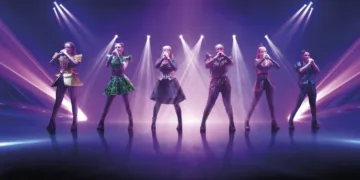
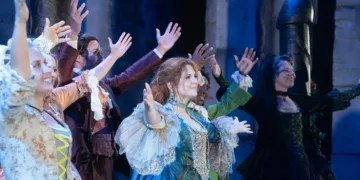
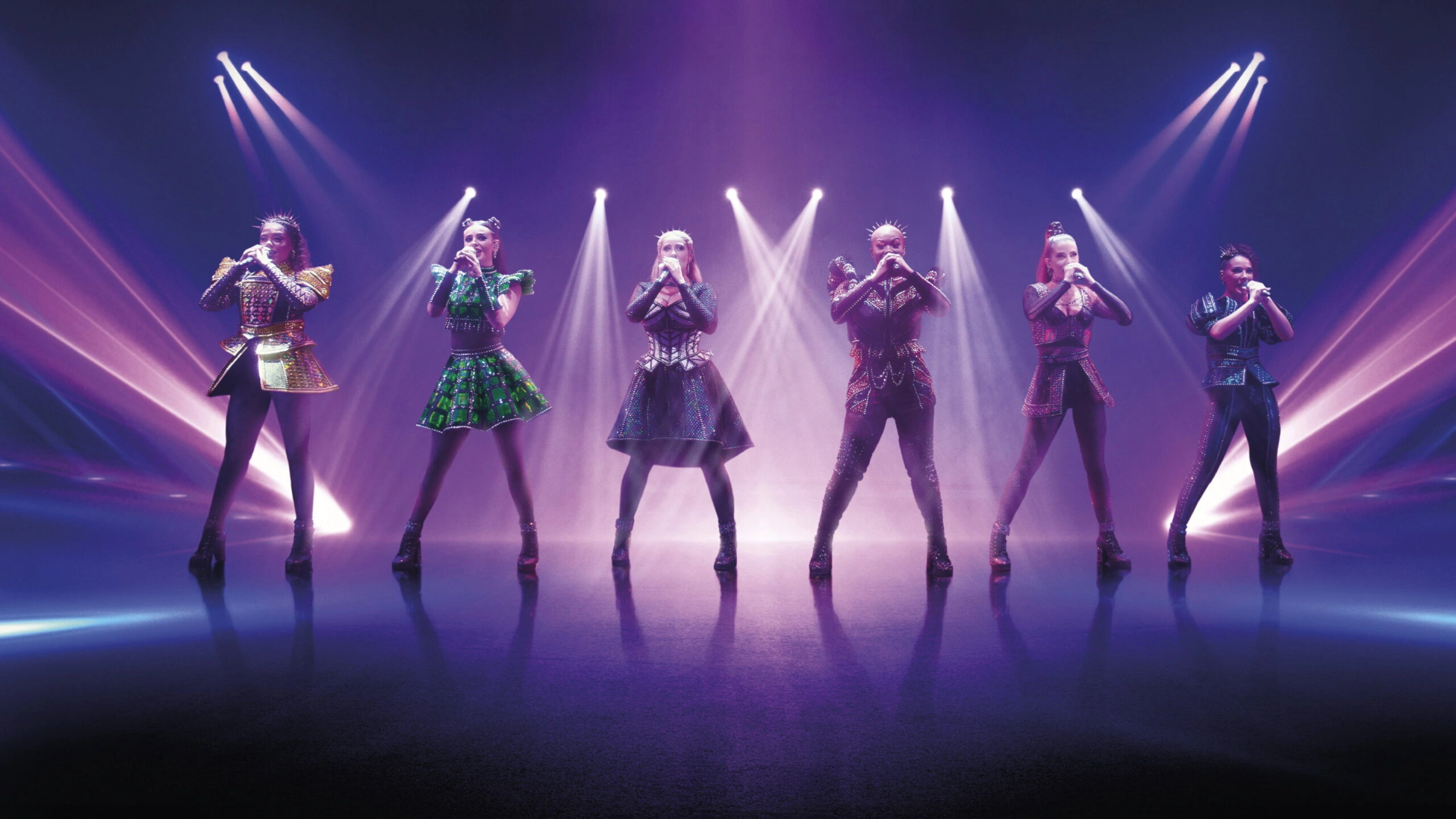
Liz Clare films the production as a concert rather than disguising its theatrical origins. The Ladies in Waiting remain visible behind the queens, handheld microphones stay in their hands, and the compact stage never pretends to be Tudor England. The illusion being sold here is pop stardom, and the six women sell it hard.
Six Queens Take the Mic
The production depends almost entirely on Jarnéia Richard-Noel, Millie O’Connell, Natalie Paris, Alexia McIntosh, Aimie Atkinson, and Maiya Quansah-Breed. There is no giant ensemble waiting to fill dead space. When one queen steps forward, the other five become her harmony singers and dancers.
That structure makes their chemistry tangible. Watch the tiny reactions during the arguments between songs. O’Connell’s Anne Boleyn seems delighted whenever another queen gives her an excuse to cause trouble. McIntosh’s Anna of Cleves carries herself like somebody who has already checked the scoreboard and knows she escaped the game with the best prize.
Richard-Noel attacks “No Way” with enough force to make Catherine of Aragon’s refusal feel physical. Natalie Paris takes the opposite route during “Heart of Stone.” The staging settles, Paris plants herself inside the ballad, and the sudden lack of comic armor makes Jane Seymour’s longing land cleanly. Then “All You Wanna Do” changes the temperature of the room.
Aimie Atkinson begins Katherine Howard’s number with bright confidence, playing every encounter with another man like another verse in a cheeky pop confession. Carrie-Anne Ingrouille’s choreography gradually makes those encounters harder to dismiss. Hands reach toward Howard again and again. Atkinson keeps performing the smile until the smile starts failing. By the final stretch, the repetition that made the song catchy has become the mechanism that makes it upsetting. That is where SIX is strongest emotionally. The music does not stop being fun before asking you to notice what the fun has been hiding.
Front-Row Tudor Pop
Clare mostly understands that the camera should serve the stage rather than conquer it. Wide shots preserve the group choreography, while close-ups reveal the expressions that a distant theater seat could easily lose. Those close-ups are especially valuable during “All You Wanna Do,” where Atkinson’s face carries the song’s tonal turn, and during Catherine Parr’s later rejection of the competition. The camera can isolate a performer at precisely the point when the musical asks us to stop seeing six interchangeable entries in Henry VIII’s biography.
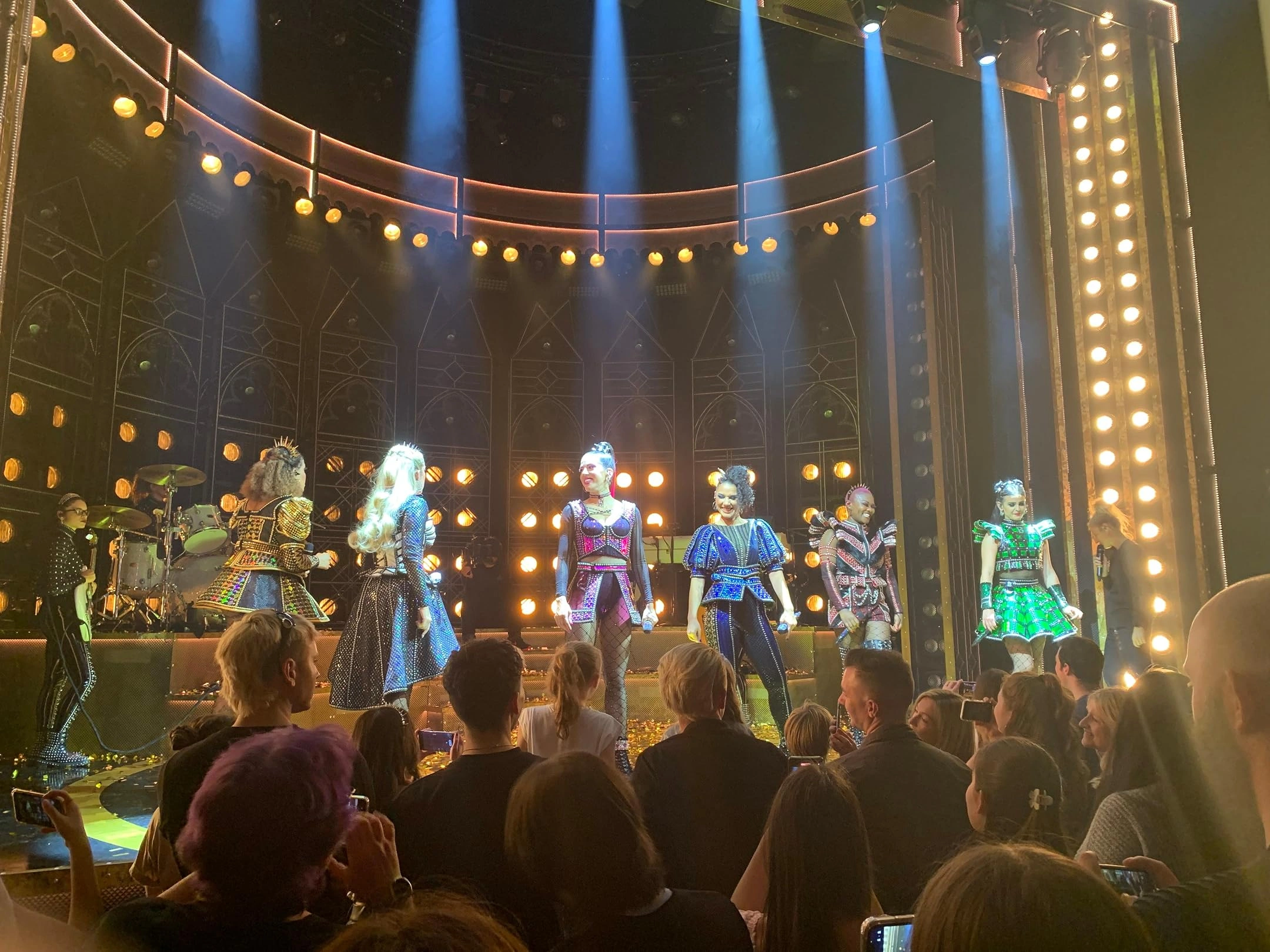
Gabriella Slade’s costumes benefit from that proximity too. Tudor silhouettes collide with pop-star styling, while rhinestones, lattice patterns, matching microphones, chokers, and Roman numeral earrings make each queen’s design feel unusually considered. Anne Boleyn’s sharp green outfit fits O’Connell’s deliberately disruptive performance so well that it creates a small filming problem: Boleyn can steal attention from the background during someone else’s song simply by standing there.
The camera coverage sometimes grows predictable. Similar combinations of stage-wide framing and performer close-ups repeat across the numbers, and the limited set leaves Clare fewer visual options than a conventional movie musical would offer.
Her most effective departure arrives around Catherine Parr’s attempt to stop the contest. The film briefly behaves as though the performance itself has broken. That interruption works because the visual grammar has been so stable until then. For a moment, the movie and the musical lose their footing together.
History Stops Keeping Score
Catherine Parr exposes the flaw sitting beneath the competition: these women are still letting Henry determine their value. The show has spent most of its runtime asking which queen suffered most because of one man. Parr’s “I Don’t Need Your Love” rejects the question itself. Their marriages happened, their suffering happened, and none of that requires Henry to remain the organizing principle of their identities.
It changes how the earlier songs feel. Anna of Cleves’ “Get Down” becomes funny because she refuses to perform misery she did not experience. Katherine Howard’s song becomes harder to hear because her story contains patterns of exploitation that extend beyond Henry. Jane Seymour’s ballad gains its own sadness because love and loss cannot be compressed into the word “died.”
The competition briefly strains as a piece of structure near the final stretch, since the show has to revive its original premise before it can dismantle it. That mechanical return is visible. You can feel the musical remembering the rules it invented roughly an hour earlier.
Maiya Quansah-Breed pulls the focus back toward the women themselves, and the Megasix restores the communal energy with all six performers sharing the stage rather than trying to defeat one another. After spending the night keeping score, they finally sound happiest once nobody is winning.
Six: The Musical Live! premiered in US theaters on August 14, 2026, following its initial international cinema releases. Filmed live at London’s Vaudeville Theatre, the production features the original West End cast as the six wives of Henry VIII transform historical trauma into a high-energy pop concert to reclaim their individual narratives.
Where to Watch Six: The Musical Live! (2026) Online
Full Credits
Title: Six: The Musical Live!
Distributor: Universal Pictures
Release date: August 14, 2026
Rating: PG-13
Running time: 95 minutes
Director: Liz Clare
Writers: Toby Marlow, Lucy Moss
Producers and Executive Producers: Andy Barnes, Wendy Barnes, Dione Orrom, George Stiles, Kenny Wax
Cast: Jarnéia Richard-Noel, Millie O’Connell, Natalie Paris, Alexia McIntosh, Aimie Atkinson, Maiya Quansah-Breed
- Composer: Toby Marlow, Lucy Moss
The Review
SIX the Musical Live!
SIX the Musical Live! works because the camera understands where the feeling lives. It catches Millie O'Connell's comic snap, Natalie Paris' control during "Heart of Stone," and the moment Aimie Atkinson's smile stops protecting Katherine Howard in "All You Wanna Do." Liz Clare keeps the staging simple enough for the performers' chemistry to carry the screen, while Catherine Parr's refusal to keep ranking trauma gives the concert its emotional turn. A few repeated camera angles and a briefly strained competition structure barely slow six performers operating in remarkable sync.
PROS
- Exceptional six-woman ensemble
- "All You Wanna Do" lands hard
- Energetic live musical capture
- Detailed costume photography
- Strong pop songwriting
CONS
- Repetitive camera coverage
- Competition conceit briefly strains
- Boleyn's costume can pull focus