





















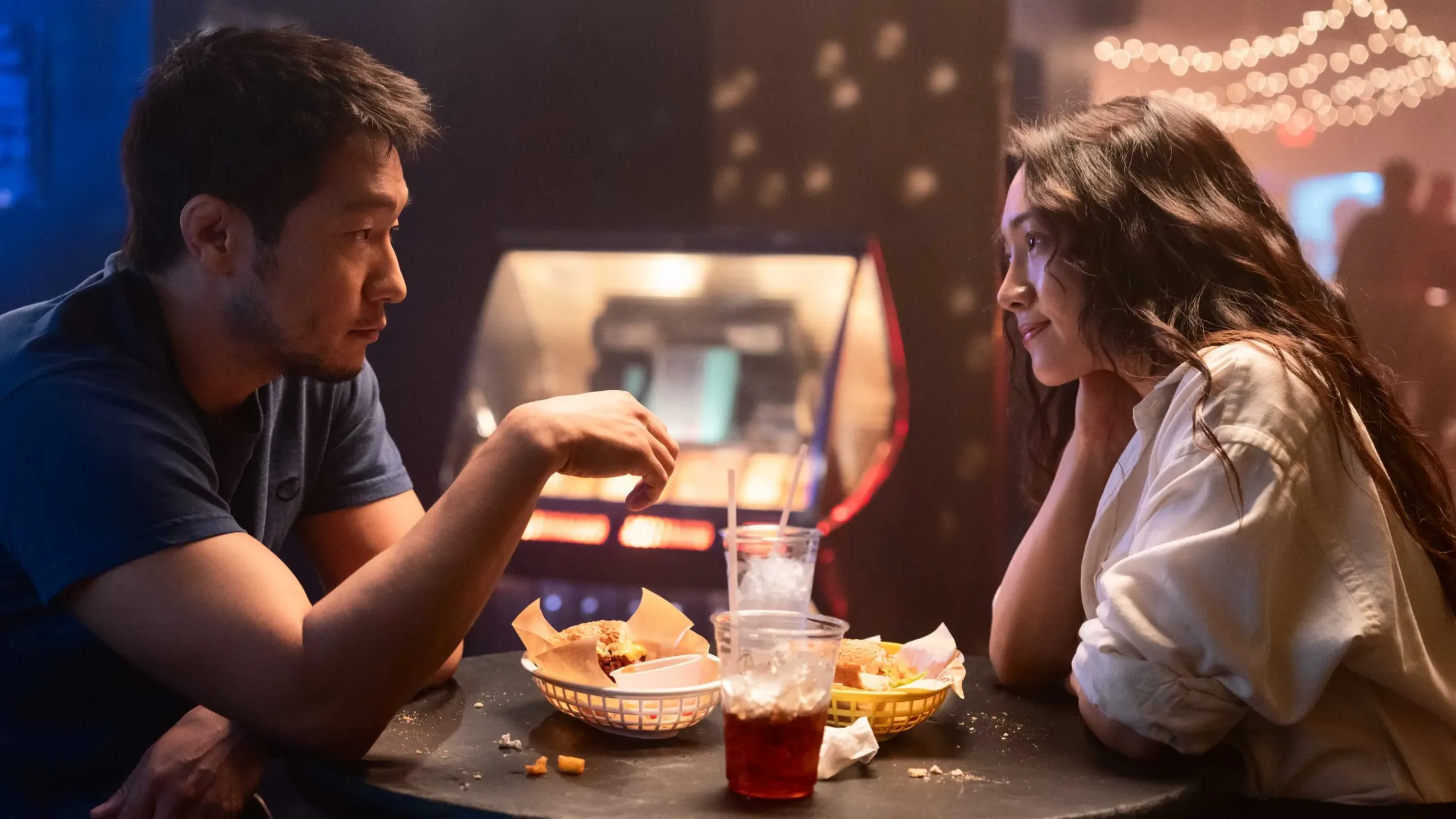

Stephanie Ahn’s feature debut, Bedford Park, begins with a collision that doubles as an inciting incident and a thesis statement. Audrey, a physical therapist living in Brooklyn, heads back to her childhood home in New Jersey after her mother’s car accident. The person behind the wheel of the other vehicle is Eli, a quiet mall security guard with a past in collegiate wrestling.
Their first encounter lands on the wrong note, sparked by a tense argument about a fruit basket, then complicated by a sudden medical emergency that locks the two into the same orbit. Audrey soon starts driving Eli to his community college classes, and the film uses those commutes as its primary narrative engine. Ahn keeps the story close to East Coast suburbia, watching how shared silence can turn into recognition.
The script lingers on the particular friction of moving back into a family home as an adult, where parental expectations fill every room and grief makes even ordinary routines feel isolating. The pacing stays slow and deliberate, treating the protagonists’ emotional weather as the plot’s real forward motion.
Drifting Spirits and Physical Fragility
Moon Choi plays Audrey with a steadiness that makes her drift feel lived-in rather than theatrical. Audrey moves through her days like someone present for the tasks and absent for the reasons behind them. In Brooklyn, her life includes casual, kinky app encounters, presented as a pattern of escape that gives her temporary relief from loneliness without changing the shape of it. The film also ties that emotional withdrawal to a body that has carried its own history: Audrey’s four miscarriages sit in the background of scenes, shaping how she holds herself and how she absorbs the pain around her.
Son Sukku gives Eli a heavy reserve that reads as self-protection. He is introduced as a former wrestling champion who now works as a mall security guard, and he carries a private life that stays partially sealed even as the story draws closer: a complicated past in Miami and a young daughter in Philadelphia. Ahn and the script communicate his neglect through details that feel almost aggressively plain.
Eli eating peanut butter and Nutella straight from the jar with his fingers is one of those choices that makes you wince, partly because it is so mundane. The film does not require a speech to translate it. The behavior sits there, bleak and telling, like a diagnostic sign the camera refuses to ignore.
The relationship between Audrey and Eli grows through proximity, not through manufactured momentum. Their car rides keep their connection awkward for a long stretch, which fits the characters and the film’s temperament. They share time because their circumstances force it, and that pressure becomes a strange form of stability. The bond that forms feels earned because the performances allow hesitation to remain on the surface.
These two stay prickly. They keep defenses intact even while showing the cracks. The storytelling leans on presence and timing, trusting small shifts in tone and posture to carry emotional meaning. The film ends up watching two people who struggle to meet the standards pressing in on them, then watching what happens when they stop pretending they can.
The Weight of Inherited Trauma
Bedford Park frames its central ache through han, described here as heartache or trauma passed down through family lines. The concept clarifies the characters’ shared condition without turning them into symbols. Audrey and Eli carry the weight of their parents’ expectations, and the story tracks how that burden shapes what they ask from other people. Each seems to want someone who can help hold the pain for a moment, long enough to breathe.
Audrey’s home life supplies the film’s sharpest pressure points. Her father functions as a figure of resentment, an alcoholic who believes he lost professional status after moving from Korea to the United States. He mourns the life he left behind, and that mourning curdles into a presence that fills the house even when he is silent. Audrey’s mother adds a different kind of strain, pushing her daughter while maintaining appearances.
She lies to friends about Audrey’s medical career to preserve an image, creating a family environment where presentation outranks truth. The film does not treat these details as backstory trivia. They operate as structural forces, shaping how Audrey speaks, what she withholds, and why returning home feels like stepping into a script written years ago.
The car becomes the film’s most important setting because it gives Audrey and Eli a place to speak plainly. On those drives, they are away from family oversight, away from the household rules that dictate what can be admitted and what must stay hidden. The film’s depiction of Korean American life in suburban New Jersey carries a sense of specificity, focusing on the burdens of second-generation existence without leaning on familiar shortcuts.
The characters live between two worlds, and the story treats that condition as daily practice rather than a single dramatic conflict. Audrey and Eli find a kind of relief in each other through recognition. They understand the cost of survival in a family structure shaped by expectation, sacrifice, and performance. Their shared identity brings comfort, and it also brings friction, since recognition can cut as sharply as it heals.
The Aesthetics of Observation
Ahn directs with restraint, favoring observation over explanation. The film’s choices suggest a confidence that character can emerge through attention, not instruction. Cinematographer David McFarland’s stationary camera setups reinforce that approach, holding on the daily rhythms of Audrey and Eli as if the film is waiting for them to reveal themselves. The visual language is intensely aware of the body. The camera studies scar tissue, rib cages, and physical wounds, treating anatomy as a record of what the characters carry and what they have survived.
Food becomes another recurring key, used to map interior life through external habits. Shared meals at food courts and Korean goods tucked into a care package function as quiet signals of need, comfort, and culture. These objects do narrative work without announcing themselves as metaphors. They sit inside scenes the way personal history sits inside a person: ordinary until it becomes unavoidable.
The slow pacing matches the film’s view of emotional healing as something that happens in its own time. People open up when they are ready, and the story refuses to hurry that readiness. Silence becomes one of the film’s most effective tools. Many of its strongest moments arrive when Audrey and Eli stop trying to fill space with words. They listen to music together in the car. They share air and distance in the same frame. Ahn’s direction trusts viewers to read what is present in those pauses, letting images and duration carry the meaning.
Bedford Park premiered at the Sundance Film Festival on January 24, 2026, where it earned the US Dramatic Special Jury Award for Debut Feature. Following its acclaimed debut, Sony Pictures Classics acquired the worldwide distribution rights. The film presents a grounded look at the lives of two Korean Americans, Audrey and Eli, who are brought together by a car accident in New Jersey and find a shared path toward healing. It is currently appearing at major international film festivals and will be available for wider audiences through Sony’s distribution network later this year.
Full Credits
Title: Bedford Park
Distributor: Sony Pictures Classics
Release date: January 24, 2026
Running time: 119 minutes
Director: Stephanie Ahn
Writers: Stephanie Ahn
Producers and Executive Producers: Gary Foster, Chris S. Lee, Nina Yang Bongiovi, Theresa Kang, Son Suk-ku, Russ Krasnoff, Moon, Sungwon Jee, Yoon-Hyue Julia Kim, Clara Wu Tsai, Agnes Chu, Mark Gooder, Alison Thompson
Cast: Moon Choi, Son Suk-ku, Won Mi-kyung, Kim Eung-soo, Jefferson White, Cindy Hogan
Director of Photography (Cinematographer): David McFarland
Editors: Malcolm Jamieson, Stephanie Ahn
Composer: Michael Brook
The Review
Bedford Park
Bedford Park is a quiet and precise study of healing. Stephanie Ahn captures the specific texture of immigrant trauma through a fragile connection. The pacing is occasionally stagnant. The subplots feel crowded. However, the central performances give the material a sense of weight. Moon Choi and Son Sukku provide a depth that makes the slow burn worth the investment. It is a confident debut that values observation over easy answers. It offers a rare and honest look at the burdens we choose to carry.
PROS
- Strong lead performances by Moon Choi and Son Sukku.
- Authentic and specific depiction of Korean American culture.
- Intimate and observational visual style.
- Earned and believable chemistry between the leads.
CONS
- Slow and sometimes stagnant pacing.
- Convoluted subplots that distract from the leads.
- Overcrowded supporting cast.
- Ambiguous dual endings that soften the emotional impact.