
























![Kingdom Hearts Collection [I-III] Review](https://gazettely.com/wp-content/uploads/2026/10/Kingdom-Hearts-Collection-I-III-1-360x180.webp "Kingdom Hearts Collection [I-III] Review: KHII Holds Steady as Newer Entries Fluctuate 37")




Lou’s most honest writing is hidden inside someone else’s wedding. After her engagement collapses, she takes the vows prepared for her own ceremony and folds them into a speech for Tilda, her best friend. The gesture is generous, dishonest, and revealing. Lou can describe devotion with precision when the words belong to another person. Asking what she wants requires a different language.
Joey Power builds Love Language around that fracture. Lou spends her workdays writing social media copy for a tortilla chip company while an unfinished YA novel sits untouched. The videoconference scenes flatten her into a small box beside marketing jargon and disposable meme ideas. Then Tilda’s guests praise the vows. Chloë Grace Moretz lets the compliment alter Lou’s posture before Lou can hide the reaction. Her shoulders loosen. Her eyes sharpen. Recognition becomes a light source.
Brides soon hire Lou to create declarations they cannot articulate. The money helps, yet the deeper reward is hearing that her sentences mattered. Power gives authorship the same emotional weight as romance. Lou is waiting for someone to choose her while refusing to choose the work that makes her visible.
Four Corners
Dash enters at Tilda’s wedding with the direct energy of a man who has already decided Lou deserves his attention. Anthony Ramos plays him with such sincerity that the script’s effort to frame him as a casual operator never holds. His strongest flirtation arrives over drinks, when he encourages Lou to charge for the vow writing. He sees a profession where she sees an accident.
Warren represents a darker temptation. He is the college crush preserved by distance, polished into an answer by years of incompletion. When Olivia hires Lou and reveals Warren as her fiancé, each interview becomes an ethical trap. Lou asks about their relationship under the cover of research, yet every question tests an old possibility.
Manny Jacinto gives Warren enough hesitation to keep the door ajar. Isabel May makes Olivia’s composure look increasingly defensive. Her claim that she and Lou know each other from Pilates is transparently false, but it gives Olivia control over a room she can feel slipping away.
Lou’s writer’s block on Olivia’s vows is a moral failure expressed through craft. She cannot complete the assignment because she has begun editing the couple rather than their language. Power lets the love rectangle gather tension, yet the final pairings lack the shared time needed to feel structurally sound. The actors supply sparks. The geometry remains crooked.
Chicago in Soft Focus
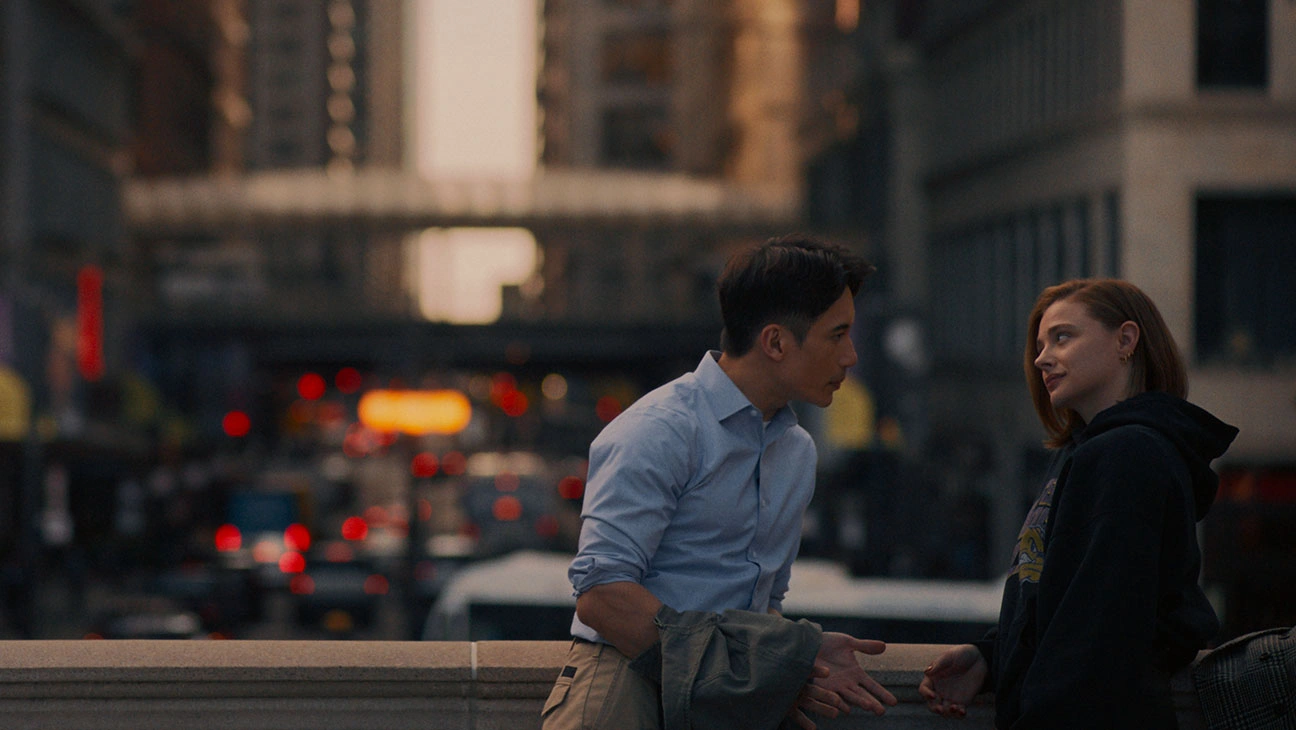
Andrew Wehde photographs Chicago in warm, polished tones that make every platform, apartment, and bar appear prepared for romantic rescue. The opening frames announce the city with prominent Chicago Tribune imagery, a blunt choice bordering on civic product placement. The film grows subtler once Lou moves through the streets.
Crowds create scale without comfort. Beneath the Wabash station, the city contracts around private conversation, steel beams and passing trains turning public space into temporary shelter. Power understands how urban intimacy works: two people can be isolated in a packed street, then exposed in a quiet corner. Lou’s evasions are staged against routes, delays, weddings, work calls, and accidental encounters. Chicago keeps placing people in one another’s path.
The bright palette rarely changes enough to register Lou’s ethical drift. Her scenes with Dash, Warren, and Olivia share the same glossy warmth, softening distinctions the drama needs. A romantic comedy can live in flattering light, yet light still carries judgment. Here it forgives everyone early.
Moretz supplies the missing contrast. Lou eats burritos with the exhausted concentration of someone completing an obligation. She sits through chip-company calls with her body already absent. When her writing receives praise, the performance gains movement. Those physical shifts give Lou an interior life the cinematography sometimes smooths away.
Where the Light Fails
Tilda and Gus function as witnesses rather than decorative friends. Billie Lourd and Lukas Gage give their frustration a history; their jokes land because they have watched Lou repeat the same evasions. When they stop cushioning her choices, the comedy gains an edge. Queer, interracial, and trans characters occupy the social world without identity becoming plot machinery. People are judged for conduct. A modest standard, strangely rare.
Power’s script is funniest when Lou’s professional disguise cracks. Her interviews with Warren and Olivia force her to collect romantic details she would rather dispute. The Pilates lie hangs in the air. Dash’s patience thins. Olivia senses that the person hired to write her vows may be revising the marriage instead.
The final stretch shifts toward self-aware satire after an hour of emotional sincerity. A pop cover of “Linger” accompanies the climax with the subtlety of a highlighted confession. The tonal turn is playful, but it arrives after the film has trained us to take Lou’s damage seriously. It feels like a lighting change made after the actors have finished the scene.
The sharper resolution lies in Lou reclaiming authorship. Her central choice concerns the distance between the life she can describe and the one she will risk living. Romance supplies the frame. Writing exposes the person inside it.
Love Language premiered at the South by Southwest Film & TV Festival on March 16, 2026, and is available through festival screenings and independent distribution channels. The romantic comedy follows an aspiring author who starts a side hustle writing wedding vows, only to discover her new client’s fiancé is her former college crush.
Where to Watch Love Language (2026) Online
Full Credits
Title: Love Language
Distributor: Caviar, 3 Arts Entertainment, No Notes Productions
Release date: March 16, 2026
Running time: 104 minutes
Director: Joey Power
Writers: Joey Power
Producers and Executive Producers: Bert Hamelinck, Allison Hironaka, Ari Lubet, Colin Jost, Jeff Grosvenor, Michael Sagol, Tyson Bidner, Corentin De Saedeleer
Cast: Chloë Grace Moretz, Anthony Ramos, Manny Jacinto, Isabel May, Lukas Gage, Billie Lourd, Chloe Fineman
Director of Photography (Cinematographer): Andrew Wehde
Editors: Jennifer Vecchiarello
Composer: Jeff Morrow
The Review
Love Language
The saturated Chicago light flatters every storefront, train platform, and romantic possibility, while Lou remains carefully shadowed by choices she refuses to make. Chloë Grace Moretz gives that avoidance wit and bruised credibility, especially when praise for Lou’s writing briefly changes her entire posture. The supporting cast keeps the love rectangle lively, yet the final pairings lack the emotional geometry needed to hold. Joey Power’s film sees commitment clearly when discussing work and self-respect. Its eyesight blurs once romance demands an answer.
PROS
- Moretz’s guarded comic performance
- Chicago used as emotional geography
- Strong supporting ensemble
- Sharp vow-writing premise
CONS
- Unconvincing final pairings
- Abrupt tonal shift
- Familiar visual polish
- Predictable music choices







