









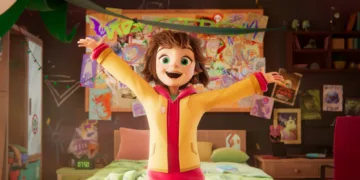







Twelve year old Myrtle Meek functions as a centrifugal force of desire. Her parents, Christopher and Maureen, keep the local library and endure their daughter’s domestic regime. They sustain a brittle order by offering continual concessions. That arrangement breaks when Myrtle fixates on a new object. She demands a Fing.
No traditional encyclopedia yields an entry. The creature remains a figure of cryptozoological rumor. Christopher leaves his quiet stacks and travels to the Zybra jungle. There he finds the Fing: a globe of vermilion fur, a single expressive eye, and an evident taste for custard cream biscuits.
A rival appears in the Viscount, a man of forty-two who lives in prolonged childhood under the care of his Nanny. He values the Fing as a means to settle debts. The setup stages a clash between institutional entitlement and the unruly logic of the wild.
The Parallel Lines of Arrested Development
Iona Bell commits to Myrtle with a performance built around tantrum as aesthetic practice. Her gestures cut sharp. She conveys a child who treats objects as dispensers of meaning. Taika Waititi plays the Viscount with grotesque comic timing and a deliberate softness that hints at arrested growth. Both characters occupy a moral zone where indulgence erodes agency. Penelope Wilton supplies the Nanny with a dry ballast that keeps the Viscount legible.
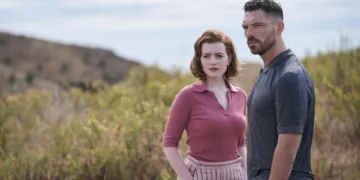
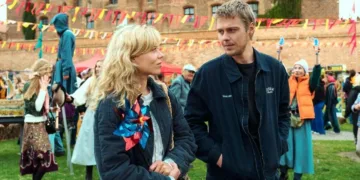
Mia Wasikowska and Blake Harrison give Christopher and Maureen a pastel fragility; they read other people’s lives expertly and their own life poorly. Their latent romanticism slides toward a form of co-dependency. When their livelihood risks exposure they pivot and show an unexpected reserve. Sidhant Anand registers Tyler, the neighbor, in a different register: a baffling enthusiasm for Meatloaf that cuts against the film’s politeness.
The ensemble establishes a social map where chronological age does not predict ethical maturity. The children calculate moves with a cold economy. The adults perform authority. The loudest presence usually dictates outcomes. A wry aside: the adults might benefit from a handbook entitled How to Be Taken Seriously by Your Own Household.
The Geometry of a Saturated Storybook
Director Jeffrey Walker composes each frame with dollhouse precision. Camera placement privileges rigid symmetry and deliberate movement. Shot compositions favor orthogonal lines and central framing that reduce actors to figures within constructed dioramas. Lighting emphasizes saturation and theatrical clarity. Shadows recede. The result reads like memory organized into color fields.
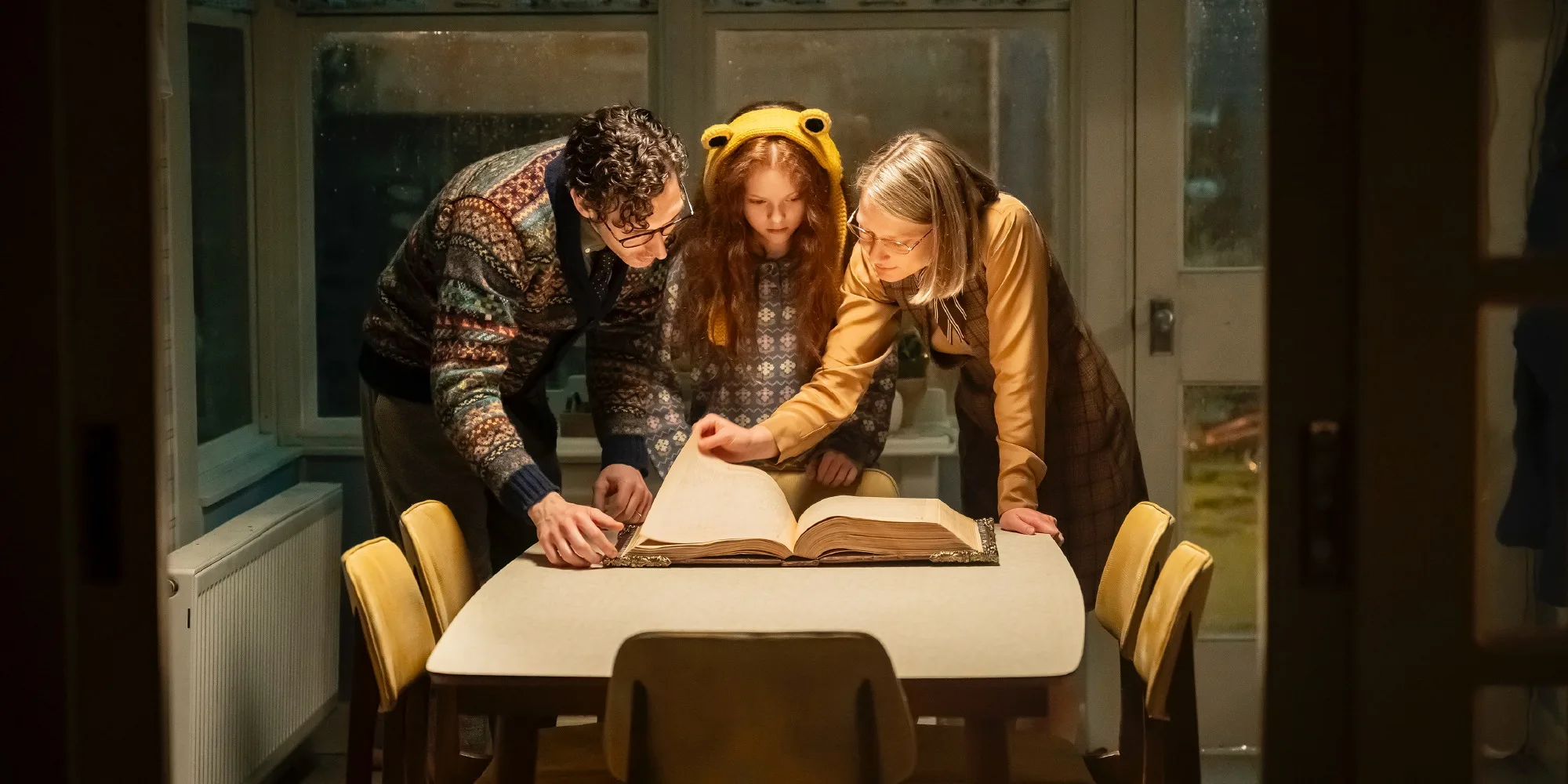
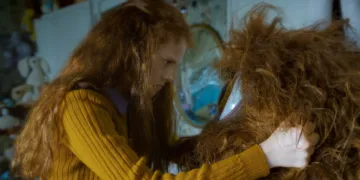
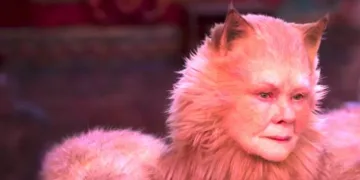
The library and the Viscount’s mansion operate as expressionistic cages; each room functions as a stage set that reveals character through placement and negative space. The Fing’s materiality depends on puppetry. The creature reads as a physical presence with weight and resistance. Its auburn coat and single eye register on the same sensory plane as the human actors.
Practical effects dominate. Occasional background digital touch-ups appear in the Zybra sequences, yet the film privileges tangible craft. The mise-en-scene gestures toward the 1980s while avoiding lazy repetition of retro tropes. Anne Dudley’s orchestral score provides a steady pulse that alternates between whimsy and unease.
The Zybra jungle resembles a fevered temperate garden. The film limits mechanistic explanation. Walker accepts mystery as a narrative engine. The camera asks the viewer to inhabit a reality governed by associative logic. Every frame arranges color, texture, and motion to direct perception.
Mirrors of Fur and Temperament
The story reads as an inquiry into material desire and its psychic cost. Myrtle and the Fing share a palette of fiery red and a volatile impulse structure. The creature functions as a nonverbal mirror of the girl’s conduct. It reflects her chaos with blunt fidelity. That reflection propels a moral reorientation that feels earned. Myrtle moves from acquisition toward care.
She recognizes the Fing as a sentient presence rather than another object for display. That shift exposes the Viscount’s approach to the wild as transactional. He appraises the living as instruments of value. Myrtle begins to treat the jungle as refuge. The modest Meek household and the sprawling wildlife park stage a tension between private constraint and public privilege. Wealth in the Viscount’s orbit insulates desire from developmental pressure.
The film stages a caution for parents: excessive accommodation corrodes growth. Boundaries register as a form of ethical attention. The resolution rejects a tidy restoration of previous certainties. It privileges the family’s evolving bonds over any neat return to former equilibria. Joy arrives in small, disorderly moments of connection. A brief, dry observation: custard cream biscuits make for persuasive diplomacy.
Fing! is a whimsical 2026 fantasy-adventure film adapted from the popular children’s novel by David Walliams. The story follows a pair of kind-hearted librarians, Mr. and Mrs. Meek, who embark on a chaotic expedition to the remote jungle of Zybra to find a “Fing”—a rare, furry, one-eyed creature—to satisfy the impossible demands of their spoiled daughter, Myrtle. The film had its world premiere at the Sundance Film Festival on January 24, 2026, as part of the Family Matinee program. It is currently available to watch on Sky Cinema and the NOW streaming service in the United Kingdom, while audiences in Australia can find it through Transmission Films and the Stan streaming platform.
Full Credits
Title: Fing!
Distributor: AGC Studios, Transmission Films, Sky Cinema, Stan
Release date: January 24, 2026
Rating: PG
Running time: 96 minutes
Director: Jeffrey Walker
Writers: David Walliams, Kevin Cecil
Producers and Executive Producers: Jo Sargent, Todd Fellman, Craig McMahon, Stuart Ford, David Walliams
Cast: Iona Bell, Taika Waititi, Mia Wasikowska, Blake Harrison, Penelope Wilton, David Walliams, Richard Roxburgh, Robyn Nevin, Sidhant Anand
Director of Photography (Cinematographer): Mark Wareham
Editors: Geoff Lamb
Composer: Anne Dudley
The Review
Fing!
Jeffrey Walker delivers a visually arresting study of domestic entitlement. The film operates as a biting satire of the modern spoiled child. It manages to balance the grotesque behavior of its leads with a genuine emotional foundation. The tactile reality of the Fing creature provides a necessary anchor for the heightened production design. While the pacing in the initial act tests the patience of the viewer, the eventual shift toward a protective bond offers a rewarding resolution. It is a sophisticated piece of family cinema that respects the intellect of its audience.
PROS
- Iona Bell’s visceral portrayal of a juvenile antagonist.
- Meticulous, symmetry-driven production design.
- Effective use of practical puppetry for the titular creature.
- Sharp, dry wit in the screenplay.
CONS
- Lengthy introductory phase before the main plot gains momentum.
- Villainous character arc feels secondary to the central family drama.
- Occasionally jarring transitions between antagonistic and heroic behavior.