


















The current appetite for watching the twentieth century decay has produced its own pilgrim class: the urban explorer, half archivist and half clout supplicant. These people, fed by “likes” that stand in for older ideas of achievement, convert ruin into product.
Marc Klasfeld’s Do Not Enter presses that habit into a horror frame. Based on David Morrell’s novel Creepers, the film follows influencers who treat trespassing as prestige labor with extra mold. They pick over the Paragon Hotel like scavengers at an architectural corpse, performing for a flickering livestream crowd. The place is a vast New Jersey relic, abandoned since the 1980s and rumored to hide a mobster’s $300 million fortune.
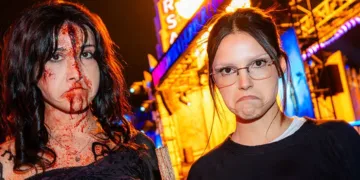
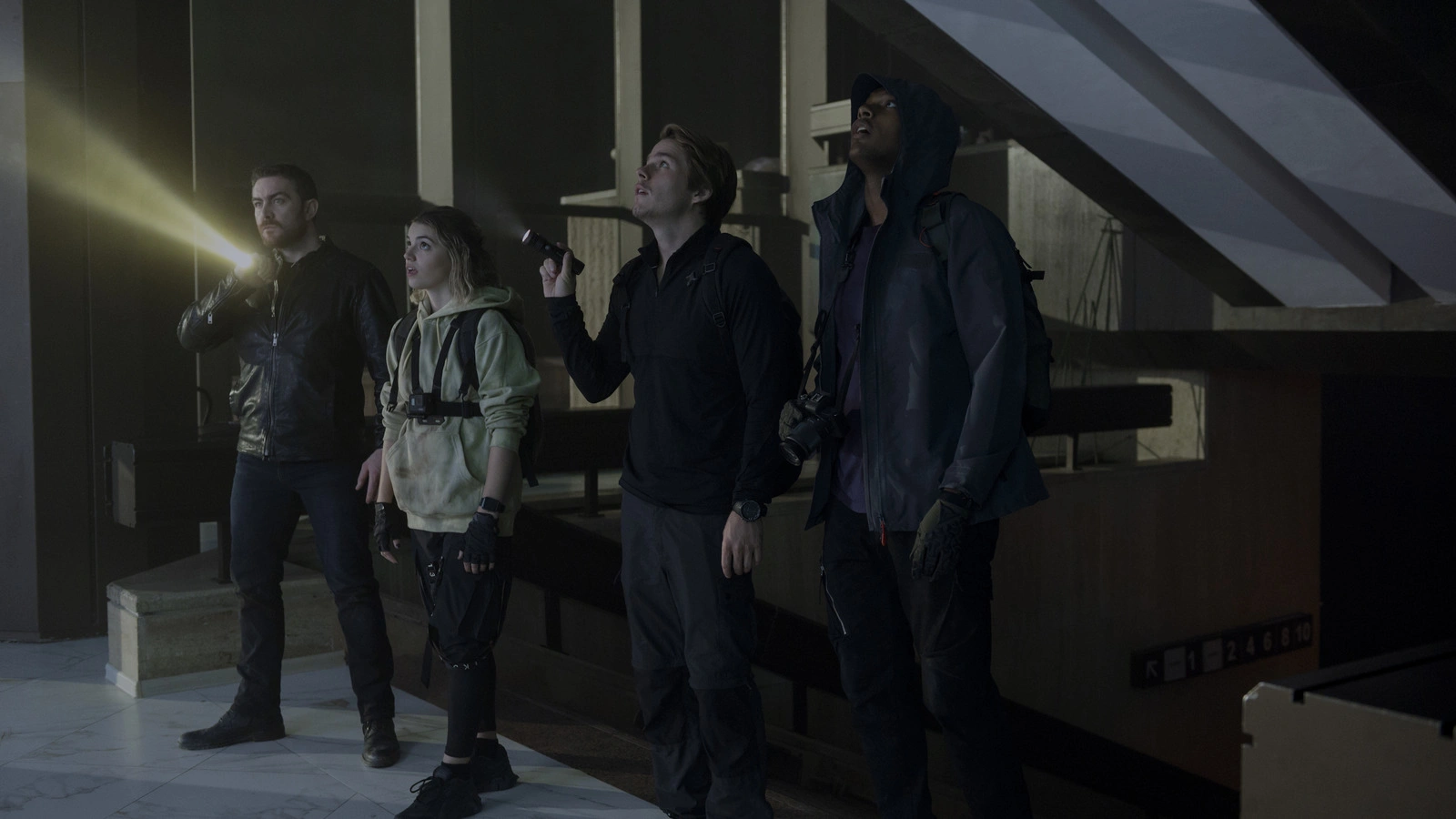
Rick, ambitious and metrics-sick, and Diane, practical in her own risk-friendly way, lead the group. The money matters to them. Viral attention matters more. Frank joins after claiming to be a Vice reporter, a credential the crew accepts with almost heroic gullibility. Once they enter the hotel, the past begins behaving like a predator.
Clout-Hunger and the Purity of the Digital Ascetic
The film begins with a high-speed chase through the NYC subway system, a sequence that identifies the group’s “attention-pathology” with admirable bluntness. They are pursuing a lost Basquiat, an art quest that plays like a heist with better vocabulary. The prologue studies group discipline through the expulsion of JD. He tries to steal part of the find, and the group ejects him at once.
That moment defines the “creeper code,” a pseudo-ethical rulebook that treats the “find” as sacred above private profit, at least at the start. Rick and Diane guide this little sect with the fever of people who have confused analytics with destiny. Their intensity covers a deeper panic over falling numbers.
Cora brings a strange physical charge to the crew. Her habit of moving through hallways by handstand and crab walk suggests a person who has inverted her bond with reality in the most literal manner possible. Call it “physical-eccentricity,” the camera-age urge to make the body look memorable before it looks sensible.
Frank’s place in the team sharpens the film’s commentary on trust. The Creepers let a stranger inside their circle because he offers a vehicle and a press badge. In their world, a credential, even a fake one, functions as a drawbridge.
Their command of social media is strong; their survival sense is close to nonexistent. They leap from moving trains for an audience of roughly a hundred people, a bargain that fails every moral and mathematical test. The gap between their risks and rewards speaks to a public hunger for recognition that has curdled into self-erasure. They are influencers with little influence, explorers with nowhere left to go except downward.
They live through a viewfinder, and that habit ruins their ability to see the actual danger in front of them. This is the film’s nastiest social joke: their phones can turn every risk into an image, yet no image can return the body once gravity enters the chat. Digital fame is a jealous god. It asks for sacrifices from worshippers too distracted to hear the knife being sharpened.
The Clutter-Altar and the Selective Physics of the Ruin
The Paragon Hotel is the film’s strongest presence, a Bulgarian stand-in for New Jersey that conveys the scale of 1980s decadence. It feels like a monument to a vanished age of organized crime and industrial money.
One of the film’s sharpest visual symbols is the “tree” of gear, a heap of backpacks and cameras left behind by earlier explorers who failed to escape. This clutter-altar is a warning the group can physically touch and still ignore. It records failed ambition in plastic, straps, and nylon, giving the hotel a recent history of appetites swallowed whole.
The building follows a logic I would call “selective-vitality.” The structure has rotted for decades, yet electricity still works in patches. Elevators drift through shafts with a sick mechanical groan. CCTV monitors wake inside a control room that should resemble a morgue for dead screens.
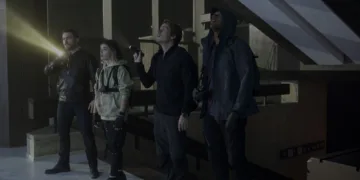
This technological haunting makes the hotel seem ready to stage its last spectacle for whoever remains willing to watch. Yon Thomas’s lighting leans heavily on flashlight beams. The result is a constant “spatial-choking,” where rooms feel partial, uncertain, and hostile to measurement.
Some parts of the hotel lack convincing decay, which creates a rough inconsistency. A few rooms look suspiciously clean, as if forty years of dust reached the doorway and lost interest. That sterility makes the place feel manufactured, a stage arranged for the suffering to come. The hotel becomes uncanny architecture: familiar hospitality warped into a lethal maze. A ruin is a mirror. It reflects what we carry into it.
The Chaos-Agent and the Manifestation of the Unliked
The story moves from heist mechanics to survival horror after a rival crew arrives under Tod’s command. Nicholas Hamilton plays Tod with “attention-deficit aggression,” all jittery threat and camera-fed bravado. Tod is an unhinged antagonist who plays Russian roulette for the lens and wants the $300 million by any means available. The fight between the crews over the hidden fortune brings human viciousness into the film’s trap. His presence complicates the escape, turning flight from a monster into a three-sided struggle for survival.
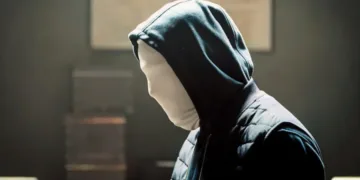
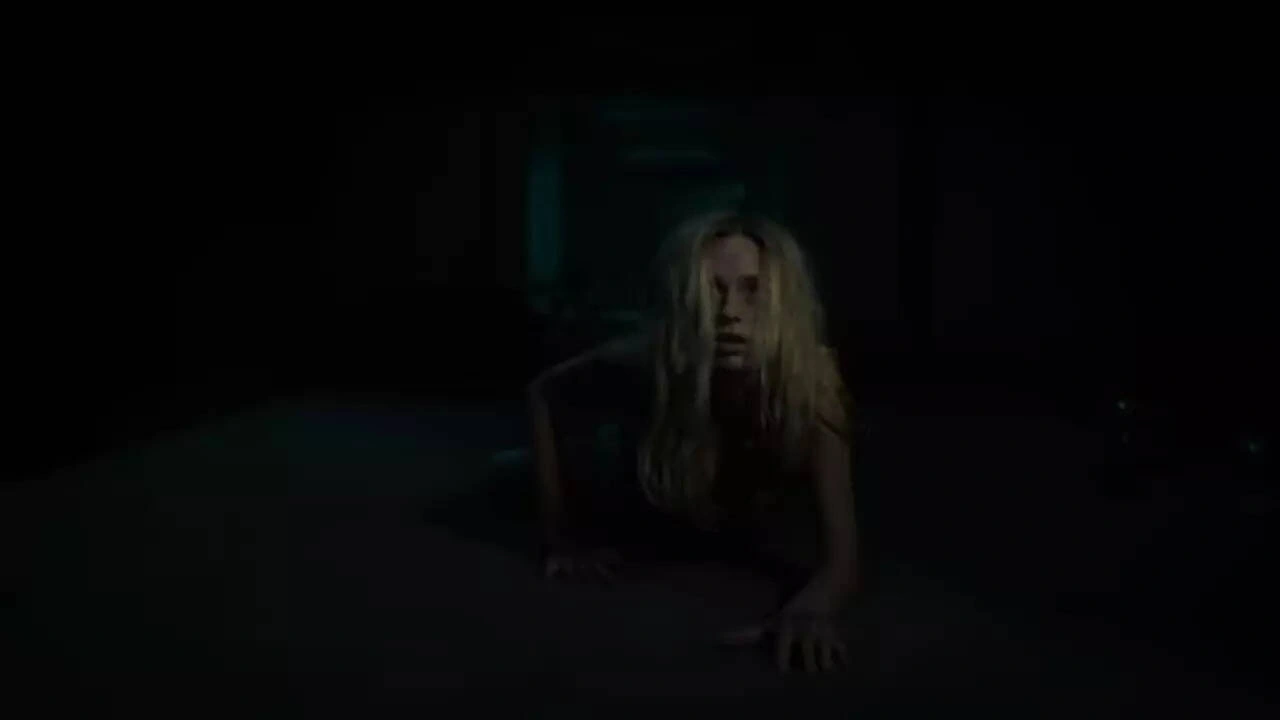
The Pale Creature, played by the physically gifted Javier Botet, pulls the film toward creature-feature territory. Its design recalls sightless predators from recent horror touchstones, and it still unsettles through movement and texture. The creature’s surrounding lore, involving vague prophecies and Satanic rituals, receives casual treatment from the script. Those details remain thin, leaving the supernatural threat as narrative machinery with little mythic weight.
The film’s “rubber-soul physics” appear during the clashes with the monster and Tod. Characters endure falls and bodily trauma that would end the matter in a harsher reality. That resilience drains tension from the final act. Survival begins to feel prewritten, with protagonists protected by narrative rank. The creature arrives late, so the film spends much of its running time on human conflict. Viewers seeking a classic monster-forward picture may feel the delay. Survival becomes the final metric. The monster gives flesh to collective obsolescence.
The Music-Video-Logic of the Digital Macabre
Marc Klasfeld’s music-video background shapes the film’s kinetic charge. The editing stays restless, folding in YouTube-style overlays, character bios, and abrupt audio distortions. This “glitch-aesthetic” clearly imitates the sensation of scrolling through a feed.
The film uses a hybrid visual grammar, moving between high-definition cinematography and the unstable grit of found-footage perspective. That variety keeps the eye busy while narrative logic wobbles under the floorboards. For a movie about spectatorship, the restless form feels apt; the frame keeps begging for attention with the same needy persistence as the people inside it.
The sound design is aggressive, using sharp cues to provoke a bodily response. These jolts work, then sometimes feel like fear on credit. The 90 minute runtime moves briskly, hopping from scene to scene fast enough to keep the many plot holes from gathering dust in the viewer’s mind. The film is a frantic style exercise, a media object as obsessed with self-display as the people holding the cameras.
Tracking the action during low-light sequences remains a constant problem. Shadows swallow choreography, so the kills land with less force than they should. The darkness may conceal limits in the CGI, most visible during wide shots of the hotel’s exterior. The film works best when it accepts its goofy teen-horror instincts. It knows it is being watched, like the explorers trapped in its machinery. The screen is a cage we build for ourselves. The final frame is the true exit.
Do Not Enter premiered in select theaters and on digital platforms on March 20, 2026. As of today, May 2, 2026, the film is widely available for home viewing. You can currently watch it through major Video-On-Demand (VOD) services including Amazon Prime Video, Apple TV, Google Play, and Vudu, as well as in a limited number of independent cinemas that continue to screen the title following its spring debut.
Where to Watch Do Not Enter (2026) Online








Full Credits
Title: Do Not Enter
Distributor: Lionsgate, Suretone Pictures
Release date: March 20, 2026
Rating: R
Running time: 91 minutes
Director: Marc Klasfeld
Writers: Stephen Susco, Spencer Mandel, Dikega Hadnot, David Morrell
Producers and Executive Producers: Jordan Schur, Richard Brickell, JoJo Chehebar, David Hillary, Viet Do
Cast: Jake Manley, Adeline Rudolph, Francesca Reale, Shane Paul McGhie, Kai Caster, Javier Botet, Nicholas Hamilton, Laurence O’Fuarain, Brennan Keel Cook, Cat Shank, Svilena Nikolova
Director of Photography (Cinematographer): Yon Thomas
Editors: Patrick J. Smith
Composer: Blitz//Berlin
The Review
Do Not Enter
Do Not Enter serves as a kinetic, if hollow, examination of the attention economy. It successfully replicates the frantic aesthetic of internet subcultures but loses momentum through narrative gaps and a confusing supernatural mythology. The Paragon Hotel provides a rich, atmospheric setting that occasionally compensates for the inconsistent survival logic. While the film lacks the depth to become a genre staple, it offers a breezy, visually aggressive experience for those seeking a quick descent into digital paranoia.
PROS
- The oppressive, large scale production design of the Bulgarian locations.
- Restless editing that mirrors the twitchy energy of a social media feed.
- Nicholas Hamilton’s manic and unpredictable performance.
- Javier Botet’s unsettling physical work as the creature.
CONS
- Nonsensical character invulnerability to physical trauma.
- Unexplained technology working in a building abandoned for decades.
- A supernatural backstory that feels tacked on and confusing.
- A script that fails to establish a believable sense of friendship.