

























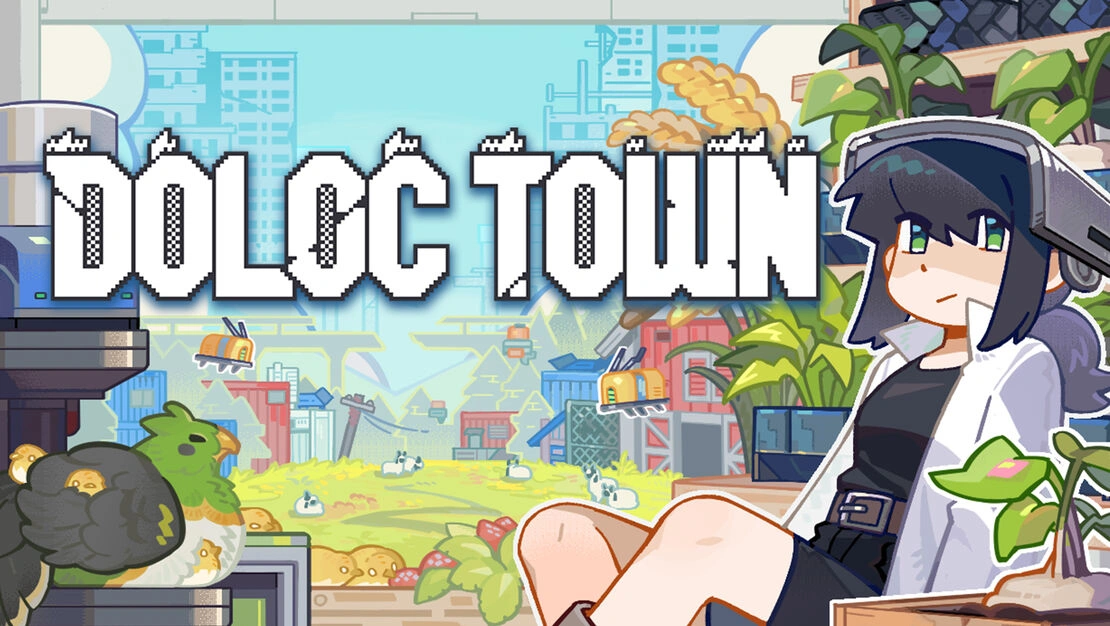

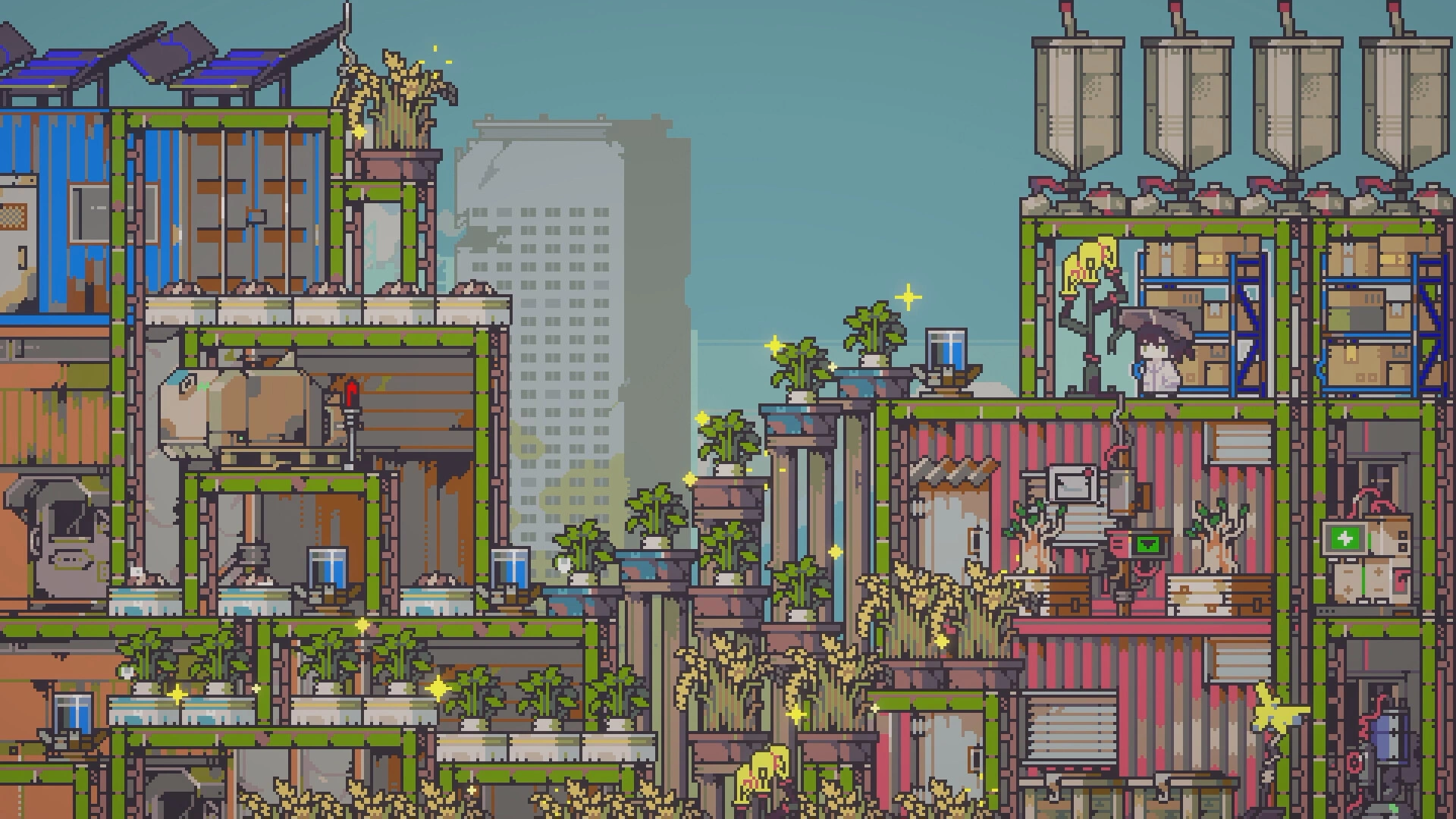
Doloc Town solves a familiar farming-sim problem by turning the farm ninety degrees. Crops do not spread across neat squares of tilled earth. Proti plants them in crafted pots, stacks those pots across platforms, and gradually fills a vertical maze with sprinklers, storage boxes, generators, smelters, and walkways. The side-scrolling perspective changes the planning problem. Space is plentiful. Convenient space is not.
That distinction gives RedSaw Games and Logoi Games’ post-apocalyptic farming sim much of its identity. Proti returns to Doloc Town searching for Eden’s legacy and answers about former mayor Ponka, finding a community surviving contaminated soil, acid rain, hostile machines, and ruined infrastructure.
The 1.0 version expands that foundation through animals, fish farming, trading factions, festivals, friendship stories, automation, a new region, and a finished storyline. Many of its individual systems will look familiar to anyone who has spent time with Stardew Valley or similar games. Their arrangement is far less conventional.
Engineering the Farm
A planter sitting three platforms above your storage can become irritating after the tenth trip up a ladder. Put the same planter beside a sprinkler, fertilizer supply, and shipping route, and the farm suddenly runs like a small factory. Doloc Town makes layout matter because movement connects every production system.
Contaminated ground explains why crops need planters, while different pots and structures create room for specialization. Cardboard boxes provide cheap early storage. Tents and shipping containers create protected spaces. Generators power machinery. Later automation removes manual chores that initially consume much of Proti’s day.
Weather keeps those systems from becoming a solved puzzle. Acid rain damages exposed crops and structures, so protective coverings become part of farm design rather than decoration. Scorching conditions increase water demand. Lightning looks threatening until rods and electrical infrastructure turn storms into an energy source. Regular rainfall can handle watering for you, while long wet stretches encourage mushrooms to appear outside town.
That interaction is where Doloc Town’s design works best. The environment creates problems, then the technology tree gives players tools to redesign their routines around them. Unlocking electric sprinklers changes how much farming fits into a morning. Later farm drones change the purpose of that morning entirely, freeing Proti to spend it elsewhere.
Leaving the Farm
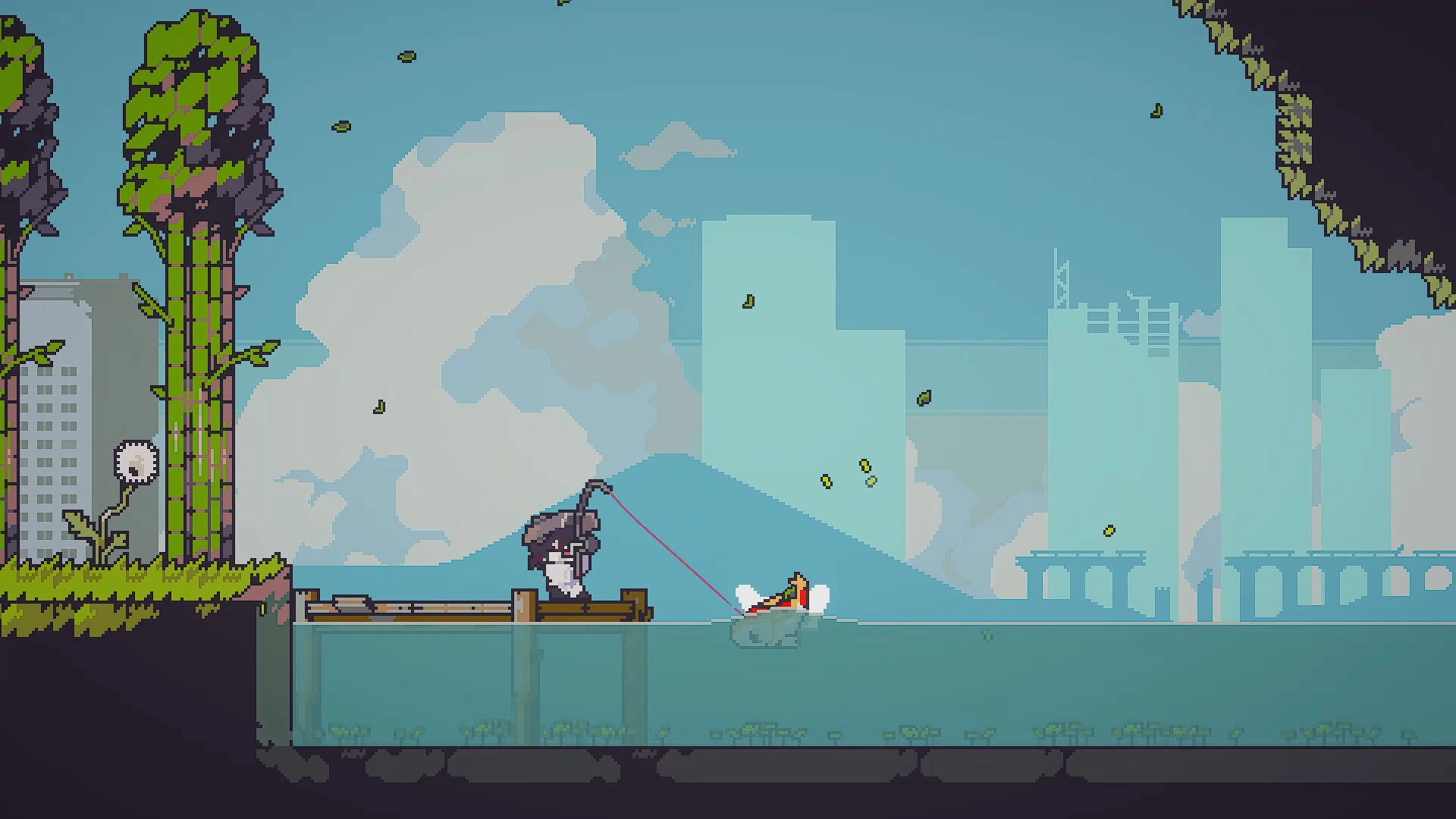
Exploration takes advantage of the same side-on structure. Forests, swamps, caves, abandoned settlements, and the ancient ruins are built around jumping, climbing, hidden passages, and vertical routes. The early double-jump immediately expands movement, while upgrades such as stronger tools and a jetpack provide reasons to revisit previously blocked areas.
 Resources support that loop cleanly. Scrap piles, garbage bags, ore deposits, old machinery, fish, seeds, and defeated enemies feed crafting and research back home. An expedition therefore serves several systems at once. A trip taken for a story object might also provide ore for a machine and seeds for the next farming expansion.
Combat is less convincing. Proti can defend themselves, but the combat drone handles much of the actual damage. With automatic targeting enabled, encounters become positioning exercises: keep moving, avoid incoming attacks, and remain close enough for the drone to work. Weapon upgrades and enhancement chips improve its output without dramatically changing the basic interaction.
That simplicity fits a character framed as a survivor rather than an action hero, yet repeated machine and monster encounters eventually expose how narrow the system is. Manual aiming feels awkward beside the responsive platforming, making automatic fire the practical choice rather than an interesting tactical alternative.
Progression fares better. Agriculture, crafting, and industrial activities build experience that eventually provides points for the tech tree. Research, requests, and NPC interactions unlock further recipes and seeds. Each advancement tends to alter something tangible: another machine, a new crop, improved automation, or access to previously unreachable resources.
Life in the Scrap Heap
Doloc Town’s story gives these systems direction without competing with them. Searching for Eden and investigating Ponka’s disappearance sends Proti through new regions, while thirteen friendship stories and bulletin-board requests establish the settlement as something other than a collection of vendors. Characters ask for fish, crops, and materials, tying relationships back into activities the player is already performing.
The social side remains thinner than the farming. There are no romances, everyday dialogue repeats, and seasonal festivals frequently behave like structured challenges rather than bustling community events. Catching salmon or gathering mushrooms gives players useful objectives, but those activities do less to develop the townspeople than dedicated character scenes do.
Late progression introduces a larger structural frustration. Certain story objectives are worded vaguely, and reaching the final stages requires substantial progress across systems that can initially appear optional. A game built around freedom becomes strangely prescriptive when it quietly checks whether the player has completed enough surrounding activities.
Its pixel art helps smooth over those rough spots. Rusted machines, broken settlements, poisoned terrain, and heaps of salvage share the screen with bright colors and small, expressive characters. Collectible tapes feed into personal music playlists, while the relaxed soundtrack gives long farming sessions an appropriately unhurried rhythm.
The defining image is still mechanical rather than cosmetic: flowerpots stacked above scrap-powered machinery while acid rain hits the structures protecting them. Every part of that arrangement has a job. Doloc Town earns its personality by making the apocalypse another system to build around.
The Review
Doloc Town
Doloc Town makes its side-scrolling perspective matter mechanically. Stacking planters, storage, sprinklers, generators, and machines turns farm design into a movement problem, while acid rain and electrical storms force those layouts to respond to the environment. Exploration benefits from the same thinking, with double jumps, equipment gates, and scavenging giving each excursion a practical purpose. Drone combat loses some appeal once enemy patterns repeat, and obscure progression requirements can stall the late game, but the farming systems keep producing satisfying decisions long after the novelty of vertical construction wears off.
PROS
- Excellent vertical farm construction
- Weather meaningfully affects planning
- Rewarding exploration and progression
- Smart automation systems
- Charming post-apocalyptic presentation
CONS
- Combat grows repetitive
- Some unclear quest requirements
- Controller construction feels imprecise
- Limited everyday NPC dialogue