



























The most distinctive thing about Mermaid Beach is where its fantasy happens. Lily does not discover magic in some anonymous storybook coast. Directors Sam P. Green and Rebecca J. Matthews place her transformation against the beaches and cold blue water of Wales, letting a very familiar family-film premise acquire a regional texture of its own.
Lily, played by Ellie Bindman, arrives from London furious about the move. Her mother Claire has relocated the family with Lily’s younger sister Sophie and stepfather Jason, whose new job has brought them to the seaside town. Lily’s resistance comes from several places at once. She misses her old life, resents Jason’s attempts to connect with her, and still carries the loss of her father five years earlier. Then she finds something luminous in the sand.
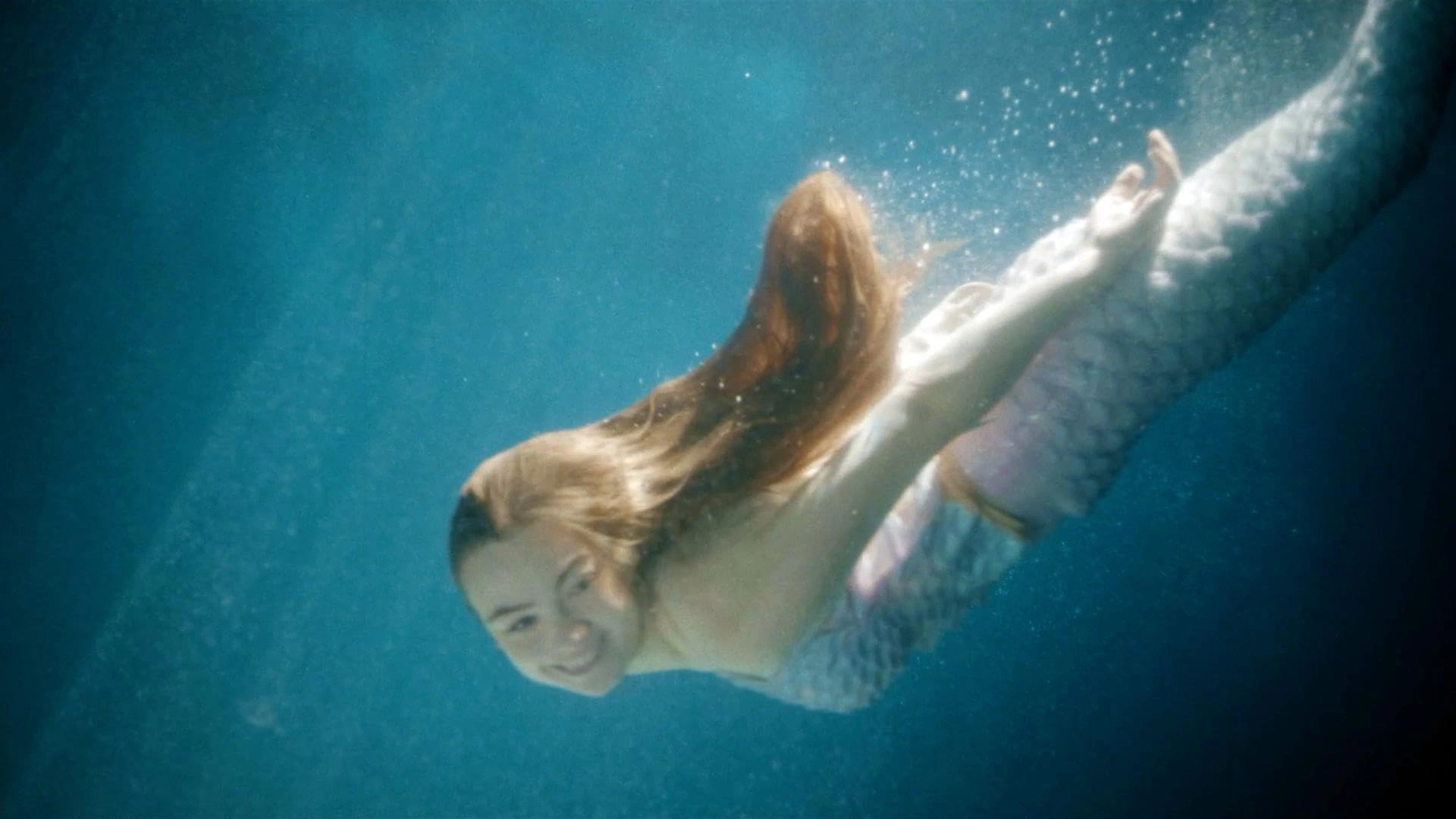
Touching the strange shell or scale causes Lily’s body to change, and entering the water completes the transformation into a mermaid. It is the kind of premise international family cinema has recycled for decades, yet the Welsh location keeps the film from feeling completely generic. The coastline becomes part of Lily’s changing relationship with her new home rather than scenery pasted behind a fantasy plot.
The Sea Sells the Fantasy
The transformation sequence exposes both the film’s charm and its limitations. Lily notices the mysterious object while sitting on the beach, examines it, then panics when scales begin appearing. Once she reaches the water, fear shifts into exhilaration. Bindman sells that emotional change through her physical performance, particularly the moment Lily realizes swimming no longer feels like an ordinary human activity.
Rafaele Nocerino’s cinematography finds its strongest material underwater. The camera follows Lily through the sea with a freedom missing from several land-based scenes, giving her discovery a sense of movement that the script cannot manufacture through dialogue. Welsh waters suddenly become a private territory where the displaced teenager can experience belonging before she has learned how to articulate it.
The illusion becomes shakier whenever the film asks viewers to examine the mermaid body closely. Lily’s tail sometimes looks like wet fabric wrapped around visible legs, which makes the practical limitations difficult to ignore. Certain transitions between shore and water are similarly awkward, with action becoming visually muddy as Lily changes position.
Bindman’s performance often carries the missing magic. Her delight during the swimming scenes gives the fantasy credibility even when the physical effect does not.
Sophie complicates the secret in a useful way. Georgia Grace plays Lily’s younger sister as an enthusiastic believer in mermaids, meaning Lily must hide the one discovery Sophie would treasure most. Their scenes turn secrecy into an emotional problem instead of a simple plot device.
Home Above the Surface
The family material has greater specificity than the film’s environmental conspiracy. Jason is not written as the cruel replacement father Lily might conveniently reject. Andrew Rolfe plays him as a decent man who simply cannot find the right language for a grieving teenager who has little interest in meeting him halfway.

That choice gives the domestic tension some welcome restraint. Lily answers adults with irritation and eye rolls, yet the script links that hostility to displacement and grief rather than treating teenage moodiness as a personality. Claire’s attempts to hold the household together also work best during quieter exchanges, when nobody has the perfect sentence that will repair the situation.
This places Mermaid Beach within a long Anglo-American tradition of children’s fantasy where supernatural discovery becomes a route toward accepting family change. The regional setting alters the emphasis. Lily’s connection to the sea slowly binds her to a town she wanted to escape, turning place itself into part of the reconciliation.
Her friendship with Shane, an awkward trainee reporter investigating mermaid sightings, gives her one local relationship outside the home. Yet his investigative thread receives less room than the family story, one of several casualties of the film’s short running time.
Pollution Without Enough Pressure
Lily’s underwater freedom eventually reveals the threat beneath the fantasy. She discovers a pipe connected to the textile factory where Jason works, with pollution endangering the marine environment she has started to protect.
The idea fits naturally with the seaside setting. Lily begins the film wanting nothing from this town, then gains a physical connection to its waters and finds herself responsible for defending them. The environmental message works because it grows from that change in allegiance.
The villains are considerably flatter. The factory owner and the mayor function as suited obstacles rather than fully developed people, while long stretches of the first half barely establish the central antagonist. Once factory business moves into offices, the film loses the visual character supplied by Lily, Sophie, Shane, and the coastline. Adults discussing corporate wrongdoing under fluorescent lighting are poor competition for a teenager discovering she can breathe underwater.
The sub-90-minute structure creates further pressure. Lily’s grief, Jason’s place in the family, Shane’s investigation, Sophie’s fixation on mermaids, the magical object, the factory pipe, and the pollution plot all compete for space. The question of why Lily receives these powers receives particularly little attention, while later confrontations arrive before every relationship has gathered enough dramatic weight.
What survives the compression is the simplest connection in the film: Lily enters the Welsh sea as a girl who wants her old home back, then keeps returning because this unfamiliar coastline has given her something worth protecting.
Mermaid Beach premiered in the United Kingdom on February 26, 2026, and is available through select regional theatrical screenings and independent distribution channels. The fantasy family film follows a teenage girl who moves to a Welsh seaside town and discovers a magical connection to the ocean after gaining the ability to transform into a mermaid.
Full Credits
Title: Mermaid Beach
Distributor: Left Films
Release date: February 26, 2026
Rating: U
Running time: 78 minutes
Director: Sam P. Green, Becca Hirani
Writers: Christopher Jolley
Producers and Executive Producers: Becca Hirani, Helen Grace, Rebecca J. Matthews
Cast: Ellie Bindman, Georgia Grace, Marie Wilson, Andrew Rolfe, Jack Taruschio Thomas
The Review
Mermaid Beach
Mermaid Beach finds its strongest identity in the Welsh coastline, where Lily’s new connection to the sea turns displacement into belonging. Ellie Bindman gives the fantasy emotional credibility, and Rafaele Nocerino’s underwater photography supplies the wonder that the mermaid effects sometimes cannot. The environmental conflict is far plainer, with thin corporate villains and a rushed final stretch leaving several ideas underdeveloped. Still, its local setting and sincere family drama give this modest fantasy a personality that travels better than its familiar premise suggests.
PROS
- Ellie Bindman’s naturalistic lead performance
- Beautiful Welsh coastal photography
- Warm Lily and Sophie relationship
- Sincere family drama
- Strong underwater sequences
CONS
- Unconvincing mermaid tail effects
- Thinly written villains
- Rushed story development
- Dull factory-office scenes
- Underexplored magical mythology