












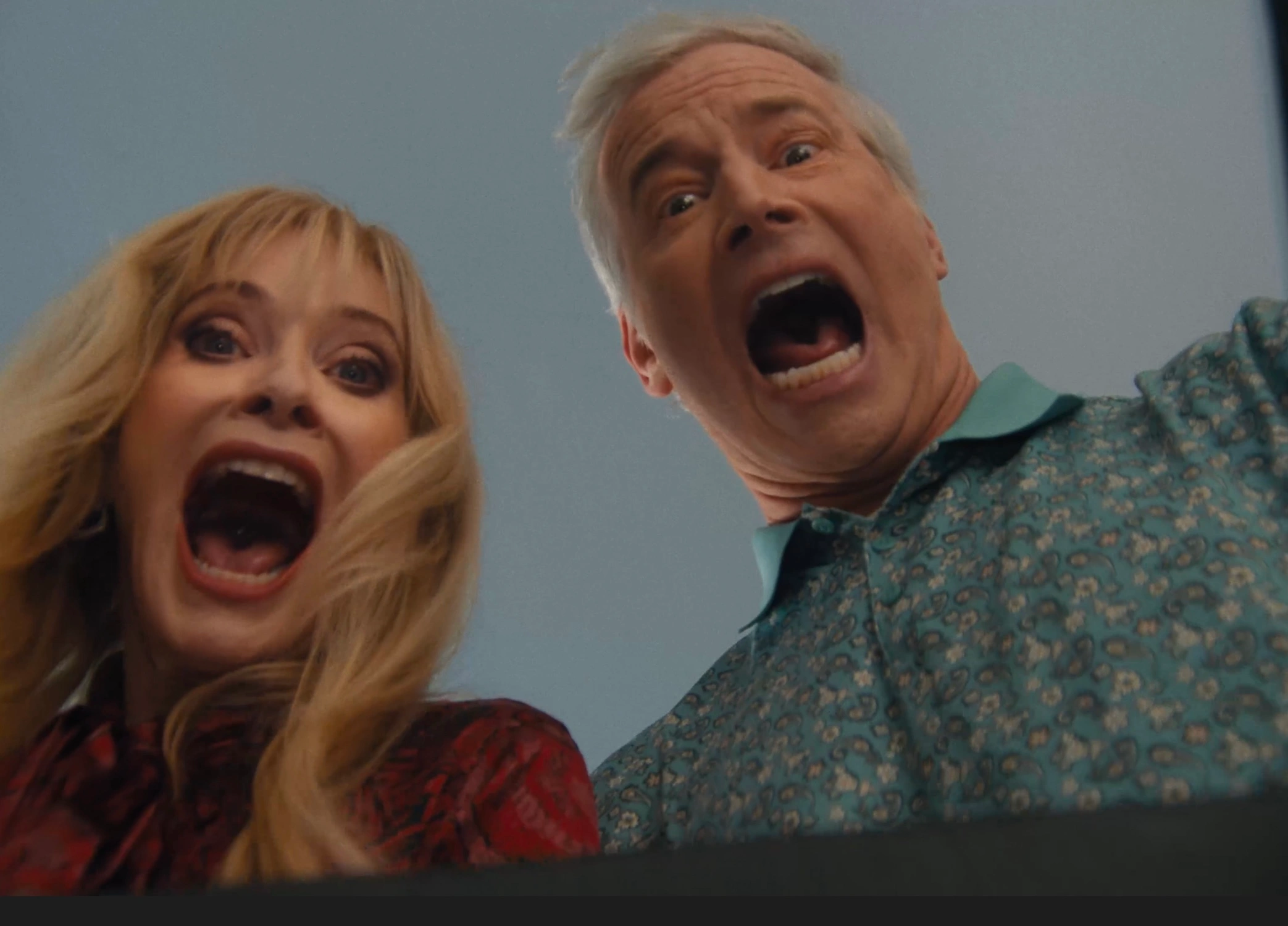

The funniest thing Grind does is treat corporate euphemism as though it were already horror terminology. A missed quota becomes a death sentence. A performance review can summon an executioner. A delivery bonus becomes bait. Directors Brea Grant, Chelsea Stardust, and Ed Dougherty barely need to exaggerate the language of modern work before the genre machinery starts turning.
Their anthology moves through four connected stories built around DRGN Corporation, a barely disguised corporate hydra whose businesses include delivery services, social media, retail, warehouses, and coffee shops. The targets are recognizably American, from app-based labor to multi-level marketing, yet the underlying arrangement travels easily. Across different economies, the promise remains familiar: accept instability now and prosperity might arrive later. DRGN keeps moving the later part.
Targets, Tips, and Punishment
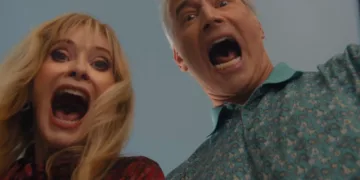
Brea Grant’s “MLM” finds its comic rhythm through escalation. Sarah (Jessika Van) has joined Lala Leggings, where failing to move enough Lycra produces penalties far stranger than losing commission. Her husband’s penis turning into a scrub jay gives some indication of how little restraint the segment intends to exercise.
Barbara Crampton makes the company’s Founder especially effective because she plays corporate warmth without visible strain. Her smile belongs to the international language of aspirational sales culture, the relentlessly polished promise that independence can be purchased through another starter kit. Against that surface, an Ax Man arriving in glittering clothes and unicorn leggings feels less like an interruption than the logical final stage of performance management.
“Delivery” shifts from sales quotas to algorithmic piecework. Benny (Vinny Thomas) races around town for DRGNDash, at one point calculating that waiting in line for somebody else’s coffee will earn him roughly a dollar. His encounter with Simon S. sends him into an industrial building where an increasingly revolting delivery job waits.
The time loop that follows makes money the reset button. Benny refuses, events repeat, and the offered payment rises until economic common sense starts defeating self-preservation. Thomas sells that calculation beautifully. His face keeps registering danger before his wallet produces a counterargument. It is a specifically modern variation on the Faustian bargain, stripped of grandeur and reduced to an app notification.
Six Million Pieces of Hell
“Content Moderation” drops much of the earlier cartoon energy and finds something colder. Joel (Christopher Rodriguez Marquette), a former teacher, arrives at DRGN’s Hatchbook operation expecting the kind of salaried technology job designed to appear life-changing. The salary is $175,000. Healthcare waits upstairs. So does free food. First he must survive The Pit.
Joel is assigned roughly 6.25 million uploaded videos to review, each representing another piece of violence, depravity, or human misery that somebody must inspect before a platform can appear clean to its users. Dougherty rarely needs to show the worst material directly. Joel’s reactions, the queue counter, and the repetition of the task make the invisible labor tangible.
Rob Huebel’s supervisor gives the segment its sharpest comic weapon. He treats free lunches and lobster rolls as reasonable compensation for psychological erosion, speaking with the cheerful logic of management systems built to convert human limits into productivity problems.
This aspect of Grind reaches beyond its American corporate caricatures. The internet looks frictionless because its ugliest work is distributed, outsourced, hidden, or performed far from the user pressing refresh. Content moderation exposes that illusion with unusual clarity. The clean interface requires somebody else to enter the sewer. Joel simply gets a better benefits package for doing it.
Union Busting Gets Teeth
By “Union Meeting,” the anthology has stopped pretending corporate retaliation needs metaphorical subtlety. Workers at Neptulia, DRGN’s coffee chain, begin discussing unionization. Management responds by sending the store mascot to murder them.
Chelsea Stardust and Dougherty lean into creature-feature chaos here, replacing the accumulated dread of “Content Moderation” with blood, practical effects, and physical comedy. The employees are sketched less fully than Sarah, Benny, or Joel, which leaves the segment with a thinner dramatic spine. Once the mascot arrives, the concept largely becomes the story.
The directness still fits the anthology’s escalating grammar. Lala Leggings disciplines sellers. DRGNDash turns desperation into compliance. Hatchbook makes trauma a prerequisite for promotion. Neptulia takes the final step and treats collective bargaining as something to be exterminated.
That recurring corporate infrastructure gives Grind a cohesion many anthology films struggle to find. Neptulia appears before its own chapter. DRGN’s subsidiaries recur. Barbara Crampton and Huebel provide recognizable faces for a machine designed to appear faceless. Changing jobs begins to resemble moving between departments of the same organization.
There is something culturally specific in the film’s American references, particularly its fixation on convenience, entrepreneurial self-branding, and corporate promises of frictionless consumption. The anxiety underneath them requires no translation. Somebody delivers the meal, filters the video, sells the product, stocks the warehouse, cleans the counter. Grind simply asks what happens when the system finally stops pretending those people are disposable and starts behaving accordingly.
Grind premiered at the SXSW Film Festival in March 2026. This horror anthology explores the darker side of the modern gig economy, presenting four interconnected stories about hustle culture, content moderation, and the perils of late-stage capitalism.
Full Credits
Title: Grind
Release date: March 2026 (SXSW Film Festival)
Running time: 104 minutes
Director: Ed Dougherty, Brea Grant, Chelsea Stardust
Writers: Ed Dougherty, Brea Grant
Producers and Executive Producers: Chelsea Stardust
Cast: Rob Huebel, Barbara Crampton, Mercedes Mason, Christopher Rodriguez Marquette, James Urbaniak, James Paxton, Jon Gabrus, Jessika Van
Director of Photography (Cinematographer): Alexander Chinnici, Mark Evans, Yaron Levy, Taylor Washington
Editors: Jeff Betancourt, Ed Dougherty, Mike Mendez, Hunter M. Via
Composer: Matt Glass
The Review
Grind
Grind turns distinctly American gig-economy rituals into splattery workplace folklore: leggings quotas summon an Ax Man, delivery tips become a time-loop trap, content moderation becomes psychological attrition, and union busting becomes literal creature violence. The anthology is blunt, and “Union Meeting” is thinner than “Content Moderation,” yet the shared DRGN machinery gives its four stories unusual cohesion. Its satire travels because the labor bargain it attacks is familiar far beyond the United States: convenience above the worker, growth above the person.
PROS
- Strong interconnected anthology structure
- “Content Moderation” lands hardest
- Vinny Thomas anchors “Delivery”
- Inventive practical-effects grotesquerie
- DRGN ties the satire together
CONS
- “Union Meeting” feels comparatively thin
- Some political points are overly blunt
- “Delivery” leaves ideas underdeveloped