



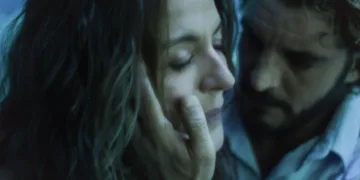
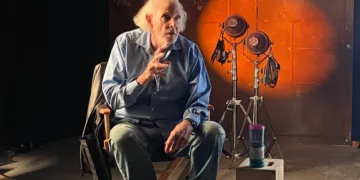











Sam Pollard understands that Desmond Tutu’s optimism only matters if the film shows what it had to survive. That choice gives Tutu its shape. Rather than treating the Archbishop as a collection of achievements, Pollard keeps placing his faith in human change beside images of apartheid violence, political hostility, and personal danger.
Tutu’s public identity contained a productive contradiction. He preached non-violence, yet repeatedly insisted that peace did not require passivity. His years fighting apartheid, his Nobel Peace Prize, and his later leadership of South Africa’s Truth and Reconciliation Commission provide the historical framework, but Pollard is far more interested in the temperament that carried him through those events. The result is a political biography driven by personality. Tutu could joke, rage, pray, confront presidents, and walk directly toward people threatening violence. Those qualities belonged to the same man.
The Man Behind the Archbishop
Much of the documentary’s warmth comes from footage shot by journalist Roger Friedman and photographer Benny Gool, who received remarkable access to Tutu during the later decades of his life. Pollard uses their material to break the formal rhythm of archive clips and historical explanation.
We see Tutu at birthday celebrations, laughing with friends, receiving visitors, and relaxing at home. Barack Obama can appear in his orbit, yet the camera often finds greater value in something as simple as Tutu laughing until a room joins him. These scenes are valuable because they show where his public energy came from.
Leah Tutu becomes essential to that portrait. Her interviews and domestic scenes reveal the cost carried by the family behind the famous activist. Their decision to leave the relative security of London and return to South Africa placed Leah inside the same danger that defined her husband’s work. Pollard never needs a grand speech to establish that sacrifice. The decision itself does the work.
Editing creates the emotional connection. Images of the older Tutu enjoying the peace of his home sit near footage of brutality from decades earlier. Knowing what those years contained changes the meaning of his laughter.
Peace Under Pressure
Pollard’s strongest historical passages test Tutu’s philosophy at points where non-violence seems almost impossible to maintain. His return from London placed him inside an increasingly volatile South Africa. The documentary moves through the Soweto uprising of 1976, Steve Biko’s death in police custody the following year, Nelson Mandela’s imprisonment, and Tutu’s expanding role as an international voice against apartheid. These events arrive quickly, yet Pollard usually attaches them to a human decision rather than presenting them as classroom chronology.
One sequence makes the stakes especially clear. Tutu confronts a Black crowd preparing to murder a suspected informer through necklacing, the practice of placing a fuel-soaked tire around a person and setting it alight. He physically enters a situation that could easily have killed him. The scene explains his politics better than any interview could. Rejecting violence meant stopping it when the people committing it believed their anger was justified.
His position made enemies in opposite camps. White supporters of apartheid attacked him for opposing the system. Some Black activists viewed his emphasis on peaceful resistance and reconciliation as insufficient.
Tutu could still be ferocious. His confrontation with Ronald Reagan over American resistance to economic sanctions against South Africa produces one of the documentary’s sharpest moments. When diplomacy fails, the Archbishop openly damns Reagan’s version of the West. Pollard lets the anger stand. Peace, here, has teeth.
Forgiveness and Its Limits
The Truth and Reconciliation Commission gives Pollard his most difficult material because Tutu’s philosophy finally encounters a problem that goodwill cannot neatly solve. Nelson Mandela appointed him to chair the commission after apartheid, creating a process where testimony and confession were meant to help South Africa reckon with decades of state violence. One archival scene shows Tutu breaking down while listening to a survivor describe torture. Pollard holds on the emotion long enough for the institutional process to become painfully personal.
The film also allows doubts about the commission to remain. Some perpetrators avoided serious punishment, leaving victims with recognition but limited accountability. People close to Tutu question parts of the process, and Pollard does not rush to defend him. Forgiveness becomes something harder than a moral slogan once the person being asked to forgive has watched the guilty walk away.
Tutu continued directing his attention toward HIV/AIDS and conflicts beyond South Africa, including Israel and Palestine. Pollard uses those later efforts to show that his moral framework did not end with apartheid. The most revealing footage still belongs to the quiet years. After decades spent confronting governments, crowds, and grief, Tutu can sit beside Leah and laugh. Pollard makes that laughter feel earned.
Tutu premiered at the 76th Berlin International Film Festival on February 16, 2026, where it won the Peace Film Prize. The documentary provides a powerful and intimate portrait of the late South African Archbishop Desmond Tutu, utilizing rare archive footage to trace his journey from his upbringing to his pivotal role in the fight against apartheid.
Full Credits
Title: Tutu
Distributor: Cinetic Media
Release date: February 16, 2026 (Berlinale)
Rating: 13PG
Running time: 101 minutes
Director: Sam Pollard
Producers and Executive Producers: Johnny Webb, Ellie Phillips, Beya Kabelu, Sam Pollard, Ricardo Pollack, Niclas Kjellström Matseke, Sir Richard Branson, Sam Branson, Cristina Ljunberg, Kop Matseke, Ayanda Ntsaluba, Jens von Bahr, Shannon Sedgwick Davis, Helen Parker, Trevor Noah, Sanaz Yamin, Liz Collier
Cast: Desmond Tutu
Director of Photography (Cinematographer): Geoffrey Sentamu
Editors: Paul Trewartha
Composer: Philip Miller
The Review
Tutu
Sam Pollard finds his strongest material whenever history gives way to personality. The archival images of apartheid carry enormous weight, yet the quieter footage of Desmond Tutu laughing with Leah explains his endurance with equal force. Scenes of him confronting Ronald Reagan, stopping a violent crowd, and breaking down during Truth and Reconciliation testimony reveal a philosophy repeatedly tested by reality. The commission’s failures complicate the portrait without diminishing the courage behind it. Tutu turns political biography into an unusually human study of what sustained one man’s faith in change.
PROS
- Remarkable private archival footage
- Strong portrait of Tutu and Leah
- Powerful apartheid-era material
- Thoughtful examination of non-violence
- Willingness to question reconciliation
CONS
- Chapter structure feels unnecessary
- Some historical periods move quickly
- Later activism receives limited space