





























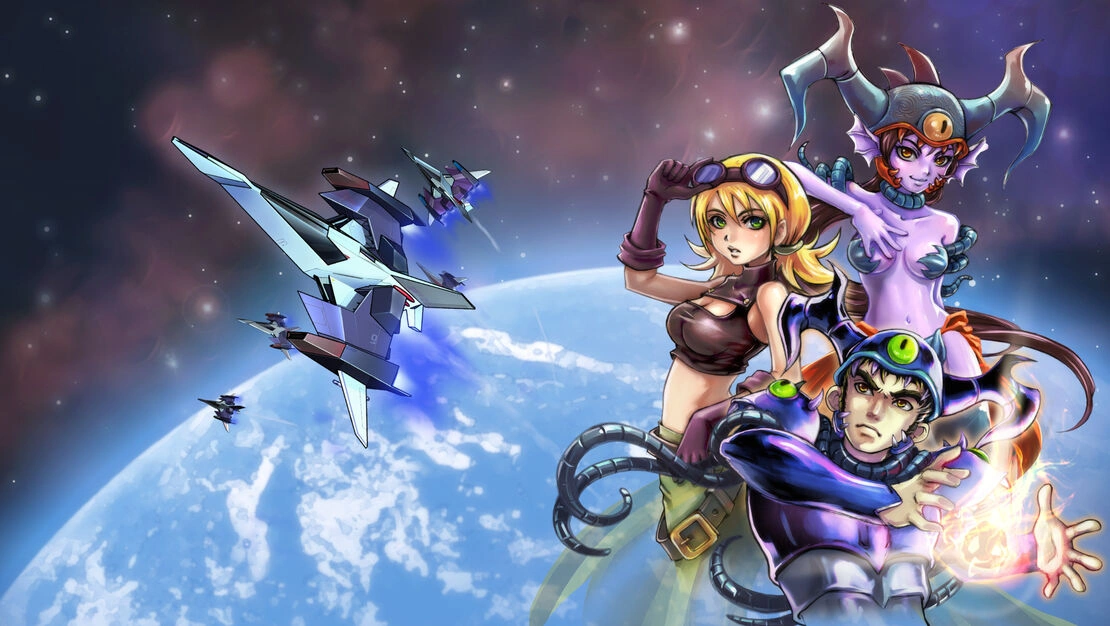

WayForward once tried to make a Game Boy Advance RPG where random encounters became side-scrolling shootouts in biological spacecraft. Twenty-one years later, that remains a far stranger proposition than most retro revivals can claim.
Sigma Star Saga DX brings the studio’s 2005 experiment back with reduced encounter rates, improved maps, extra save options, rewind functionality, rebalanced progression, and other adjustments. Its foundation remains untouched. Ian Recker, an elite Earth pilot, deliberately allows himself to be captured by the alien Krill so he can infiltrate their military. They implant him with a parasite suit that increases his physical capabilities and allows him to pilot their organic ships.
From there, Recker moves between planets searching for bio-matter while reporting to commanders whose intentions become increasingly questionable. The RPG framework and shooter combat are still stitched together in a way few games have attempted since. The seam is visible almost every time you play.
Orders Become Complicated
Recker begins with a simple assignment: spy on the Krill and locate information about a weapon capable of deciding the war. The mission grows less comfortable once human leadership starts withholding information and Krill officers reveal disagreements of their own.
That uncertainty gives the plot its strongest material. Earth is willing to pursue destructive power with the same ruthlessness it attributes to its enemy, while several Krill characters complicate the idea of an uncomplicated invading force. The race for bio-matter gradually turns Recker’s cover identity into an actual conflict of allegiance.
Psyme carries much of that tension. She is a Krill ace who treats Recker with hostility, mocks his ignorance of Krill customs, and gradually develops a fierce loyalty toward him. Scarlet, a captured human scientist, pulls him toward his original loyalties. Their mutual distrust feeds a romantic triangle that changes according to player decisions and can contribute to different endings.
The choices give New Game+ a reason to exist, though Recker himself is less developed than the people competing for his loyalty. Some dialogue reduces Psyme and Scarlet to familiar archetypes just when the wider war is asking sharper questions about obedience and power.
Two Systems Fighting for Space
Most of Sigma Star Saga DX takes place from a top-down perspective. Recker explores planets, shoots simple enemies, talks to NPCs, finds keys and tools, and returns to earlier areas after gaining new traversal abilities.

The Scanner uncovers hidden objects. Krill Boots increase mobility and help activate certain environmental triggers. Later movement options let Recker cross gaps that previously blocked progress. These tools give planetary exploration a light ability-gated structure, but the combat never develops alongside them. Recker mostly runs and fires his weapon, and common enemies rarely demand anything beyond positioning and repeated shots.
Space combat has considerably more mechanical personality. Random encounters pull Recker into one of several bio-organic ships for side-scrolling battles built around enemy waves, hazards, minibosses, or survival. Ship speed and handling vary, which means an encounter can feel very different depending on the craft the game assigns. Gun Data is the system holding the entire experiment together.
Exploration yields over seventy pieces divided among cannon, bullet, and impact categories. Combining them can produce spread patterns, lasers, rockets, barriers, unusual projectile paths, and aggressively powerful builds. A single component can materially change how a ship clears a screen, giving exploration value beyond finding another healing item.
The system also exposes the game’s imbalance. Many combinations are too situational to justify giving up a reliable setup, so experimentation eventually narrows toward a few dependable configurations. Certain combinations can erase ordinary enemies and weaken bosses before their patterns have time to matter.
There is another structural problem. Ground exploration supplies equipment for space combat, yet space combat contributes relatively little back to ground exploration. Ships gain experience while Recker’s field abilities remain separate, leaving the two halves connected by Gun Data rather than by a shared progression loop. The hybrid design sounds integrated on paper. In play, it often resembles two modest games trading custody of the player.
DX Cleans the Machinery
The DX changes target friction rather than reinvention. Random encounters occur less frequently, several maps have been cleaned up, unnecessary loops have been reduced, hitboxes have been adjusted, and additional saving options make repeated travel easier to tolerate.

Rewind is particularly useful during boss encounters or hazardous flight sequences. Correcting one collision without replaying a larger section removes the sort of punishment inherited from handheld design rather than preserving it for nostalgia’s sake.
Some older irritations survive. Krill stations can still be awkward to read because similar rooms offer few visual landmarks. Shooter encounters begin repeating layouts long before the campaign finishes. A cramped field of view can make planetary enemies or projectiles feel harder to anticipate than their behavior deserves.
WayForward’s pixel work fares better. Planet environments use exaggerated GBA-era colors, ships have chunky biological silhouettes, and the character sprites retain the studio’s expressive style. The optional dot-matrix filter helps those colors sit more comfortably on a modern display.
DX gives Sigma Star Saga the treatment its systems needed most: fewer interruptions between the interesting ideas. What remains underneath is still uneven, but finding one bizarre Gun Data combination and watching it transform the next space battle explains why this particular experiment survived long enough to get another shot.
The Review
Sigma Star Saga DX
Sigma Star Saga DX still has one of WayForward’s stranger design ideas: feed RPG exploration directly into customizable shoot-’em-up combat through Gun Data. Finding cannon, bullet, and impact chips gives experimentation real purpose, yet repetitive encounters, shallow ground fighting, and limited interaction between its two gameplay halves keep the system from fully clicking. DX meaningfully improves maps, encounter frequency, saving, hitboxes, and pacing without disguising the original structure underneath. It remains messy, inventive, and unusually easy to remember.
PROS
- Deep Gun Data combinations
- Distinct RPG-shmup structure
- Useful DX quality-of-life upgrades
- Excellent pixel artwork
- Multiple endings encourage replay
CONS
- Repetitive random shootouts
- Shallow ground combat
- Weak connection between gameplay halves
- Tedious station navigation
- Many Gun Data options feel situational