











August 30, 1972 looks different once Madison Square Garden stops being a monument and becomes a room full of people shaking tambourines. Power To The People: John & Yoko Live in NYC restores that texture to John Lennon and Yoko Ono’s two One to One benefit concerts, stripping away most retrospective explanation so the event can exist on its own unstable terms.
Directed by Simon Hilton from footage originally filmed by Steve Gebhardt, the 81-minute concert film documents Lennon’s only full-length performances after leaving the Beatles. He and Ono appeared with Elephant’s Memory to raise money connected to Willowbrook State School after Geraldo Rivera’s reporting exposed horrific conditions there.
Kevin Macdonald’s One to One: John & Yoko used several of these performances while building a portrait of the couple’s early New York years. Hilton reverses the emphasis. Politics, biography and immigration battles largely remain outside the frame. What survives is the stage itself, with all its confidence, awkwardness and unfinished energy.
Rock History in Split Screen
Ben Wainwright-Pearce’s editing places the film firmly inside the visual culture that produced the concert. Split screens divide Lennon, Ono, Elephant’s Memory and the audience across the same image, recalling Woodstock and the period when concert cinema treated simultaneity as part of the experience rather than something to tidy away.
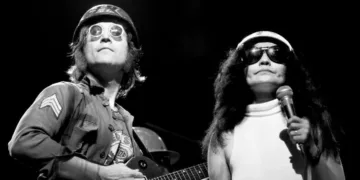
The restoration gives that approach unusual clarity. Lennon’s blue glasses, Army jacket and perpetual gum chewing register as sharply as Wayne Gabriel leaning into his guitar or audience members rattling the tambourines distributed around the arena. The images remain recognizably archival instead of acquiring the waxy smoothness that aggressive restoration can impose.
The sound benefits even further. Jim Keltner and Rick Frank create a thick double-drum foundation, while Stan Bronstein’s saxophone cuts through arrangements that can otherwise become crowded. Elephant’s Memory plays with the looseness of an American bar band and the force required to fill an arena.
That American quality matters. Lennon arrived from Britain carrying the cultural weight of the Beatles, then surrounded himself with New York musicians and political activists. The resulting music feels less like imported British rock royalty visiting Manhattan and closer to a temporary New York band trying to find its shape in public.
Lennon Finds the Groove
Lennon does not enter as a polished arena showman. He chews gum, stays largely on rhythm guitar and lets the first stretch feel like a band testing its balance. His joke about the audience attending a rehearsal becomes sharper after “Instant Karma!” when he thanks them for the rehearsal again. The musicians have finally caught the pulse.

“New York City” is the natural opening statement. Lennon attacks the song as an adopted resident rather than a tourist, turning his relocation into fast, rough rock. “Well Well Well” pushes his voice toward abrasion, while “Cold Turkey” goes further. His body jerks against the microphone as the lyric about withdrawal becomes physically uncomfortable.
“Mother” is even harder to distance yourself from. Sitting at the keyboard, Lennon moves from restraint into those raw cries about parental abandonment. The restored mix leaves enough space around the vocal for each scream to land without becoming theatrical.
Only one Beatles song appears. “Come Together” triggers an immediate audience response, then Lennon forgets part of his own lyric and jokes that he should stop writing such daft words. The mistake makes the performance better. This is a man surrounded by one of the largest catalogues in popular music refusing to behave as its museum curator.
“Imagine” offers the gentler counterpoint, while “Hound Dog,” followed by Lennon’s shout to Elvis, connects him back through American rock history to the music that shaped him before Liverpool exported its own version around the world.
Yoko, Protest, and a Messy Stage
Ono makes the cultural collision stranger. “Move on Fast,” “Born in a Prison,” “We’re All Water” and “Open Your Box” abandon the melodic expectations attached to Lennon’s songs for shrieks, sustained cries and confrontational phrasing. Her voice can be abrasive enough to break the flow of the set, yet hearing it inside 1972 changes the frame. Several passages sound closer to the punk and experimental rock about to emerge from New York and London than to the mainstream rock filling arenas at the time.
“Open Your Box” captures the couple’s dynamic in miniature. Ono introduces it as a song banned in America. Lennon immediately undercuts the announcement by joking that it was so banned they never noticed. The exchange is funny, slightly rude and entirely characteristic of their shared stage.
Their politics are equally direct. Lennon inserts “stop the war” into “Come Together.” Before “Give Peace a Chance,” Ono reads a speech condemning anti-war dissent through the language of patriotism and law and order, then reveals that the words came from Hitler. Oddly, Willowbrook receives little direct discussion from the stage, leaving the cause that created the concerts largely outside the performances themselves.
“Give Peace a Chance” eventually turns Madison Square Garden into organized disorder. Stevie Wonder, Melanie, Rivera and a crowd of guests pack the stage while vocals drift off-key and bodies move according to different rhythms. Later benefit concerts would refine this format into precision television. Here, the model still feels young enough to fall apart in public. Then Lennon disappears into the crowd onstage without a grand exit. The camera keeps recording the people left behind.
Power To The People: John & Yoko Live in NYC premiered on April 28, 2026. This concert film features newly restored footage from John Lennon and Yoko Ono’s two legendary One-to-One benefit performances held at Madison Square Garden in 1972.
Where to Watch Power To The People: John & Yoko Live in NYC (2026) Online
Full Credits
Title: Power To The People: John & Yoko Live in NYC
Distributor: LUF Kino
Release date: April 28, 2026
Rating: PG
Running time: 81 minutes
Director: Simon Hilton
Producers and Executive Producers: Peter Worsley, Sean Ono Lennon
Cast: John Lennon, Yoko Ono, Stevie Wonder, Melanie
Director of Photography (Cinematographer): Steve Gebhardt
Editors: Ben Wainwright-Pearce
Composer: Sean Ono Lennon
The Review
Power To The People: John & Yoko Live in NYC
Power To The People: John & Yoko Live in NYC preserves a 1972 benefit concert with the rough edges that made the period culturally distinct. The split-screen editing connects the film to the visual language of Woodstock, while Elephant’s Memory gives “Mother,” “Cold Turkey,” and “Come Together” genuine muscle. Ono’s confrontational vocals make the set less immediately accessible, yet they also expose how close this New York stage already stood to punk’s arrival. The crowded, imperfect “Give Peace a Chance” finale feels less polished than later charity spectacles, which makes it historically revealing.
PROS
- Excellent split-screen restoration
- Fierce “Cold Turkey” and “Mother”
- Powerful Elephant’s Memory backing
- Ono’s experimental edge
- Strong 1970s cultural texture
CONS
- Minimal Willowbrook context
- Familiar footage from One to One
- Uneven Ono vocals
- Ragged final performance