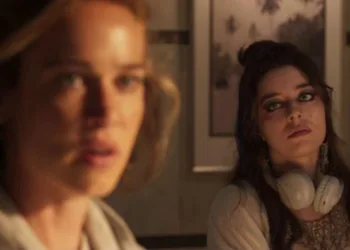




























Maddie brings an emerging pattern of emergency calls to the attention of Los Angeles’s Office of Emergency Management, and its representative treats her warning as evidence that she needs to sober up and go to bed. Ty Worrell’s contempt gives “That Sinking Feeling,” the tenth-season premiere of 9-1-1, a recognizable ugliness before the lava arrives.
He can demand an accounting of the sinkhole’s damage and still refuse to hear the person examining its warning signs. The episode makes a distinction between occupying a position of responsibility and accepting information that might make the job harder.
Temporarily running dispatch while Sue recovers from a stroke, Maddie finds connections between calls that would otherwise remain separate accounts of distress. An aquarium’s dangerously acidic water joins the disturbances around the sinkhole. Her work gives the city’s scattered symptoms a relationship.
This is a satisfying expansion of her role because it develops an ability already embedded in dispatch: listening carefully to people whose immediate circumstances obscure the larger picture. The writing weakens that insight slightly by giving her such an obligingly unpleasant opponent. Worrell makes institutional deafness easy to locate, and easy to imagine removing with one personnel change.
The rescue operation offers a warmer account of authority. When the road gives way beneath Captain Chimney, Ravi pulls him from the edge; Eddie enters the water to reach a woman trapped in a car. Command does not make Chimney self-sufficient, and needing rescue does not discredit his leadership.
These exchanges establish the 118’s cohesion through physical dependence. The scale of the sinkhole matters because it keeps creating tasks that exceed any single person’s capacity. The episode’s reassuring fantasy of public service rests on people being available to one another, including the person giving orders.
Its civilians receive enough attention to keep that fantasy from becoming an exhibition of professional prowess. The older learner driver, frightened by his malfunctioning pacemaker, asks Hen to carry his love to his daughter and granddaughter if he dies.
The familiar appeal works because it gives the rescue a future to preserve: people elsewhere are waiting for this man. Everyone survives the initial collapse, but the aquarium emergency prevents that success from closing the account. By the time the sinkhole emits its piercing sound, the horror-inflected music has shifted the pleasure of rescue toward anticipation of something the team has yet to understand.
Buck’s new parental role complicates the same attachment to capable, generous people. He has taken in Theo, his biological son through sperm donation, after the deaths of the boy’s parents. The arrangement gives an existing biological connection an unfamiliar daily responsibility.
Buck’s broken nose and repeated non-work hospital visits introduce his reluctance to regulate Theo’s rough play with a comic excess that suits the series. His attempts to minimize the injuries are revealing. A man comfortable putting his own body at risk can mistake absorbing every blow for a workable form of care, particularly with a child who has already lost so much.
Dinner at Eddie’s house makes the cost visible beyond Buck’s body. The conversation about phone screen time establishes an ordinary intimacy among Buck, Eddie, and Christopher while Theo plays. Then the basketball knocks Christopher down. His assurance that he is fine keeps the incident proportionate, and Theo’s immediate apology preserves the difference between causing harm and intending it. The scene places responsibility on the adult who must interrupt behavior before someone else gets hurt. Buck’s affection is beyond dispute; his difficulty saying no leaves Christopher exposed to the consequences.

That is a useful complication of the show’s faith in chosen family. Sharing meals and helping raise children gives Eddie a legitimate stake in Buck’s decisions, along with the uncomfortable obligation to challenge them. Their closeness makes his frustration painful without requiring a loud confrontation.
Buck suggests that he and Theo leave, and Eddie agrees. The departure leaves something unsettled between people accustomed to being welcome in each other’s homes. It also prevents the household scenes from turning into an easy lesson delivered by the experienced parent to the novice.
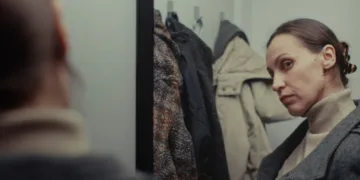
Athena’s detective work returns the question of judgment to a professional setting. Her admission to May that she fears her promotion followed her shooting gives her new position an insecurity that experience alone cannot settle. The burned man abandoned outside the hospital offers a practical test.
His coworkers’ account of an accident appears to explain his injuries and their panicked behavior, but Athena keeps examining what fails to fit. The ring in his pocket and the van’s movements lead her toward a jewelry-store robbery. The episode earns her confidence through the work of finding discrepancies.
Newell’s encouragement to accept the apparent success is less openly hostile than Worrell’s dismissal of Maddie. He praises Athena while discouraging further inquiry, a combination that makes approval feel conditional on knowing when to stop. Both women encounter resistance as they take on expanded responsibilities.
Athena’s case adds a subtler pressure, since accepting praise would mean leaving evidence unexamined. Her persistence proves productive. The subsequent decision to enter the thieves’ underground tunnel without backup requires a separate judgment, and the writing appears too eager to let the discovery justify the risk.
A volcano beneath Los Angeles belongs comfortably to this series’ extravagant imagination. An experienced investigator descending into an unknown tunnel alone is a smaller credibility problem with a sharper effect on character. The robbery brings Athena into the path of the citywide disaster with efficient dramatic force. Yet the sequence purchases that connection by interrupting the exploration of her new authority to make her another person in need of rescue. The 118 has returned to evacuate people around the growing sinkhole when it erupts, with Athena still below ground.
9-1-1 returned for its tenth season on ABC on October 15, 2026, with episodes available to stream the following day on Hulu. Created by Ryan Murphy, Brad Falchuk, and Tim Minear, the hit procedural drama follows Los Angeles emergency first responders—including police officers, firefighters, paramedics, and dispatchers—as they navigate life-threatening natural disasters and high-stakes emergencies while balancing personal turmoil.
Where to Watch 9-1-1 Season 10 Online










Full Credits
Title: 9-1-1 (Season 10)
Distributor: ABC, Hulu
Release date: October 15, 2026
Rating: TV-14
Running time: 42–45 minutes per episode
Director: Bradley Buecker, James Wong, Shiri Appleby, Jihane Mrad
Writers: Ryan Murphy, Brad Falchuk, Tim Minear, Molly Green, James Leffler, Lyndsey Beaulieu, Silas Savard, Taylor Wong, Christopher Monfette
Producers and Executive Producers: Ryan Murphy, Brad Falchuk, Tim Minear, Angela Bassett, Peter Krause, Bradley Buecker, Alexis Martin Woodall, John J. Gray, Kristen Reidel, Juan Carlos Coto
Cast: Angela Bassett, Peter Krause, Oliver Stark, Aisha Hinds, Kenneth Choi, Jennifer Love Hewitt, Ryan Guzman, Corinne Massiah, Elijah M. Cooper, Gavin McHugh
Director of Photography (Cinematographer): Joaquin Sedillo, Gavin Kelly, Duane Mieliwocki
Editors: Adam Penn, Erica L. Anderson, Matthew Hodgson, Robert M. Williams Jr.
Composer: Mac Quayle, Todd Haberman
The Review
9-1-1 Season 10
The Season 10 premiere finds its strongest drama in the responsibilities that survive a successful rescue. Maddie’s attention to scattered warnings and Buck’s struggle with parenting give the spectacle human substance, while the 118’s mutual dependence makes its competence worth celebrating. Worrell’s cartoonish obstruction simplifies the institutional criticism, and Athena’s reckless tunnel descent strains the authority her investigation earns. Still, the escalating emergency and the unresolved family tension give this opening hour considerable force.
PROS
- Rescue sequences establish genuine teamwork.
- Maddie’s expanded role develops her existing skills.
- Buck’s parenting conflict balances compassion and accountability.
- Connected emergencies build effective dread.
CONS
- Worrell makes institutional failure too conveniently personal.
- Athena’s tunnel descent sacrifices professional judgment for peril.