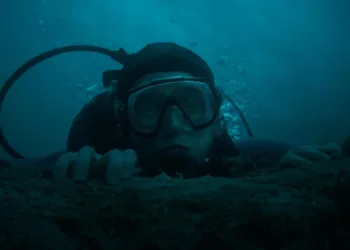



























Pointing a ship toward a distant planet and simply letting it fly changes Starfield in a way that sounds almost absurdly small until you actually do it. Cruise Mode takes over, the cockpit stops feeling like a glorified menu, and suddenly there is time to leave the pilot seat, walk past the crew, work at a crafting station, or stare through a window while the destination slowly grows closer.
That sensation is the real foundation beneath Terran Armada. The paid expansion arrives beside the free Free Lanes update, and the two pieces fit together naturally because both pull attention back toward the ship. Starfield originally asked players to care deeply about building spacecraft while frequently treating those vessels like waiting rooms between fast-travel screens. Free Lanes gives them a life between takeoff and arrival.
Travel can now be interrupted by distress calls, wrecks, ambushes, anomalies, bases, and encounters that appear along the route. These events are not endlessly surprising, but their value comes from breaking the certainty of movement. A trip can become an incident.
Landing and takeoff still expose the seams in Bethesda’s structure, so this remains recognizably the same Starfield. Yet moving through a system finally carries a feeling the 2023 release struggled to create: distance.
The Ship Becomes Home
Free Lanes works because it changes what happens during the quiet parts. Leaving the cockpit during Cruise Mode makes crew members feel less like bonuses attached to ship statistics. They occupy the same moving space as the player. Crafting during transit gives travel functional value. Looking outside while the ship crosses open space gives it emotional value. The game finally allows the vessel itself to hold a stretch of play rather than merely transport the player toward the next one.
X-Tech reinforces that renewed investment in equipment. The system expands weapon and suit modification, including stronger properties and legendary-style improvements that give late-game characters reasons to revisit favorite gear. Terran weapons benefit immediately. Picking up one of the faction’s rifles and improving it through X-Tech feels better than discarding another interesting weapon because the random roll happened to be weak.
Ship customization receives useful additions too, including the ability to install stealth capabilities beyond the Starborn ship. For players who already spent hours building vessels, that change lands particularly well. A carefully constructed ship can now carry functions previously locked away from most designs. Free Lanes does not turn Starfield into a different RPG. It makes the version already sitting underneath the old friction easier to feel.
An Armada With a Great Entrance
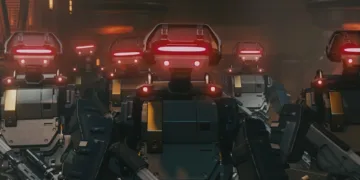
Terran Armada understands the value of intimidation early. A mysterious broadcast announces the faction’s arrival before the player is sent aboard the Trident, a luxury starship that has already fallen to Terran forces. Moving through the vessel and seeing what happened to its passengers gives the faction immediate weight. They seem organized, technologically dangerous, and capable of destabilizing the Settled Systems.

The campaign gradually connects them to soldiers shaped by the Colony War, presenting a force that believes its claim over humanity’s future carries greater legitimacy than the societies that survived without it. The premise has enough tension to support a major faction storyline.
Delta helps give that cold military identity a personality. The robot joins the player during the Trident sequence and spends later fights clinically assessing combat while occasionally commenting on wasted ammunition when shots miss. His delivery turns mechanical efficiency into dry comedy.
He can feel detached from everything happening around him, yet that detachment suits a campaign filled with robots, automated warfare, and soldiers who have built an identity around technological superiority. The problem appears once the Armada stops being mysterious.
Incursions disable grav drives and force players into repeated confrontations with Terran forces. Early encounters work because they tie directly into Free Lanes’ renewed interest in space. You detect a disruption, locate the hostile ships, fight through the formation, gather information, and sometimes board the surviving vessel. After several incursions, the emotion shifts from danger to routine.
Fighting in the Void
The repetition hurts because individual battles can be excellent. Ship combat appears far more frequently than it did across many sections of the original campaign, and Terran Armada gives those systems space to breathe. Larger confrontations force attention toward positioning and target selection, while boarding actions break fleet combat into close-quarters encounters.

Zero-gravity fights are especially effective. Boost-pack movement changes the geometry of a firefight, and weapon recoil suddenly matters differently when the player is floating through a corridor rather than standing firmly on a floor. These sequences take mechanics that once appeared as occasional curiosities and build encounters around them.
A large dogfight late in the campaign captures the fantasy the expansion has been reaching toward from its opening broadcast. Ships fill the battlefield, targets compete for attention, and the Terran threat finally feels proportionate to the language surrounding it.
That makes the campaign’s restraint elsewhere harder to ignore. Anchor Point Station supplies new content, but there is no major new region carrying the identity of the expansion. Most activity spreads across familiar parts of the Settled Systems.
The Terrans suffer from the same limitation. Their introduction suggests a faction capable of changing the player’s relationship with the galaxy, yet the story never gives that idea enough room. There is no substantial path toward joining them, testing their ideology from inside, or turning their arrival into a meaningful faction choice. For an expansion built around an invading force, the strangest feeling arrives after the guns stop firing: wanting the enemy to have stayed longer.
The Review
Starfield: Terran Armada
Terran Armada is at its best when Starfield finally lets space feel like somewhere you travel through rather than a menu between destinations. Cruise Mode, stronger ship encounters, zero-G boarding fights, X-Tech upgrades, and Delta give returning players fresh reasons to stay aboard their ships. The Armada itself makes a striking entrance, then loses force through repetitive incursions and a campaign that stops before its faction premise can fully develop. It leaves Starfield feeling richer and livelier, while preserving most of the game that was already there.
PROS
- Free Lanes transforms space travel
- Excellent zero-G boarding fights
- Delta brings welcome personality
- X-Tech rewards build experimentation
- Strong late-game dogfight
CONS
- Incursions become repetitive
- Terrans feel underdeveloped
- No meaningful Armada faction choice
- No substantial new explorable region
- Fast-travel restrictions can irritate