

























Greg’s hidden bottles and Denise’s basement manuscript tell the same story from opposite sides: the Platt house has already failed as a place of safety before anything with claws reaches Oak Street. The End of Oak Street then performs a wonderfully ridiculous act of literalization. It takes a family held together by routine, secrecy, and the social theater of 1982 suburbia, lifts the neighborhood into a prehistoric world, and asks the walls to defend the arrangement.
David Robert Mitchell first makes those walls look reassuring. The block party, roaming bicycles, compact homes, period furniture, and easy neighborly rituals build a suburb that seems preserved inside an Amblin-era memory. Greg and Denise disturb that picture almost immediately. He has lost his job, hides alcohol, and keeps the truth from his wife. She types a novel in the basement about a woman imagining escape from family life. Their children carry their own private tensions. Domestic normality survives through concealment.
Call it the shelter fallacy: the belief that a functioning household can be inferred from a functioning house.
The film gets much sharper once the prehistoric disruption turns that metaphor into geography. After the storm, roads stop leading anywhere useful. Familiar vegetation gives way to something older and hostile. Streets designed around routine become exposure zones. Fences, windows, porches, and backyards lose their ordinary meanings because a predator has no respect for property lines. Mitchell’s fondness for wide frames works especially well here. Characters can occupy one part of the image while danger enters another, giving suburban openness the logic of a trap.
That spatial joke becomes nastier when the Platts retreat indoors. They board windows and concentrate on defending the household while signs of other people’s panic continue beyond it. The neighborhood began as a communal performance, full of casual movement between lawns and homes. Crisis shrinks that community to four walls and whoever happens to be inside them. The American suburb has always sold privacy as security. Mitchell gives the sales pitch teeth.
His creature staging makes the idea persuasive because the attacks keep violating domestic scale. A huge serpent-like predator sliding through a house is frightening partly because the architecture remains recognizable. Hallways, rooms, doors, and corners retain their mundane proportions while something impossibly large occupies them. Elsewhere, creatures batter yards and porches, and the physical comedy of humans trying to preserve household logic during prehistoric chaos keeps colliding with genuine menace. A rifle in Denise’s hands looks like an answer until the scale of the threat makes human preparedness seem quaint.
This is where the film’s nostalgia proves useful. The period setting could have functioned as a costume party of analog props, bikes, warm interiors, and Spielbergian cues. Mitchell keeps sabotaging the comfort those references promise. The suburb is carefully reconstructed so it can be damaged. The homage survives, yet its emotional guarantee does not. An old movie grammar associated with childhood wonder becomes a machine for exposing how fragile the fantasy of a protected home always was.
Denise is the most interesting test of that idea. Her secret writing already imagines a life beyond the role she performs on Oak Street. Once survival replaces routine, she becomes the family’s most decisive defender, moving from private dissatisfaction to direct action. There is an obvious reading available here: catastrophe frees her. The film resists such neatness. Nearly every new freedom she gains is redirected toward preserving the family she had imagined leaving.
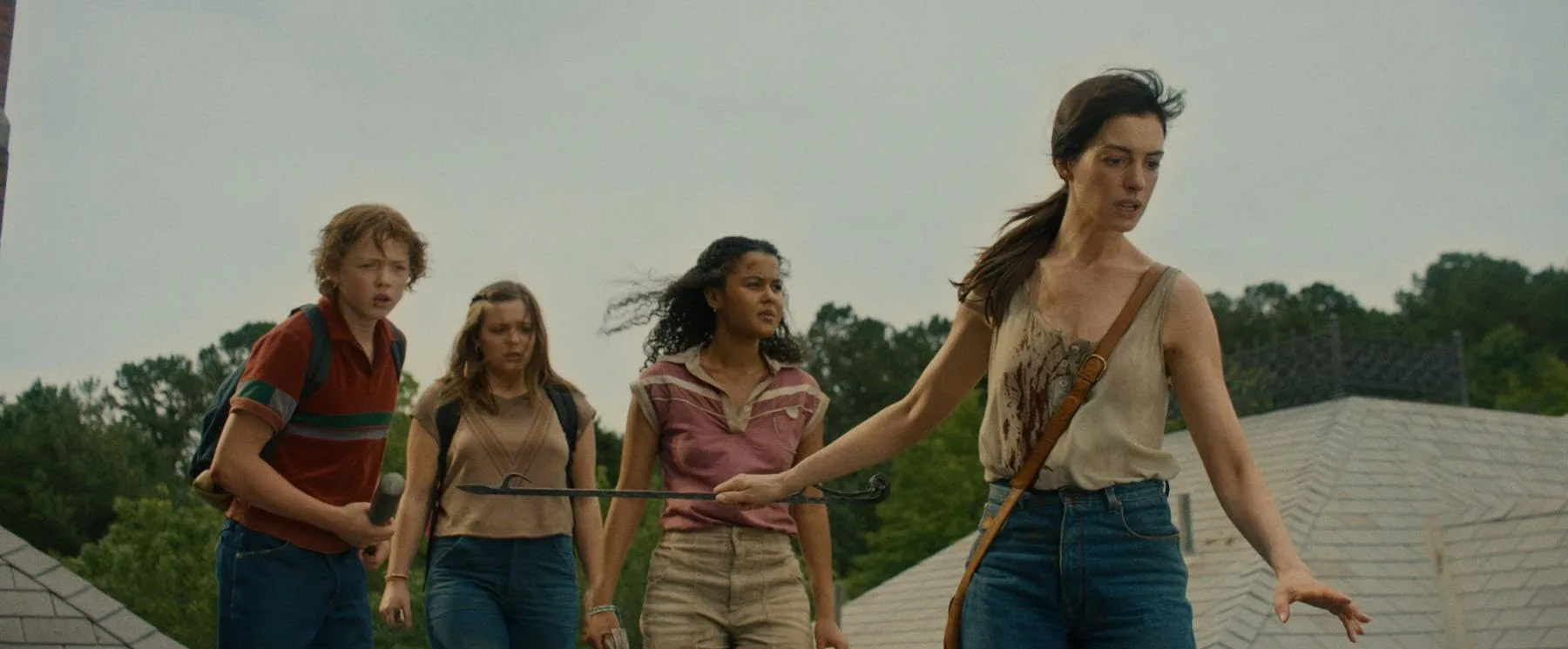
That tension saves the film from turning its domestic material into decorative seriousness between dinosaur attacks. Denise can gain agency without gaining escape. Greg can be exposed as conflict-avoidant, dishonest, and frightened without becoming a cardboard villain. His insistence on reassurance, even when the world outside has become absurdly lethal, belongs to the same system as his hidden unemployment and drinking. He treats unpleasant truths as problems that might disappear if nobody names them. Prehistory is a fairly aggressive rebuttal to that philosophy.
The marital confrontation therefore lands in deliberately ridiculous territory. Two adults finally say what has been rotting inside their marriage while creatures capable of eating them occupy the neighborhood. The timing is funny because the emotional emergency has been waiting longer than the literal one. It is also the point where Mitchell’s argument starts turning against itself.
If Oak Street represents a false promise of domestic security, why does destroying it push the Platts toward renewed attachment? One answer is that the film separates the family from the ideology wrapped around it. House, job, neighborhood status, routine, and polite silence can collapse while affection and responsibility remain worth preserving. That distinction gives the apparent reconciliation some weight.
A less generous reading remains available. The catastrophe can look like cosmic couples therapy, an expensive mechanism that scares two unhappy people back into the approved shape of a family. Denise’s dissatisfaction then becomes something the plot disciplines through danger. Greg’s failures become forgivable once survival provides him with clearer duties. The dinosaurs destroy the cage and then remind everyone how much they loved living together inside it. That is a strange political program for a monster movie, which may be precisely why the film is interesting.
Mitchell never fully resolves the contradiction, and the uncertainty suits a movie whose best images keep turning safety into exposure. Oak Street can be condemned as a fantasy of security. The Platts receive a stay of execution. Mitchell is much surer about the first judgment than the second.
The End of Oak Street premiered internationally on August 12, 2026, and opens in movie theaters and IMAX venues across North America on August 14, 2026, distributed by Warner Bros. Pictures. You can catch the film on the big screen during its theatrical run at major cinema chains and IMAX theaters. The plot centers on the suburban Platt family, who must band together to survive after a mysterious cosmic event suddenly transports their entire neighborhood into an unrecognized, prehistoric ecosystem inhabited by dangerous creatures.
Where to Watch The End of Oak Street Online






Full Credits
Title: The End of Oak Street
Distributor: Warner Bros. Pictures
Release date: August 12, 2026 (International), August 14, 2026 (North America)
Rating: PG-13
Running time: 100 minutes
Director: David Robert Mitchell
Writers: David Robert Mitchell
Producers and Executive Producers: J.J. Abrams, Hannah Minghella, Jon Cohen, David Robert Mitchell, Matt Jackson, Tommy Harper, Chris Bender, Jake Weiner, Joanne Lee, Leeann Stonebreaker
Cast: Anne Hathaway, Ewan McGregor, Maisy Stella, Christian Convery, Jordan Alexa Davis, P.J. Byrne, Chris Coy, Bethany Anne Lind, Mary Bagrowski, Emily Kuroda, Denitra Isler, Hudson Meek, Anne Gee Byrd
Director of Photography (Cinematographer): Michael Gioulakis
Editors: John Axelrad
Composer: Michael Giacchino
The Review
The End of Oak Street
The End of Oak Street turns an Amblin-shaped suburb into a smart pressure chamber for a family already coming apart. David Robert Mitchell’s creature staging gives domestic spaces real menace, while Denise’s growing agency keeps the dinosaur spectacle tied to the marriage underneath it. The film is less certain once catastrophe starts repairing the household it spent so much time exposing, but that unresolved tension gives its nostalgia bite. It is funny, tense, and unusually interested in what survives after the fantasy of suburban safety collapses.
PROS
- Tense suburban creature staging
- Strong domestic contradiction
- Denise’s active survival arc
- Period nostalgia with critical purpose
CONS
- Family restoration softens the critique
- Catastrophe resembles couples therapy
- Denise’s agency circles back home