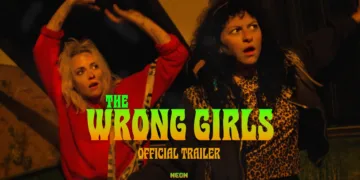
















Frankie can figure out stolen cable; Molly can turn odd ingredients into an edible experiment; the world around them still seems determined to classify both women as idiots. Their Los Angeles apartment, Casa de Chill Zone, is cluttered with a Bong-o-Tron, cat infrastructure, improvised décor, and the kind of domestic engineering that makes conventional adulthood look suspiciously unimaginative. The Wrong Girls keeps returning to that joke: two women who appear hopeless by ordinary standards have built a life with its own logic, competence, and pleasures.
Dylan Meyer’s film gives that life a suitably ridiculous threat. Frankie, an engineering-school dropout working as a delivery driver, ends up with an experimental substance that she and Molly ingest before grasping its importance. The drug turns their already uncanny mutual understanding into psychic ability while dangerous people come looking for what they swallowed. The chase mechanics are familiar, yet the better idea sits inside the friendship. Frankie and Molly have spent years developing a private language through old disasters, routines, insults, reassurance, weed, food, and the repeated act of getting each other out of trouble. Telepathy simply makes visible what everyone else has failed to recognize.
That matters because the film’s idea of adulthood is quietly hostile to the standard correction arc. Frankie carries the humiliation of leaving Stanford and measures herself against a version of success she abandoned. Molly has enough talent in the kitchen to imagine another future. Josh, Molly’s boyfriend, represents the reasonable argument that their shared comfort has become a shelter from change. The film gives him enough ground to keep the friendship from turning into an uncomplicated fantasy. Frankie and Molly do protect each other from consequences. They can also see capacities in each other that the outside world reduces to wasted potential.
Kristen Stewart and Alia Shawkat make that distinction readable in behavior. Stewart stretches words until irritation becomes comic texture, lets Frankie’s bravado collapse into petulance, then snaps back into problem-solving when a practical mess demands it. Shawkat works at a warmer frequency, meeting Frankie’s defensive energy with reassurance, domestic patience, or a joke that arrives half a beat sideways. Their exchanges have the loose speed of people who stopped explaining themselves years ago. When the psychic connection appears, it feels like escalation rather than invention.
The film has a harder time granting the same specificity to its jokes. A briefcase-code gag moving through 420 and 069 belongs to a comic vocabulary that already felt old before Frankie ever touched the mystery drug. Sexual numbers, intoxication mishaps, broad names, talking-cat material, munchies, and general incompetence keep dragging the film toward the safest version of stoner comedy. Putting women in the driver’s seat changes the social permission of the genre, yet a recycled punchline stays recycled.
That gap is especially visible because Meyer occasionally finds stranger, sharper comic details elsewhere. Casa de Chill Zone has the density of a home built through years of accumulated nonsense rather than a production designer’s generic idea of mess. Garbage-bag clothing, a stubborn modern door, buffet fixation, psychedelic interruptions, and the sudden importance of tiny inconveniences give the film an attention span that resembles its leads. The chase plot wants efficiency. Frankie and Molly keep becoming interested in things that efficiency would discard.

Some of that wandering genuinely slows the caper. The opposing forces chasing the drug never exert enough pressure to make every detour feel costly, and the science-fiction plot can seem like scaffolding holding up a smaller film about two friends refusing to reorganize their lives for other people’s comfort. Yet the looseness also produces the movie’s most personal comic spaces. Its best digressions are tiny declarations that usefulness is an overrated organizing principle. The film becomes funnier when it lets Frankie and Molly care intensely about something everyone else would consider stupid.
That is where its gender politics become sharper than its genre mechanics. Stoner comedy has often granted male slackers permission to waste afternoons, ruin plans, pursue terrible ideas, and call friendship a life philosophy. Frankie and Molly inherit that freedom without being pushed into romance or treated as a temporary phase awaiting the correct man, job, or apartment. Their intimacy can be codependent, juvenile, financially disastrous, and still meaningful. The film permits all four states to coexist.
The psychic drug works best as an absurdly literal translation of what Frankie and Molly already possess: a language so private that outsiders keep mistaking it for stupidity. Their bond has been doing the supernatural work from the beginning. The Wrong Girls gives two women permission to be ridiculous without turning their lives into problems awaiting correction. The telepathy merely makes that permission impossible to miss.
The Wrong Girls premiered in movie theaters across North America on August 14, 2026, distributed by Neon. You can watch the film on the big screen during its wide theatrical release in cinemas nationwide. The plot follows two pot-loving, codependent best friends in Los Angeles who accidentally get handed a mysterious briefcase intended for someone else, thrusting them into a chaos of mistaken identity and dangerous men pursuing them.
Where to Watch The Wrong Girls Online






Full Credits
Title: The Wrong Girls
Distributor: Neon
Release date: August 14, 2026
Rating: R
Running time: 99 minutes
Director: Dylan Meyer
Writers: Dylan Meyer
Producers and Executive Producers: James Weaver, Alex McAtee, Seth Rogen, Evan Goldberg, Allison Rose Carter, Jon Read, Maggie McLean, Dylan Meyer, Kristen Stewart, Scott Aharoni, Sinan Eczacibasi, Metin Alihan Yalcindag
Cast: Kristen Stewart, Alia Shawkat, LaKeith Stanfield, Zack Fox, Tony Hale, Seth Rogen, Kumail Nanjiani, Geena Davis, Kate McKinnon, Thomas Nicholson, Thor Knai, Thomas La Barbera Christensen, Cate Blanchett, Sugar Lyn Beard
Director of Photography (Cinematographer): Todd Banhazl
Editors: Kathryn J. Schubert
Composer: Ty Segall
The Review
The Wrong Girls
The Wrong Girls is funniest when Frankie and Molly’s private language turns failure into its own form of competence. Kristen Stewart and Alia Shawkat give the friendship enough behavioral detail to make the telepathy feel like a logical extension of their bond. The film’s stoner gags and chase plotting are less inventive, and its looseness sometimes drains urgency. Still, Dylan Meyer finds a sharper idea in letting two women be irresponsible, codependent, capable, and meaningful on their own terms.
PROS
- Stewart and Shawkat’s chemistry
- Specific female friendship
- Lived-in comic world
- Playful visual digressions
CONS
- Familiar stoner gags
- Loose chase pacing
- Thin sci-fi pursuit
- Recycled punchlines