



























Islamic scientific history rarely gets to become a verb in games. The House of Hikmah changes that with the Key, a device that lets 14-year-old Maya alter matter itself, transforming objects into metal, glass, ether, and other states while she searches for answers about her late father. Knowledge here is something you touch.
Lunacy Studios builds its debut around the House of Wisdom, reimagined as a magical institution connecting scholars from different periods of the Islamic Golden Age. Maya arrives after Abdullah, her father and one of the House’s scholars, dies in a shipwreck. His absence has left the place unsettled. A force called the Shadow has begun spreading through its realms, feeding on regret, shame, and grief.
It is a striking premise partly because games so rarely use this history as living material. Islamic scholars often appear in Western historical fiction as names attached to inventions or footnotes between civilizations. Here, Fatima al-Fihri, Ibn Sina, Hasan Ibn al-Haytham, Mariam al-Asturlabi, and Ismail al-Jazari become characters with laboratories, anxieties, relationships, and disagreements.
Lessons the Dead Leave Behind
Maya initially wants the kind of answer grief rarely supplies: something definite enough to explain why Abdullah is gone and what she is supposed to do with the things he left behind. The scholars complicate that desire because each carries a different memory of him.
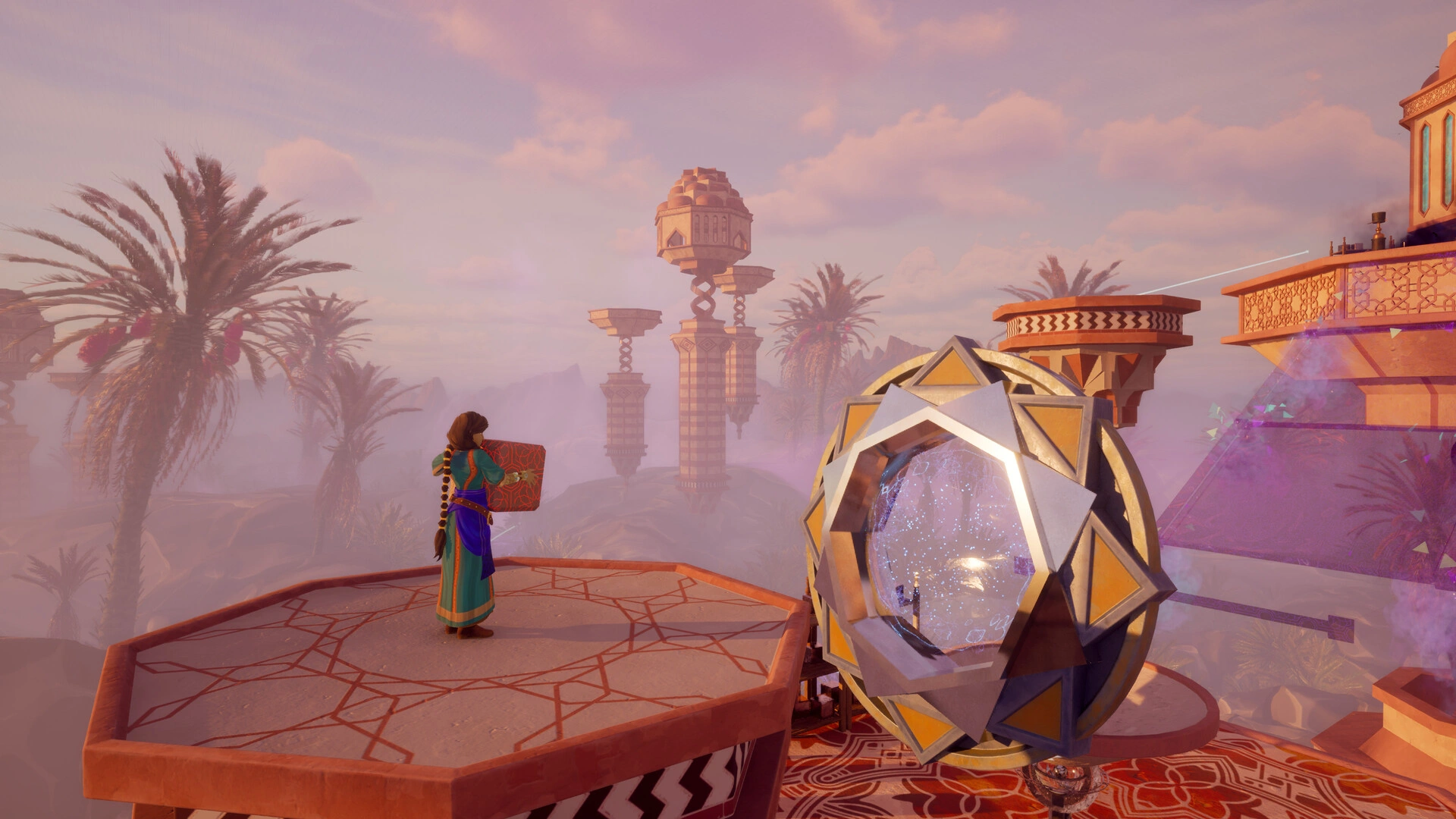
Ibn Sina’s measured presence gives Maya a figure of intellectual stability, while Hasan Ibn al-Haytham’s nervous, erratic behavior makes knowledge feel far less orderly. Their personalities also shape their domains. Mariam al-Asturlabi’s astronomical space turns scientific observation into gigantic machinery, while al-Jazari’s realm imagines engineering through floating mechanisms and elaborate moving structures.
This creates an interesting cross-cultural reversal. Many adventure games borrow Middle Eastern architecture as exotic scenery while locating their intellectual framework somewhere else. The House of Hikmah gives the scholars authorship over the spaces themselves. Architecture, mathematics, optics, and mechanics determine what Maya sees and how the player interacts with it.
The grief story is less consistent. The Shadow externalizes guilt by returning a character’s darkest thoughts to them, an effective device when Maya is forced to confront her own anger and uncertainty. Later conversations revisit similar lessons about acceptance often enough that the metaphor starts explaining itself. Maya’s youthful stubbornness helps. She ignores warnings, makes reckless decisions, and occasionally behaves like someone who is fourteen rather than a conveniently mature vessel for the game’s themes.
The voice performances keep those scenes grounded, particularly Maya’s small pauses, frustrated sighs, and hesitations. English and Arabic voice options also fit a game whose cultural specificity feels foundational rather than ornamental.
Matter, Movement, and Repetition
The Key provides the clearest connection between the House’s intellectual heritage and its puzzle design. Maya can make an object heavy enough to activate a pressure mechanism, convert a surface into reflective glass to redirect light, turn barriers immaterial, or solidify ghostly material into usable platforms.
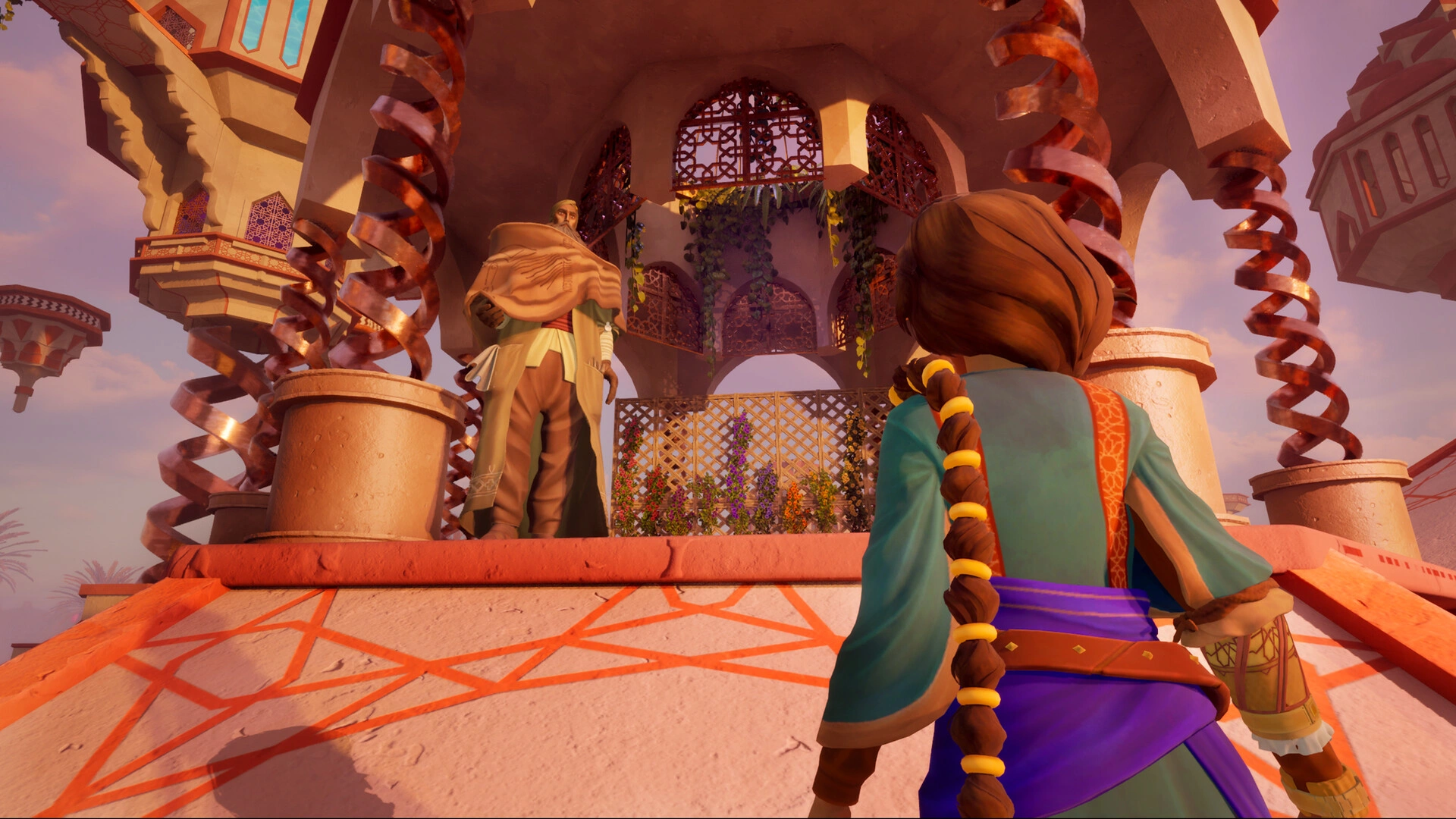
Early puzzles teach each property separately before combining them with switches, weighted plates, wind currents, and teleporting fissures. There are satisfying moments when a room initially looks impossible, then a remembered rule suddenly reorganizes the entire space. The design shares some DNA with first-person philosophical puzzlers such as The Talos Principle, though The House of Hikmah places greater emphasis on physical transformation and gentle platforming.
Its difficulty curve eventually flattens. Once the small vocabulary of materials becomes familiar, some rooms involve cycling through known transformations until the intended combination reveals itself. A system introduced as experimentation starts behaving like a checklist.
Platforming fares worse. Maya’s movement can feel floaty, and mantling occasionally sends her into an unwanted second jump or a slip from the ledge she has just reached. Falling carries little penalty, so these moments rarely create tension. They create interruption.
Loose Pages and treasures reward exploring side paths, yet collectible tracking clashes with that impulse. Missing something may require replaying a level in its story configuration rather than returning through a dedicated exploration mode. In a game lasting roughly five hours, repeating completed spaces feels particularly conspicuous.
Beautiful Rooms, Unsteady Foundations
The Atrium may be the game’s best argument for its setting. Sunlight falls across palms, cushions, water features, tea sets, and the portals leading into each scholar’s domain. It feels inhabited rather than assembled from a generic catalogue of Islamic motifs.
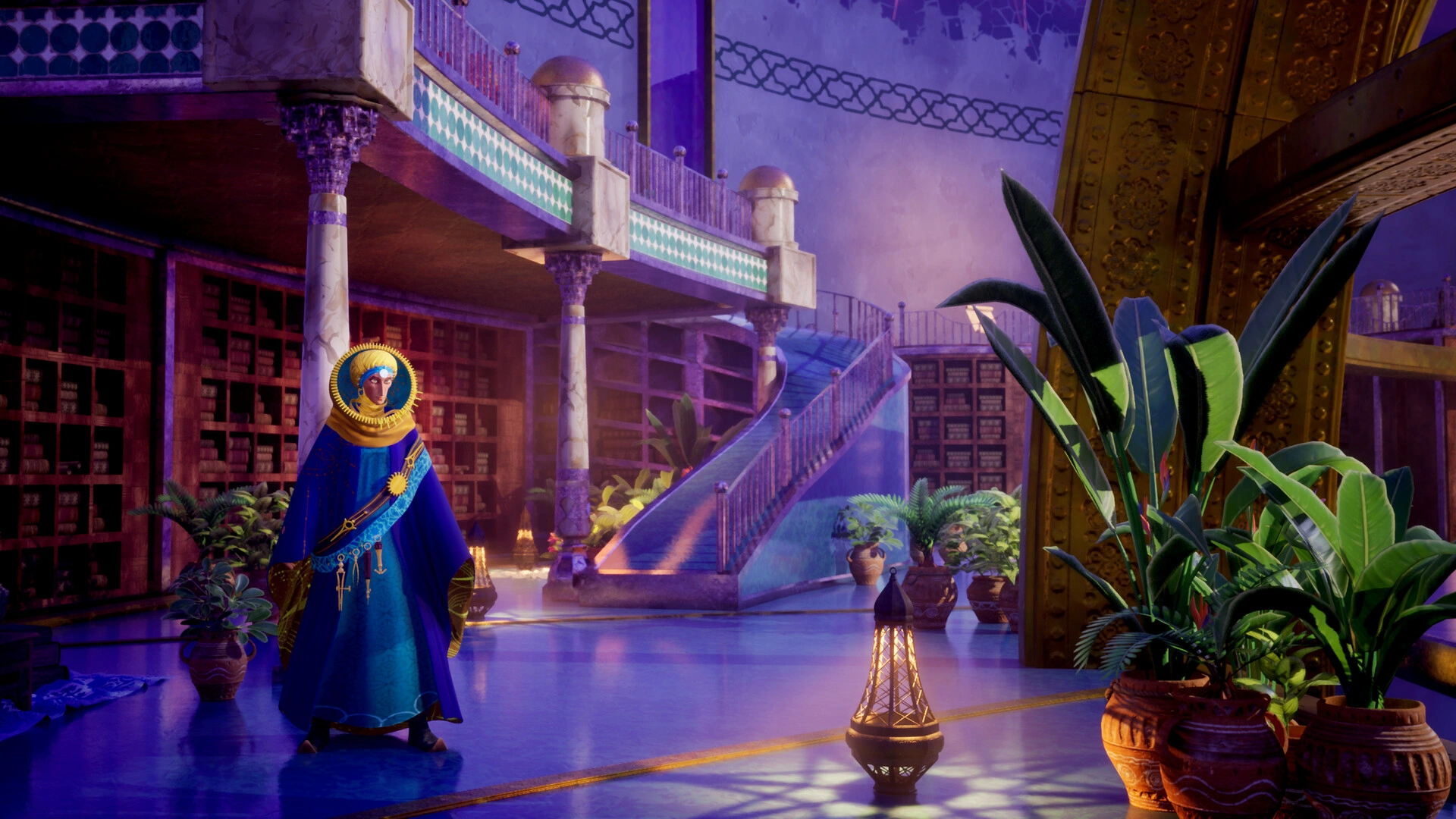
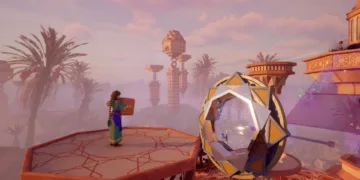
Beyond it, Lunacy Studios allows the imagery to become wonderfully extravagant. Maya passes through a colossal planetarium suspended among stars, an apparently endless library surrounded by floating parchment, and mechanical structures hanging high above palm trees.
Character designs take a more stylized approach, with elaborate robes, embroidery, dramatic headwear, and carefully differentiated silhouettes. Maya’s long braid and the interface materializing around her wrist give even routine movement a recognizable visual identity.
Austin Wintory’s score provides an equally strong cultural bridge. Rebab, oud, simsimiyya, and orchestral textures accompany Maya without turning the music into a museum display. The quieter passages let those instruments shape the emotional temperature of exploration, particularly when Maya is moving alone through vast spaces left behind by scholars and by her father.
The technical state can break that spell abruptly. Save files may reload with puzzle objects missing, NPC triggers can fail, and some interactions require loading an earlier checkpoint before progress becomes possible. Pop-in, occasional crashes, frame-rate drops, and unreliable mantling add smaller abrasions.
These problems are especially damaging in a puzzle game, where the player needs to trust that an unsolved room represents a failure of reasoning rather than a missing object. That uncertainty is an unfortunate companion to a game built around the pleasure of understanding how things work.
The Review
The House of Hikmah
The House of Hikmah finds its strongest identity where Islamic intellectual history becomes something the player can physically manipulate. The Key turns ideas about matter, optics, engineering, and discovery into tactile puzzles, while Maya’s encounters with scholars give grief a cultural and generational dimension rarely seen in adventure games. Repetitive transformations, unreliable traversal, and progression bugs weaken that design considerably, especially across such a short campaign. Lunacy Studios still builds a world with a clear cultural voice, helped enormously by its architecture and Austin Wintory’s instrument-rich score.
PROS
- Distinct Islamic Golden Age setting
- Inventive matter-transformation puzzles
- Strong scholar characterizations
- Beautiful environmental art
- Excellent culturally rooted score
CONS
- Puzzle repetition sets in early
- Unreliable platforming and mantling
- Save and progression bugs
- Uneven emotional pacing