
























Decades of explosions become surprisingly persuasive evidence once Wile E. Coyote walks into a law office carrying a grievance instead of another Acme gadget. His body has always been the joke: stretched, flattened, scorched, dropped from cliffs, then restored in time for another attempt at the Road Runner. Coyote vs. Acme finds unexpected character inside that repetition. Each disaster now belongs to a history of failure, and Wile’s decision to sue the company responsible for his equipment turns cartoon punishment into accumulated frustration without spoiling its comic rhythm.
That balance depends heavily on Wile remaining Wile. He never needs a conventional dialogue scene to explain himself. Signs, narrowed eyes, collapsing posture and frantic bursts of movement carry his side of every exchange. A lesser version of this premise might have treated speech as the price of admission to feature-length storytelling. Here, silence remains expressive. The film trusts a familiar silhouette and a few sharply timed gestures to communicate embarrassment, suspicion, determination and something close to wounded dignity.
Will Forte’s Kevin Avery helps that language survive contact with live action. Kevin handles minor claims from toons and has built a career around settling problems before they become dangerous. Wile’s case against Acme refuses to stay small. Kevin’s habit of backing away from larger fights pairs neatly with the coyote’s rigid obsession. One man has trained himself to expect defeat; the other has spent decades treating defeat as permission to try again. Their scenes work because Kevin’s caution and Wile’s physical insistence push against each other while the performers still occupy the same comic space.
John Cena’s Buddy Crane approaches Acme’s defense with corporate confidence scaled to the movie’s cartoon logic. The exaggeration pays off during gags such as his encounter with Tweety, where human strength and cartoon elasticity operate under incompatible rules. A courtroom sketch involving a rocket shoe pursuing a judge gets at the same idea from another angle. The funniest hybrid moments refuse to make the animated characters behave like visitors in a realistic world. Reality has to bend around them.
The visual translation becomes shakier whenever Wile’s performance loses that elasticity. His frantic movement still carries the snap associated with the character, especially when an Acme device begins another inevitable rebellion against its owner. Some closer interactions give his face a stiffer dimensional quality, reducing the speed with which an expression can transform from confidence to panic. The effect rarely kills a joke, yet it exposes how much personality depends on deformation, timing and immediate physical change. Wile can survive almost any explosion. He is less resistant to animation that asks him to sit still.
The larger world has a similar problem with flexibility. Acme’s influence stretches through the film, giving Kevin and Wile a corporate enemy large enough to justify their absurd legal campaign. The human and cartoon populations, however, coexist according to rules that stay hazy. Injury can become slapstick in one moment and evidence in another. Toons can function as celebrities, clients, pests or ordinary citizens depending on the gag. Loose rules suit Looney Tunes comedy, yet the mystery asks those same rules to support consequences. The harder the plot pushes toward conspiracy, hidden research and corporate wrongdoing, the easier it becomes to notice how selectively this universe decides what matters.
That pressure grows as Kevin, his niece Paige and Wile chase clues connected to Acme’s past. Dr. Lorre’s failed escape supplies the conspiracy with an ominous starting point, while familiar Looney Tunes figures keep entering the investigation through jokes and detours. The cameos are most effective when their behavior changes the scene. Recognition alone has limited comic value. Daffy, Tweety or another familiar face earns the interruption through timing, aggression, vanity or some other trait that can collide with the live-action space.
The investigation itself has fewer ways to surprise. Clues accumulate, Acme’s scheme widens and the legal fight grows larger, yet the plotting becomes heavier at the same moment Wile’s simplest actions remain precise. A sign held for the right beat can reveal his entire mood. Corporate exposition may need several scenes to establish far less. The imbalance makes the mystery feel busy rather than truly dangerous.

Feature length earns its place whenever the extra time changes relationships. Kevin begins to understand the stubborn intelligence behind Wile’s apparently hopeless campaign, giving their partnership a tenderness that stays compatible with slapstick. Road Runner benefits from a similar shift. His appearances retain the speed and antagonism of the old cartoons, while hints of mutual recognition give the chase a little emotional weight. The film finds its strongest sentiment inside relationships that already existed in visual form. It merely lets their implications stay on screen for a few seconds longer.
The film’s strange route to release gives its corporate battle an irony no screenplay could have planned. A completed movie about a small claimant challenging an enormous company became a work that had to escape corporate shelving before reaching an audience. That history sharpens certain jokes, particularly Acme’s confidence that size and money can determine what deserves to exist. It cannot repair the mystery’s weaker construction, and it never needs to. The parallel is valuable precisely because the fictional and industrial struggles remain separate enough to expose each other.
Wile keeps returning to the same basic action: devise, fail, recover, try again. Coyote vs. Acme discovers how much character was hiding inside that cycle all along. The coyote can turn a cardboard sign, a drooping ear or a fresh crater into a complete dramatic thought. The feature surrounding him keeps assembling lawyers, conspiracies, corporate secrets and courtroom machinery to reach ideas its silent star can express with one well-timed look.
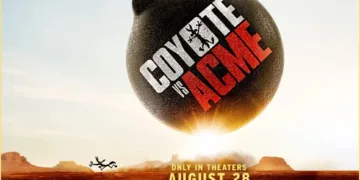
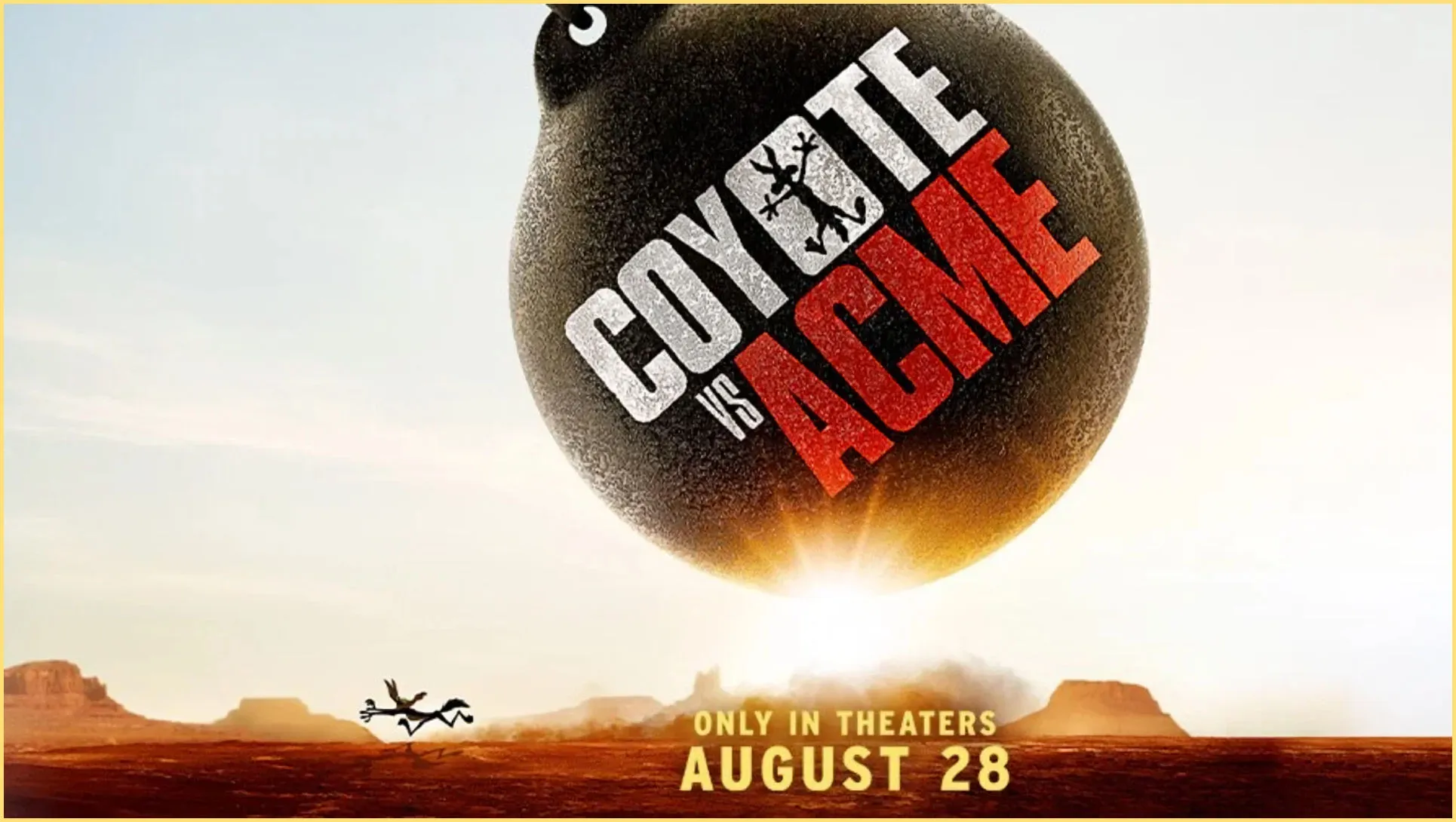
Coyote vs. Acme screened at San Diego Comic-Con on July 25, 2026, and premieres in movie theaters on August 28, 2026, distributed by Ketchup Entertainment and Warner Bros. Pictures. You can watch the film on the big screen during its wide theatrical release in cinemas nationwide. The plot centers on down-and-out billboard attorney Kevin Avery as he joins forces with Wile E. Coyote to sue the Acme Corporation for decades of supplying defective gadgets.
Where to Watch Coyote vs. Acme Online




Full Credits
Title: Coyote vs. Acme
Distributor: Ketchup Entertainment, Warner Bros. Pictures
Release date: July 25, 2026 (San Diego Comic-Con), August 28, 2026 (United States)
Rating: PG
Running time: 103 minutes
Director: Dave Green
Writers: Samy Burch, James Gunn, Jeremy Slater, Ian Frazier
Producers and Executive Producers: Chris DeFaria, James Gunn, Allison Abbate, Jesse Ehrman, Carsten H.W. Lorenz
Cast: Will Forte, Lana Condor, Tone Bell, Luis Guzmán, Martha Kelly, P.J. Byrne, Eric Bauza, Kenneth Choi, Candi Milo, Jim Cummings, John Cena
Director of Photography (Cinematographer): Brandon Trost
Editors: Carsten Kurpanek
Composer: Steven Price
The Review
Coyote vs. Acme
Coyote vs. Acme is at its strongest when Wile E. Coyote's movement, silence and comic punishment are allowed to carry the drama. The hybrid format finds real tenderness in an old chase without sanding away the character's visual timing. Its corporate mystery and hazy human-toon rules are less precise, yet they never erase the film's best discovery: Wile was already an expressive actor long before anyone gave him a lawsuit.
PROS
- Wile's expressive silent performance
- Strong human-toon comic interaction
- Visual gags respect cartoon physics
- Kevin-Wile emotional connection
CONS
- Corporate mystery grows cumbersome
- Human-toon rules stay hazy
- Some close-up animation feels stiff
- Cameos vary in purpose